


The Structural Shift Reshaping Commercial and Public Safety Drone Operations
The FAA’s Normalizing Unmanned Aircraft Systems Beyond Visual Line of Sight (BVLOS) Operations notice of proposed rulemaking (aka BVLOS NPRM, Part 108/Part 146),1 the Designation-Restrict the Operation of Unmanned Aircraft in Close Proximity to a Fixed Site Facility NPRM (aka Section 2209 NPRM),2 the FAA’s DETER enforcement policy,3 the FAA’s Drone Normalization Strategy,4 and the FCC’s evolving Covered List and exempted foreign UAS and UAS components5 together mark a structural inflection: The U.S. drone ecosystem is moving from waiver‑supported experimentation to organization‑centric, telemetry‑backed regulation.
That shift will increase the complexity of compliance, raise fixed and recurring costs, expand restricted airspace around critical sites, and accelerate enforcement for Remote ID and airspace violations (As previously analyzed in Commercial UAV News, January 27, 2026, the economic and compliance burdens of Part 108/146 are likely to push small operators toward platform‑based models or out of the market entirely).6 Under this construct, large, capitalized providers and platform‑centric automated data service providers (ADSPs) will gain scale advantages. Conversely, small operators and many public‑safety programs will face challenges that may force them to seek the support of “Uber-like” drone service providers (see Commercial UAV News, January 27, 2026: Does Part 108 and Part 146 Signal a Gig Economy Breakout Opportunity for Commercial Drone Services?),7 obtain additional funding and staffing, or risk exclusion from high‑value/important BVLOS work.8
When a Public Safety Mission Becomes a Compliance Crisis
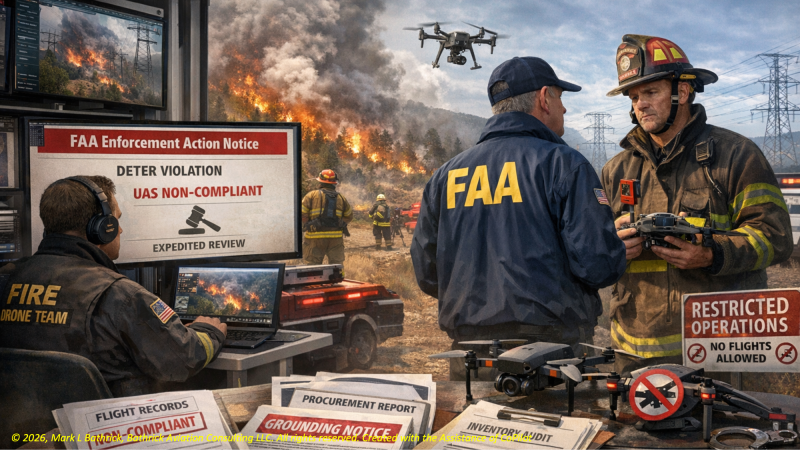
A municipal fire department receives a call: A remote wildfire is spreading near a transmission corridor. Their drone team, experienced, professional, and previously reliant on Part 107 waivers, launches a BVLOS drone as a first responder (DFR) mission to assess hotspots. Mid‑flight, a Remote ID query flags the aircraft as non‑compliant, and a nearby critical‑facility owner reports an incursion. Within hours, the department faces an expedited enforcement notice under the FAA’s DETER policy, and the incident triggers a temporary restriction that prevents follow‑on flights. The team’s response plan, fleet inventory, and procurement history are suddenly the focus of legal and operational scrutiny. The mission that should have been a public‑safety success becomes a compliance crisis.
This illustration is plausible because the regulatory architecture the FAA is building intentionally ties visibility (Remote ID), access (ADSP/UTM), and accountability (DETER) together. The result: Operations that were once judged primarily on pilot skill, mission-specific waivers, and professional judgment will increasingly be measured against organizational systems and telemetry that enable or fail them in complying with increasingly complex, intersecting, and demanding operational requirements.
Context and Background: A Familiar Arc
The history of aviation and automobiles offers a clear template for what we are seeing now. Early aviators and motorists were pioneers, entrepreneurial, improvisational, and often reckless as they experimented with these new technologies. Public enthusiasm for new mobility and prosperity soon collided with accidents, noise, and safety concerns. Governments responded with licensing, airworthiness standards, traffic laws, and infrastructure.9 Over decades, regulation transformed risky novelty into a safe, standardized, and economically productive system.10
Drones have followed a similar trajectory, and as argued in “Lessons in Legacy,” the drone industry is repeating many of the same early-market patterns seen in the automotive sector.11 Over a decade before Part 107 was enacted, government unmanned aircraft systems (UAS) programs, such as DOI’s “Drones for Good”12 program, operated under their public aircraft operator authorities.13 These programs developed policies, training programs, and best practices based on their manned aircraft programs and tested various use cases.14 They also advanced outcome metrics that demonstrated the value of drones.15
Part 107 opened the door to commercial operations and served as a proving ground for use cases, business models, and safety practices. But the waiver process, useful for early experimentation, proved too cumbersome to scale for routine BVLOS operations.16 The FAA’s BVLOS NPRM (Part 108/Part 146) and related policies are the next stage: formalizing organizational approvals, performance standards, and third‑party service roles so that routine BVLOS can be safe, auditable, and scalable. The FAA’s Drone Normalization Strategy Report provides the roadmap that will transition drones from “new entrants” to established aviation stakeholders.17 This is not a retreat from innovation; it is the natural institutionalization of it that mirrors the early days of aircraft and automobiles.
The messages from these impending regulations and changes in enforcement of current regulations capture the thesis and the imperative: “Senior leaders should assume that the ‘experimental’ era of drones is over.” and “For senior leadership in agencies and industry, the message is equally clear: treat this as a transition from ‘flying drones’ to ‘running a regulated, professional aviation system.’”
Why this Change Matters (Magnitude and Significance)
Three structural shifts explain why the coming rules are consequential:
- From individual waivers to organizational approvals. Part 108/146 centers on permits, certificates, and ADSPs, meaning approvals will be granted to organizations that can demonstrate systems, not just to pilots who can demonstrate skill. That changes who can compete for BVLOS work and the time and financial investment necessary to reach this new bar.
- From ad‑hoc operations to telemetry‑driven oversight. Remote ID, LAANC, ADSP data streams, and likely improvements in data fusion and AI use will feed FAA oversight and enforcement. The DETER program accelerates enforcement timelines and incentivizes rapid settlement. Visibility equals accountability.
- From permissive airspace to layered restrictions. Section 2209 UAFRs and fixed‑site restrictions expand the number of places where drones are limited or require special access. Expanded C‑UAS authorities and procurement rules (e.g., trusted‑platform lists) further constrain which platforms and operators can serve certain missions and how they must be connected to new systems of systems to operate.18
Together, these shifts raise the bar for capital, governance, and data capability. They also create a new market architecture: platforms + operations networks + ADSPs will be the dominant model for high‑value, routine BVLOS services.19 As written in “Detect, Avoid, and Trust,” legacy detect-and-avoid and centralized awareness models cannot support the scale envisioned under Part 108.20
What These Regulatory Changes Mean for Operators Who Plan to Stay VLOS
Some companies and individual pilots may look at the growing complexity of BVLOS regulation and conclude that they will simply continue flying under traditional visual line of sight (VLOS) rules. At first glance, this seems like a way to avoid the cost and administrative burden of Part 108/146, ADSP integration, DAA equipage, and organizational approvals. But the reality is more nuanced: VLOS operations are becoming more regulated, more scrutinized, and more safety‑critical than many pilots realize, and the new BVLOS framework will indirectly reshape VLOS expectations, enforcement, and risk exposure.
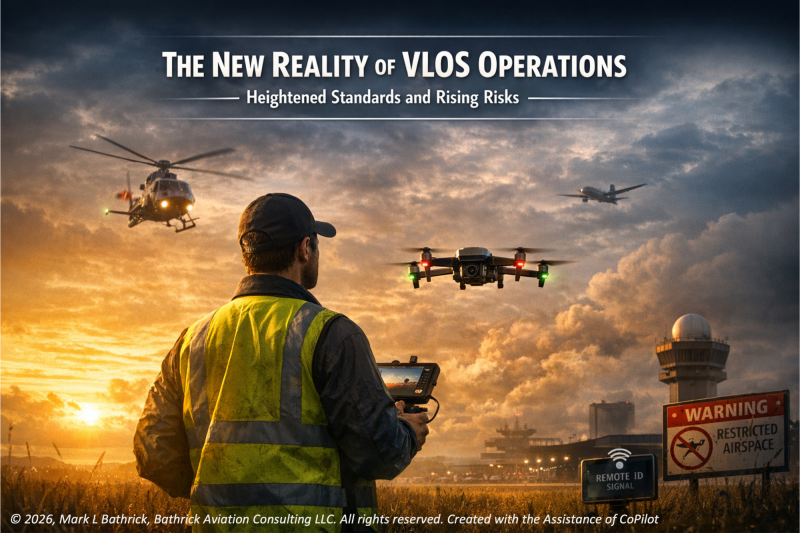
The FAA’s recent safety analysis makes clear that VLOS is not a low‑risk fallback, but a discipline with its own rising standards.21 The FAA emphasizes that most drone collisions with helicopters and other aircraft occur below 500 feet and that pilots involved in these incidents were not actually in compliance with VLOS requirements even when they believed they were. FAA investigations show that pilots often overestimate their ability to see and avoid low‑flying aircraft or fail to maintain continuous observation of surrounding airspace, not just the drone itself. The FAA stresses that compliant VLOS requires the ability to see the aircraft and enough of the surrounding airspace to detect and avoid other aircraft with sufficient reaction time, often requiring a clear view to the horizon for up to half a mile.
This matters because the DETER enforcement program, Remote ID visibility, and the FAA’s data‑driven oversight strategy apply to all UAS operations, not just BVLOS. A VLOS pilot who loses situational awareness near a helicopter, flies near a newly designated Section 2209 facility, or operates with incomplete Remote ID telemetry may now face accelerated enforcement timelines, mandatory settlement pathways, and organizational scrutiny like BVLOS operators. In other words, VLOS is no longer a regulatory safe harbor; it is part of the same integrated oversight ecosystem.
For companies, this means that even if they never pursue BVLOS, they will still need:
- Stronger governance and documentation, because Remote ID and DETER make every flight auditable.
- Better training and airspace risk assessment, especially in environments where helicopters operate at low altitudes.
- Updated SOPs and incident‑response plans, because VLOS violations now trigger the same enforcement mechanisms as BVLOS violations.
- Awareness of expanding Section 2209 UAFRs, which restrict operations regardless of VLOS/BVLOS status.
For individual pilots, the implications are equally significant. The FAA’s VLOS guidance makes clear that pilots must maintain continuous awareness of the surrounding airspace, not just the drone, and that visual observers do not eliminate the pilot’s responsibility. Pilots who rely heavily on screens, fly near obstacles, or assume they will hear a helicopter before seeing it are at elevated risk of noncompliance. As the FAA notes, even an undistracted pilot may need 12.5 seconds to react to another aircraft, during which a helicopter can travel half a mile. This reinforces that VLOS is a skill, not a default mode, and that the FAA expects pilots to treat it with the same seriousness as any other aviation discipline.
The bottom line: choosing to remain VLOS does not exempt operators from the rising expectations, data requirements, and enforcement intensity of the new regulatory era. VLOS operations will remain viable and valuable, but they will increasingly require the same professionalism, documentation, and safety culture that the FAA is institutionalizing through Part 108/146 and the Drone Normalization Strategy. Companies and pilots who invest early in these competencies regardless of whether they pursue BVLOS will be safer, more compliant, and better positioned for future opportunities. As emphasized in “Four Must-Have Competencies for Success in Drones” and “Earning the Right to Operate,” aviation discipline and public trust are not optional, even for VLOS operations.22 23
The LEAD TURN Framework — An Actionable, Prioritized Approach
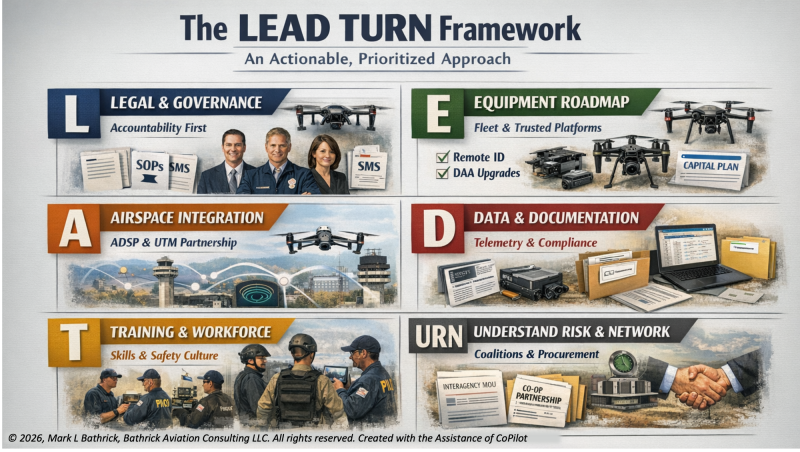
To “lead turn” this transition, i.e., to proactively shape and benefit from it, operators and agencies should adopt a six‑element framework I call LEAD TURN. Each element is practical, measurable, and prioritized for rapid implementation. This aligns with my “From Silos to Systems” and “Beyond the Box” articles that stress that safe, secure, and prosperous aviation modernization requires integrated governance, not isolated compliance.24 25
L: Legal & Governance (Accountability first)
Create a governance structure with named accountable executives: an Operations Executive, a Safety Manager, and a Compliance Lead. Document authority lines, decision rights, and escalation paths. This is the foundation for SMS, DETER readiness, and permit applications. Without named accountability, permit and certificate applications stall and enforcement exposure increases. (Implementation: assign roles and publish SOPs within 30–90 days.)
E: Equipment Roadmap (Fleet and Trusted‑Platform strategy)
Inventory every airframe, sensor, and C2 link. Map Remote ID status, DAA readiness, and FCC/DoD “trusted” status. Create a 12–36 month capital plan that phases in DAA and trusted‑platform upgrades where mission economics justify it. For public‑safety agencies, prioritize interoperability and vendor support for exemptions. (Implementation: fleet audit in 1 month; roadmap in 3 months.)
A: Airspace: ADSP & UTM Integration (Partnerships, not islands)
Airspace rules apply to all government and commercial UAS operators. ADSPs will be the operational fabric for BVLOS. Identify candidate ADSPs, run pilot integrations, and test data feeds (position, conformance, alerts). Negotiate service‑level agreements that include transit corridors, incident response, and data ownership. For small operators, ADSP partnerships are the fastest path to BVLOS access. (Implementation: ADSP pilots in 3–9 months.)
D: Data & Documentation (Telemetry as truth in compliance)
Data will serve as the foundation for permitting, certification, and operational compliance. Build data pipelines for Remote ID, flight logs, maintenance records, and incident reports. Ensure logs are tamper‑resistant and searchable for DETER settlement scenarios. Adopt a “data first” posture: if you can’t produce the telemetry, you can’t prove compliance. (Implementation: logging standards and retention policy in 1–3 months.)
T: Training & Workforce (Skills and safety culture as roles evolve)
Through disciplined training, new entrants evolve from tentative participants into trusted aviation stakeholders, gaining not only technical competence but the judgment, credibility, and shared safety ethos that has defined America’s aviation culture for over a century. Train pilots into operations supervisors, flight coordinators, and data analysts. Invest in recurrent training aligned to Part 108 expectations, DETER incident response, and ADSP interfaces. For public safety, cross‑train incident commanders on UAS governance and legal exposure. (Implementation: role definitions and initial training in 3–6 months.)
URN: Understand Risk & Network (Coalitions and procurement)
America’s leadership in aviation safety is founded on sound risk management and shared knowledge across the community. Form regional cooperatives or managed‑service agreements to share SMS, ADSP access, and procurement leverage. Use cooperative purchasing to lower the cost of DAA and trusted platforms. For government programs, pursue interagency MOUs to preserve mission access. (Implementation: coalition formation and procurement planning in 6–12 months.)
Because UAS are, at their core, aircraft, a practical and time‑saving starting point for “lead turning” compliance is to look to the FAA’s established Part 135 certification framework as a baseline for organizational discipline. Part 135 provides a proven model for operational control, safety management, maintenance oversight, training, and accountability, the very elements the emerging drone regulatory structure is now emphasizing at scale. For commercial drone services companies, public safety agencies, and even advanced individual operators, adopting Part 135-like constructs can accelerate the transition from ad hoc flight operations to structured, auditable aviation systems. As noted in my previous 17-page BVLOS NPRM analysis, the FAA is clearly signaling a shift toward Part-135-style organizational rigor.26
Pro-Tip: It is likely that government contracts for UAS services will follow the path agencies have been employing for years, leveraging FAA certifications as an entrance screening tool and foundational requirement on which to add unique public aircraft operator (PAO) requirements.27 As an example, DOI aviation contract solicitations require applicants have an FAA certification, often setting the bar at the Part 135 level.28 Within the context of government operations, those companies with BVLOS operating certificates will likely have greater access to government UAS service contracts over those with only BVLOS operating permits.29
While this framework offers a strong foundation, it is critical not to treat UAS as simply smaller versions of manned aircraft. The UAS class of aircraft introduces unique characteristics, such as remote piloting, reliance on command-and-control links, software-defined capabilities, distributed operations, and heavy dependence on telemetry and data systems that require tailored approaches. They also carry privacy, data security, and criminal misuse concerns that must be included among the core competencies for success (See Commercial UAV News March 24, 2025 – Four Must-Have Competencies for Success in Drones).30 In short, traditional Part 135 principles provide an efficient starting point, but true readiness depends on adapting those philosophies to the distinct technical, operational, and regulatory realities of unmanned aviation.
Plans to “Lead Turn” — Separate, Concrete Paths
Below are two tailored plans: one for drone services companies and government drone programs, and one for individual drone pilots. Each plan is prioritized, with estimated resource scale (low/medium/high) and immediate next steps.
A. Plan for current drone services companies and government drone programs
Objective: Preserve and expand mission access while meeting Part 108/146, Section 2209, and DETER expectations.
Phase 0: Immediate (0–3 months)
- Fleet Remote ID audit (Low): Verify every aircraft’s Remote ID status; remediate non‑compliant units. Next step: produce a one‑page inventory.
- SOP & SMS‑lite (Medium): Draft a lightweight SMS that documents hazard reporting, maintenance, and incident response aligned to DETER. Next step: publish SOPs and train staff. NOTE: Government public safety drone programs should download and reference the FAA’s Public Safety Small Drone Playbook.31
- Legal posture (Low): Retain counsel familiar with FAA enforcement and DETER settlement mechanics. Next step: create an incident response checklist with counsel.
Phase 1: Near term (3–9 months)
- ADSP pilot (Medium): Contract with an ADSP for a limited set of missions; test data feeds and conformance alerts. Next step: run 3–5 pilot flights under ADSP supervision.
- DAA gap analysis (Medium): Identify missions that require DAA and estimate upgrade costs. Next step: prioritize sites where BVLOS revenue justifies investment.
- Coalition outreach (Low): Join or form a regional cooperative for shared SMS and ADSP access. Next step: convene stakeholders and draft MOU.
Phase 2: Mid-term (9–18 months)
- Permit/certificate readiness (High): Prepare documentation for Part 108 permit or Part 146 ADSP participation as applicable. Next step: compile safety cases, maintenance programs, and training records.
- Trusted‑platform procurement (High): Begin phased fleet upgrades to meet FCC/NDAA procurement constraints for federal and critical‑infrastructure work. Next step: issue RFPs and secure financing.
- Operationalize data (Medium): Integrate Remote ID, LAANC, and ADSP telemetry into a single operations dashboard. Next step: deploy a SOC (small operations center) for flight monitoring.
Phase 3: Long term (18–36 months)
- Scale BVLOS services (High): Move from pilot projects to routine BVLOS contracts with SLAs. Next step: standardize ADSP interfaces and billing models.
- Policy engagement (Low): Participate in FAA and industry working groups to shape implementation details and transitional relief. Next step: submit coalition comments to dockets. [Endnotes 1–6, 9]
Estimated resource scale: Medium to high for most organizations; small operators should prioritize coalitions and ADSP partnerships to avoid prohibitive capital outlays.
B. Plan for individual drone pilots
Objective: Remain employable and valuable as the industry shifts from pilot‑centric to organization‑centric operations.
Immediate (0–3 months)
- Remote ID and currency check (Low): Ensure personal aircraft and certifications are current. Update logbooks and training records.
- Upskill to operations roles (Low–Medium): Take courses in operations supervision, SMS basics, and ADSP interfaces. Position yourself as a flight coordinator or data analyst.
Near term (3–9 months)
- Certify on trusted platforms (Medium): Gain experience on the platforms your local employers or agencies are adopting. Document hours and proficiency.
- Learn incident response and DETER playbook (Low): Understand the settlement process and how to document incidents to protect your certificate.32 33 34
Mid-term (9–18 months)
- Specialize in mission types (Medium): Become the go‑to pilot for infrastructure inspection, wildfire mapping, or delivery corridor ops—areas where BVLOS demand will grow.
- Network into ADSPs and cooperatives (Low): Seek roles with ADSPs or managed services that will be the primary customers for BVLOS work.
Long term (18+ months)
- Transition to supervisory roles (Medium–High): Aim for operations supervisor, safety manager, or ADSP coordinator positions. These roles command higher pay and are more resilient to regulatory change.
Why this matters for pilots: The market will reward pilots who can operate within systems—those who can manage telemetry, interpret ADSP alerts, and lead incident response will be indispensable.
Pro Tip: Taking advantage of the free drone business resources available online, such as written guides, proven strategies, webinars, and more, is an excellent way to save time and money.35
Conclusion and a Call to Action
The regulatory wave arriving with Part 108/Part 146, Section 2209, DETER, and the Drone Normalization Strategy is not a bureaucratic curiosity, it is a market‑shaping event. It will create enormous opportunity for operators who can invest in systems, data, and partnerships, and it will marginalize those who treat the change as incremental paperwork.
Who should act now and how:
- CEOs and program managers: convene a cross‑functional task force (operations, safety, legal, procurement) and begin ADSP pilots.
- Public‑safety leaders: pursue cooperative ADSP access and seek grant funding for DAA and trusted platforms. As I’ve written in my wildfire modernization series, public safety agencies succeed when governance, training, and procurement are aligned.36 37 38 39
- Individual pilots: upskill into operations and data roles; document experience on trusted platforms.
Lead turning the future is not about resisting regulation; it is about understanding it and building the capabilities to thrive within it. The organizations and individual pilots that do this first will not only survive, but they will also define the next era of safe, routine, and profitable drone operations. As I argued in “Earning the Right to Operate,” leadership and trust are the true differentiators in emerging aviation, not technology alone.40 41












Comments