


In our previous discussion, Drone Defense at Home: Closing the C-UAS Rules of Engagement (ROE) Gap, we established a critical reality: While Counter-Uncrewed Aircraft Systems (C-UAS) technology is maturing rapidly, the Rules of Engagement (ROE) required to employ them safely in domestic airspace are still not fully integrated into our national C-UAS conversation.
1The technology exists to stop drones, but the "when, where, and how" remains a complex safety and legal decision maze that is rarely the focus of C-UAS conference agendas and C-UAS industry materials and pitches.
However, we are witnessing a fundamental pivot. The era of the "Silver Bullet," where a single company claims to detect, track, and defeat every drone with a proprietary "magic box" is ending.2 Government customers are increasingly more aware of the limitations of these “we can do it all” claims when it comes to the complex and dynamic “measure-countermeasure-counter-countermeasure real world” of C-UAS in the permissive environment3 of the U.S. national airspace system (NAS). They are also realizing that, at the end of the day, they and not the C-UAS companies will be responsible for both the intended and unintended consequences of any kinetic, electronic, or other C-UAS “mitigations.”
In response, the "System of Systems" era of C-UAS has arrived. To differentiate themselves and survive, C-UAS companies must stop selling isolated hardware and start selling specific roles within a larger, integrated, and legally compliant domestic air domain awareness and defense network.
Four major catalysts are driving this shift:
- The sweeping authorities introduced in the FY2026 National Defense Authorization Act (NDAA), specifically the "SAFER SKIES Act.”4 5
- The Pentagon’s new "Amazon-like" procurement model under Joint Interagency Task Force 401 (JIATF 401).6
- The urgent airspace security mandate for the 2026 World Cup7 8 9
- Growing recognition among government C-UAS stakeholders that deploying mitigations without clearly defined and embedded Rules of Engagement (ROE) exposes agencies and officials to significant legal risks, regulatory violations, and loss of public trust due to potential misuse, unintended consequences, or failure to ensure accountability and transparency.10 11 12
For current and prospective C-UAS businesses, here is a strategy to winning government contracts in this new landscape.
Strategy 1: Become a "System of Systems" Player
Traditional C-UAS providers often build "walled gardens" where their radar/RF sensor system only communicates with their camera and their jammer. This approach is failing, particularly considering greater government customer education and awareness. Interoperability and being able to effectively team with a range of companies with complementary system capabilities that contribute to a robust and redundant layered “system of systems” is key to success.
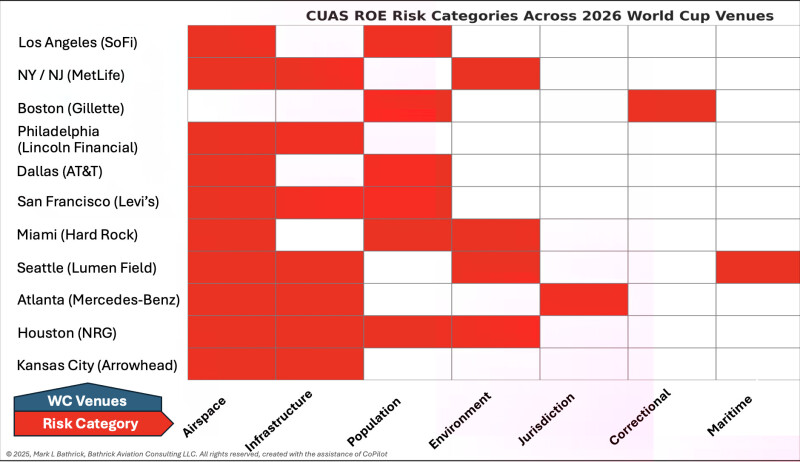
A prime example of this driving force is the growing recognition of the intricate nature of the physical, jurisdictional, social, and safety environments within which domestic C-UAS systems must operate safely and effectively. Multifaceted environments, like those around the 11 distinct host cities for the 2026 World Cup, require diverse sensors from multiple vendors to cover blind spots created by urban canyons or maritime borders. These sensors must feed integrated data assessment, analytics, and decision support systems that will also draw on available adjacent data sources like social media feeds, 911 calls/police dispatches, government CCTV/smart city cameras, emergency management systems, and crowdsourced mobile apps.
The Strategy: Embrace Data Interoperability and Open Architecture.
Government customers, particularly under the new JIATF 401 structure established by Section 912 of the FY26 NDAA, are moving toward centralized validation and a "list of authorized technologies.”13 If your system cannot feed data into a larger Command and Control (C2) network, you will likely be excluded from this list.
Actionable Steps:
- Market Your Specific Strength: Stop claiming to be the entire solution. Seasoned government executives confronted with solving complex issues know that lasting solutions almost always require integrated services from a diverse team of best-in-class providers. If you build the world's best optical tracker, market it as the premier visual component of a larger integrated system.
- Bring “a Friend:” Work to identify complementary partners who help round out your offering from a capability to a more integrated solution.14 As a federal program executive, securing time on my calendar was significantly easier when a multi-company coalition, rather than a solo vendor, requested time. A single company meeting often carries the optical risk of perceived favoritism, making officials hesitant to engage for fear of appearing to endorse a specific commercial entity or bypass fair competition protocols. In contrast, a joint delegation offering an integrated solution shifts the dynamic from a "sales pitch" to a "capabilities briefing," and sends a powerful message that the heavy lifting of problem identification and technical integration has already been accomplished. It demonstrates that the industry partners have proactively validated how their technologies work together to solve a complex mission gap.
- Adopt Open Standards: Ensure your application programming interface (API) can feed into a "Common Operating Picture" (COP).15 Just as fighter pilots rely on fused data, C-UAS operators need a "Single Pane of Glass" to make split-second decisions.
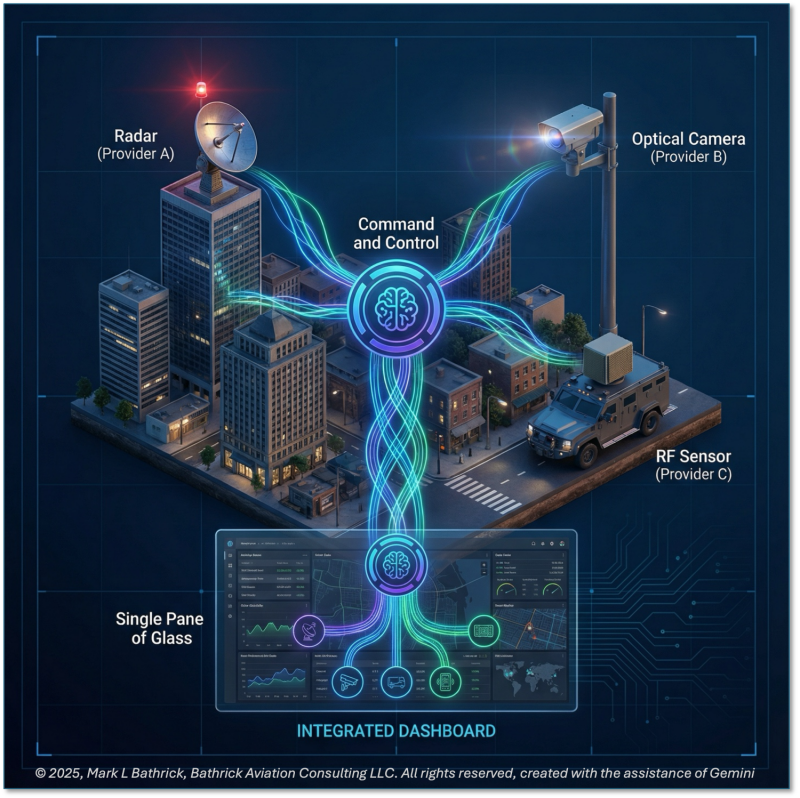
- Verify Interoperability: Proactively test your hardware with major command and control (C2) providers that will be involved in domestic C-UAS operations. Being "plug-and-play" ready is now a requirement for the Pentagon's new marketplace.16 Ensure your product can measure up against these critical elements of interoperability:
- Syntactic Interoperability: The ability of two or more systems to communicate and exchange data. It ensures that data formats are compatible, allowing the "envelope" of data to be opened by the receiving system.
- Semantic Interoperability: The ability of computer systems to exchange data with unambiguous, shared meaning. This is critical in healthcare and defense; for example, ensuring that a "temperature" reading is understood as Celsius vs. Fahrenheit, or that "hostile track" means the same thing to a sensor and a shooter.
- Technical Interoperability: The basic connectivity between systems (hardware/software) that allows for the exchange of signal and data.
- Organizational Interoperability: The alignment of business processes and policy frameworks between organizations to allow for data exchange (e.g., differing privacy policies between government organizations [e.g., Federal, State, Local] and proprietary interests of commercial data sources). This is often the most challenging and frequently overlooked aspect of interoperability. It is often hindered by a lack of understanding of the nature, extent, and relationships among government stakeholders.
- Syntactic Interoperability: The ability of two or more systems to communicate and exchange data. It ensures that data formats are compatible, allowing the "envelope" of data to be opened by the receiving system.
Strategy 2: Sell Compliance as a Product (The "Digital JAG")17
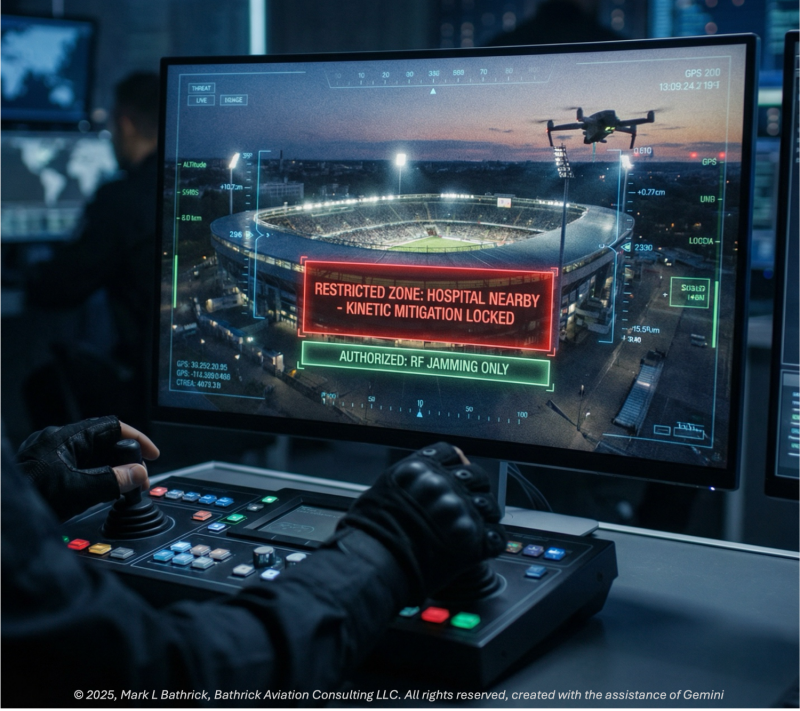
An operator under the stress of a dynamic airspace security event, whether a Marine at a forward base or a police officer at a stadium, cannot flip through a legal binder to decide if and how they are authorized to engage a subject drone near a hospital. The decision support must be built into the machine.
The Strategy: Embed ROE Compliance into your Software.
The FY26 NDAA grants new authority to State, Local, Tribal, and Territorial (SLTT) law enforcement to mitigate drone threats (Section 8602).18 Coincident with this authority is the inherent accountability and potential organizational and personal liability that comes with the authorization to mitigate threat aircraft. This authority also includes mandatory training (Section 8606) and a 48-hour reporting requirement for any mitigation action (Section 8602).19 Your technology must automate this compliance and decision assurance for authorized C-UAS users.
Actionable Steps:
- Build the "Digital JAG": Develop Decision Support Systems (DSS) that automatically recommend (or constrain) "Soft Kill" vs. "Hard Kill" based on the target’s location and threat level. Ideally, the system should "grey out" kinetic options if the drone is over a crowd or near an airport, acting as an automated safety officer.
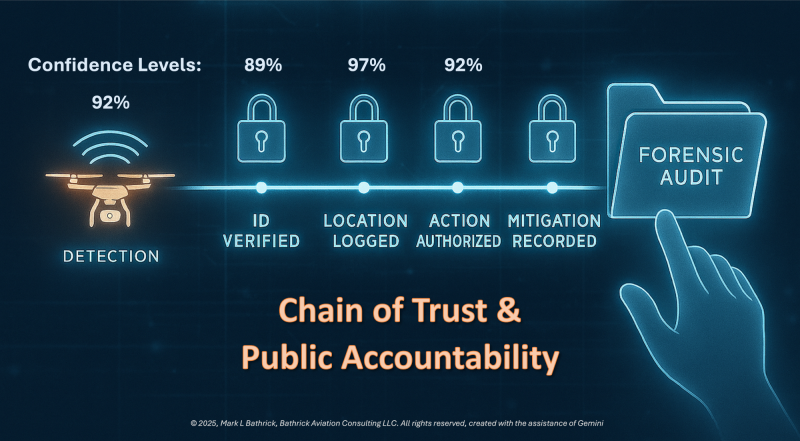
- Integrate Real-Time Data Provenance and Chain of Trust Logging into C-UAS Decision Systems: In a litigious regulatory and legal climate, why a system classified a drone as a threat is as important as the mitigation. Furthermore, as we’ve seen with the rash of purported drone sightings in New Jersey in 2024, news of drone incidents can spread instantly via social media, news outlets, and public feeds. This creates increased pressure for transparency and accountability, as stakeholders (public, media, regulators) demand immediate answers and proof of proper conduct. Your C-UAS system must include a digital “Chain of Trust” that provides operational C-UAS system decision makers with a real time dashboard of confidence levels of these critical data measures:
- Completeness: The degree to which all required data is present. Missing data (e.g., a missing remote ID, an electronically invisible manned flying VFR in Class G airspace) can lead to flawed situational awareness.
- Consistency: The absence of difference when comparing two or more representations of a specific datum. (e.g., is the reported height of a detected aircraft perceived properly across systems that use different datums like above ground level (AGL) or mean sea level (MSL)).
- Latency: The expectation that data is available when it is needed. In air defense or high-frequency trading, data that is even milliseconds old may be considered "low quality" or useless.
- Validity: The degree to which data conforms to the syntax (format, type, range) of its definition.
- Precision vs. Accuracy: Accuracy is how close a measured value is to the true value (e.g., a radar showing a plane at its exact location). Precision is how consistent those measurements are (e.g., the radar reporting the same location multiple times). Critical systems need both.
- Confidence Intervals: A statistical term used to quantify the uncertainty of data. In automated decision-making, a system must know how accurate its data is (e.g., "Target identification has a 89 percent confidence factor").
- Error Rate: The frequency of errors in data transmission or generation. Safety-critical systems require ultra-low error rates (often expressed as 10-9 failures per flight hour in avionics).
- Provenance: “Where did this data come from and has it been altered?”
- Chronology: Documentation of the capture, custody, control, transfer, analysis, and disposition of data.
- Lineage: The lifecycle of data from its origin (sensor/input) through various transformations (algorithms/processing) to its destination (user display).
- Non-Repudiation: Assurance that the sender of information is provided with proof of delivery and the recipient is provided with proof of the sender's identity, so neither can later deny having processed the data.
- Traceability: The ability to verify the history, location, or application of an item by means of documented recorded identification.
- Chronology: Documentation of the capture, custody, control, transfer, analysis, and disposition of data.
- Completeness: The degree to which all required data is present. Missing data (e.g., a missing remote ID, an electronically invisible manned flying VFR in Class G airspace) can lead to flawed situational awareness.
In an era of cyber warfare and AI-enabled "deep fakes," detecting spoofed data is as important as detecting bad data. If a C-UAS mitigation is ordered (or denied) based on a sensor reading, the authorized C-UAS organization must be able to trace that reading back to a verified, authenticated sensor to ensure it wasn't injected by an adversary.
By embedding automated data provenance and chain of trust logging into C-UAS systems, companies can meet their domestic government customers’ dual demands of legal defensibility and instant transparency. This approach not only protects operators and organizations in a litigious environment but also builds critical public trust in the age of instant news and social media. This automated "black box" is also essential for the compliance audits mandated by the FY26 NDAA (Section 8606).
- Integrate V2V Protocols: C-UAS data ingestion and processing nodes aren’t limited to the conventional terrestrial components that typically come to mind when we think of C-UAS. Incorporating low-latency, high-reliability vehicle-to-vehicle (V2V) communication protocols into public safety and security aircraft as part of a C-UAS architecture revolutionizes airspace awareness. This integration enables the instant differentiation of authorized friendly drones, such as those operated by police, fire, and emergency response teams, from unidentified or potential threats. This capability drastically simplifies the ROE decision loop; by immediately filtering out known friendly assets through verified V2V handshakes, operators can focus mitigation resources solely on genuine threats, eliminating the hesitation and risk associated with potential friendly fire. Furthermore, airborne assets themselves become critical nodes in this "system of systems." Much like manned fighter aircraft are integral to military air defense detection and identification, manned public safety and security aircraft can serve as dynamic sensors within the C-UAS network, yet they possess an even more critical need for timely, accurate threat data to ensure their own safety in congested airspace. Technologies like Ciconia’s Coordination & Collision Avoidance System (C&CAS),20 which received a 2021 Department of Homeland Security (DHS) grant,21 leverage these Vehicle-to-Vehicle (V2V) protocols to establish a decentralized conflict management network. This network not only safeguards manned assets from drone collisions but also facilitates significantly denser and more closely coordinated operations.22 Consequently, manned and unmanned teams can safely operate in close proximity during high-intensity response scenarios. A review of the recent $500M DHS Notice of Funding Opportunity (NOFO) Counter-Unmanned Aircraft Systems (C-UAS) Grant Program indicates these capabilities would be eligible under “UAS used for monitoring, surveillance, or data collection” (Section 3F, page 19) and “sensor fusion software” (Section 7B.a.3, page 31).23 24
Strategy 3: Master the "Local" Environment
As the saying goes, “no plan survives first contact with reality.” One size does not fit all. The ROE for a stadium in Seattle (with maritime traffic and ferries) are radically different from those for a stadium in Kansas City (surrounded by highways).25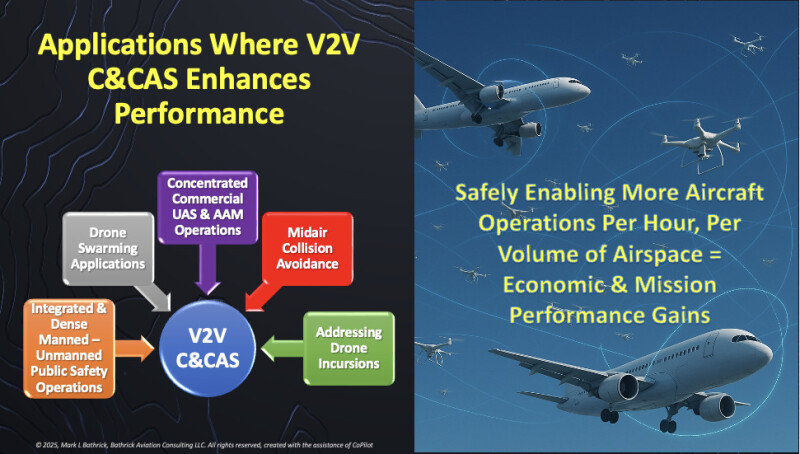
The Strategy: Environmental Adaptability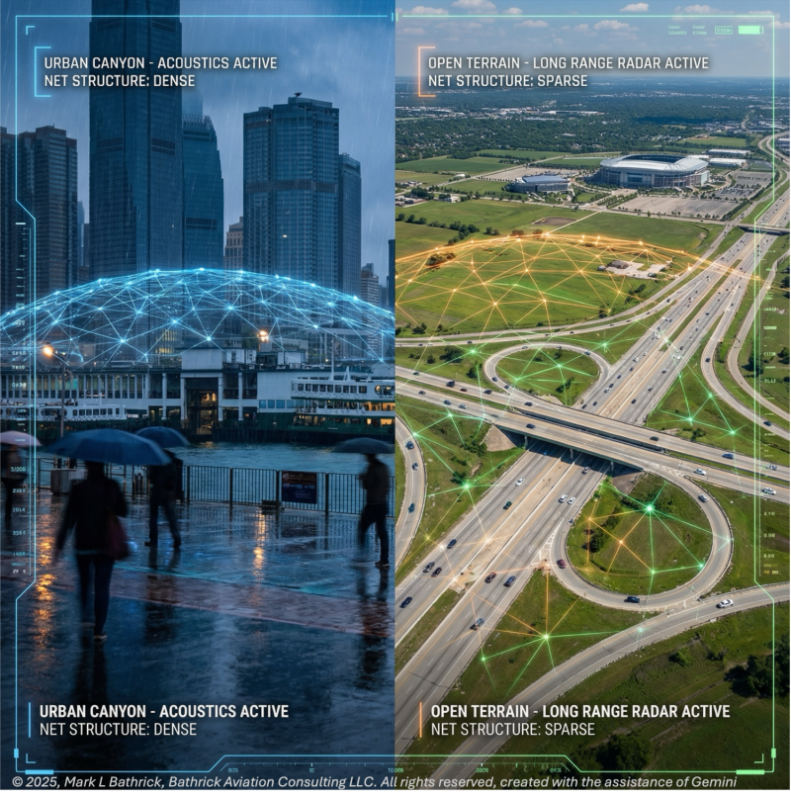
Systems must be configurable to "Local ROE." A jammer that works in the desert may be illegal to use in Philadelphia near the Navy Yard due to spectrum interference risks. This need to tailor local C-UAS ROE to local restrictions, vulnerabilities, available systems, etc. is reflected in diversity of the 11 U.S. venues for the 2026 World Cup matches.26 No single C-UAS ROE will fit them all.
Actionable Steps:
- Geofenced Mitigation: Program your systems to recognize specific "No-Fire" zones based on local infrastructure. For example, a system sold to SoFi Stadium in Los Angeles must automatically lock out kinetic options due to the proximity of LAX flight paths.27
- Offer "Flyaway Kits": The Pentagon and DHS are seeking modular, mobile solutions. Can your system protect a VIP motorcade in the morning and anchor a static stadium defense at night? Develop modular packaging that allows for rapid reconfiguration to differing local conditions and constraints and different C-UAS mission use cases (e.g., mobile, static, etc.).
Strategy 4: Navigate the New Procurement Landscape
The money is moving and it is BIG. The FY26 NDAA authorizes DHS and DOJ to provide grants specifically for purchasing C-UAS systems to "benefit public safety" (Sections 8603 & 8604).28 This opens a massive new market of State, Local, Tribal & Territorial (SLTT) government buyers who are not military experts.29 On top of this there are separate State legislative initiatives intended to further expand the authorities of local police to down drones.30
The Strategy: Optimize for Grant-Readiness and the "Amazon" Portal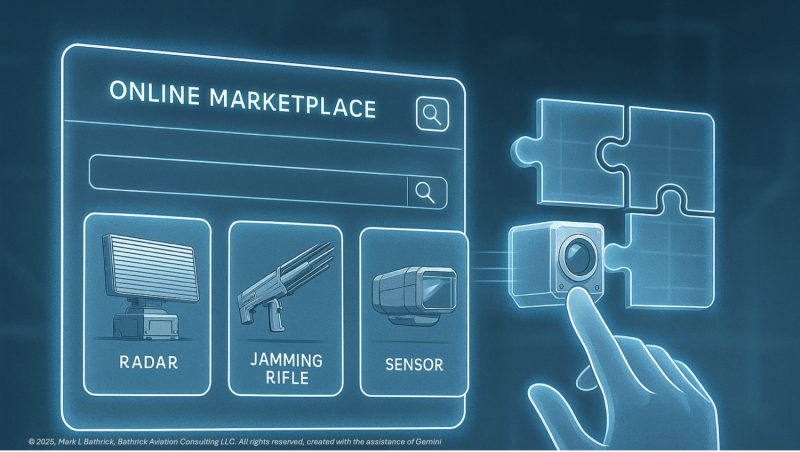
JIATF 401 is tasked with creating a streamlined acquisition division to budget and plan for C-UAS capabilities.31 32
Actionable Steps:
- Get on the List: The NDAA mandates a "list of authorized technologies" maintained jointly by the DOJ, DHS, DOD, and FAA. Your primary business objective must be getting your component vetted and added to this list. Learn from those who have already succeeded in this space.33
- Bundle Training: SLTT agencies are mandated to complete training and certification (Section 8602). Differentiate your product by bundling it with high-fidelity simulation training that teaches operators not just how to press the button, but when—bridging the gap between technology and ROE.
Conclusion: A Time-Phased Roadmap to Winning in the "System of Systems" Era of Airspace Safety, Security, and Prosperity
The C-UAS market is maturing. The days of the "Wild West" procurement are ending, soon to be replaced by the structured, regulated environment of the SAFER SKIES Act and JIATF 401.
For new and existing companies, the advice is clear: Don't try to reinvent the wheel. Find the "white space," perhaps as the middleware layer that glues sensors together, or the "Left of Boom" specialist focusing on locating pilots rather than just jamming drones.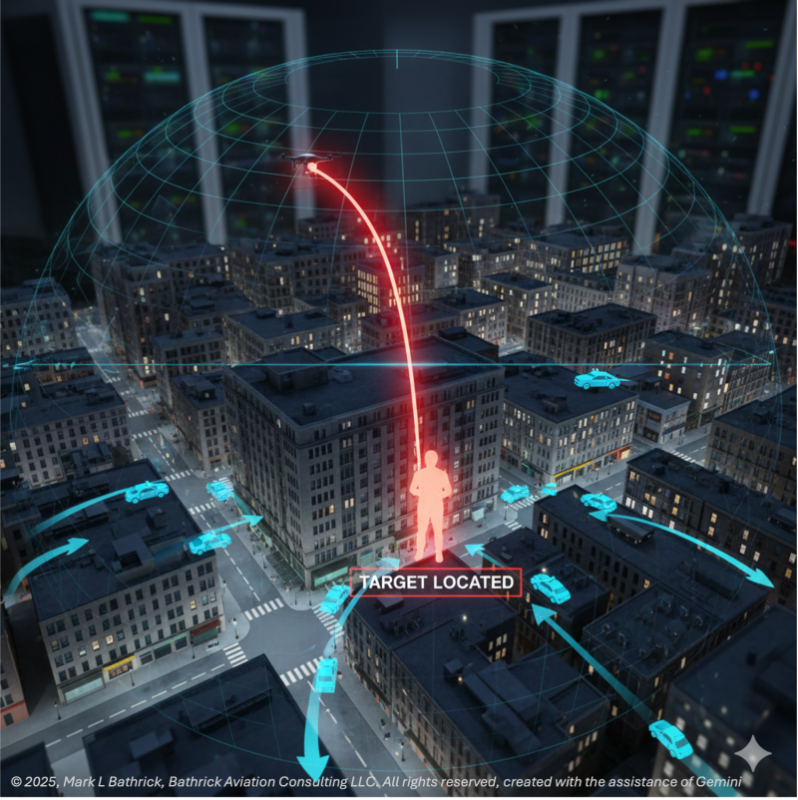
Ultimately, the winner won't be the company with the biggest laser. It will be the company that strategically chooses the right partners, plays best with others, integrates seamlessly into the "System of Systems," and most importantly keeps the operator out of court and off the front page by being able to embed location and use case specific ROE directly into the system.
This roadmap provides a detailed, actionable path for a C-UAS company to transition from selling isolated hardware to becoming a leader in the new "System of Systems" era. 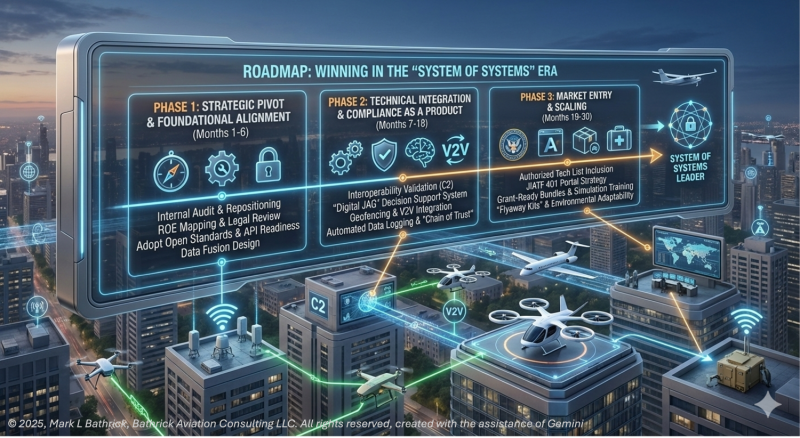
Phase 1: Strategic Pivot & Foundational Alignment (Months 1-6)
Objective: Shift company strategy from selling "silver bullet" products to offering an integrated capability, preferably with a complementary partner company, proving your team understands customer needs by weaving ROE compliance throughout the system of systems.
- Key Activities & Deliverables:
- Internal Audit: Conduct a rigorous internal review of current product capabilities against the "System of Systems" and ROE compliance requirements. Identify gaps in interoperability and automated decision support.
- ROE Integration and Agility Mapping: Create a high-level map of how ROE considerations can easily be added and revised for target customer use cases (e.g., critical infrastructure protection, high-profile event security).
- Deliverable: A strategic plan and product roadmap pivot document.
- Internal Alignment: Ensure executive leadership, engineering, and sales teams are aligned on the new strategic direction.
- Early Coalition Building: Initiate informal discussions with complementary C-UAS companies (e.g., a radar company, a command-and-control software provider) to explore potential teaming opportunities.
- Internal Alignment: Ensure executive leadership, engineering, and sales teams are aligned on the new strategic direction.
- Technical Requirements (Interoperability & Open Architecture):
- Adopt Open Standards: Commit to and begin implementing open architecture standards for data exchange. Ensure the system’s API is robust and well-documented, ready to feed data into a larger Command and Control (C2) network.
- Data Fusion Readiness: Design or modify products to ensure its output can be seamlessly integrated into a "Common Operating Picture" (COP) for operators, as opposed to a proprietary, siloed display.
- Adopt Open Standards: Commit to and begin implementing open architecture standards for data exchange. Ensure the system’s API is robust and well-documented, ready to feed data into a larger Command and Control (C2) network.
- NDAA & SAFER SKIES Act Awareness: Thoroughly review the C-UAS provisions in the FY26 NDAA, including the SAFER SKIES Act and the establishment of JIATF 401.
- Data Provenance Foundation: Begin architecting the system to automatically log and cryptographically secure a "Chain of Trust" for all data. This will be crucial for future legal accountability and auditability.
- NDAA & SAFER SKIES Act Awareness: Thoroughly review the C-UAS provisions in the FY26 NDAA, including the SAFER SKIES Act and the establishment of JIATF 401.
- Common Pitfall: Continuing to market the system as a "does-it-all" solution, which will alienate potential partners and buyers looking for modular components.
Phase 2: Technical Integration & Compliance as a Product (Months 7-18)
Objective: Execute the product roadmap pivot by building and testing the technical and compliance features that define a System of Systems component.
- Key Activities & Deliverables:
- Interoperability Validation: Proactively test the system's hardware and API with major C2 providers (e.g., FAAD C2) to verify "plug-and-play" readiness. This is a critical step for inclusion in the new government marketplace.
- "Digital JAG" Development: Build a Decision Support System (DSS) that automates ROE compliance. The system should offer features like automated "Soft Kill" vs. "Hard Kill" recommendations based on threat level and geolocated risk, aligned with the location and mission specific ROE.
- Geofencing & Adaptability: Implement configurable geofencing capabilities that allow for site-specific ROE. For example, the system must be able to automatically lock out kinetic mitigation options in a "No-Fire" zone, like a stadium near an airport.34
- Deliverable: A System of Systems-ready product prototype or update with demonstrated interoperability and embedded ROE compliance features.
- Stakeholder Engagement Strategy:
- Formal Teaming Agreements: Solidify partnerships with complementary C-UAS companies through teaming agreements, focused on joint development and go-to-market strategies for government opportunities.
- Government Outreach: Begin engaging with relevant government stakeholders (e.g., JIATF 401, DHS S&T, FAA) to showcase the new capabilities and get early feedback.
- Technical Requirements (Data Provenance & Auditability):
- Implement Data Logging: Finalize and implement the automated logging system that creates an immutable "Chain of Trust" for every detection, identification, and operator action. This "black box" is essential for compliance audits.
- Compliance & Legal Considerations:
- V2V Integration: Incorporate Vehicle-to-Vehicle (V2V) communication protocols to instantly distinguish between authorized friendly drones (like police UAS) and unknown threats. This significantly simplifies the ROE decision loop and enhances safety.
- Training Mandate Preparation: Design training modules that go beyond technical operation and cover the ROE decision-making process, preparing for the mandatory certification requirements of the SAFER SKIES Act.
- Common Pitfall: Neglecting the user experience of the "Digital JAG" interface, making it too complex for an operator under stress to understand and trust.
Phase 3: Market Entry & Scaling (Months 19-30)
Objective: Successfully enter the government market by leveraging the JIATF 401 portal, securing grants, and establishing a reputation as a trusted partner.
- Key Activities & Deliverables:
- Authorized Technology List: Aggressively pursue inclusion on the joint DOJ/DHS/DOD/FAA "list of authorized technologies" mandated by the NDAA. This is the primary objective for market entry.
- JIATF 401 Portal Strategy: Optimize product listings for the JIATF 401 "Amazon-like" portal, ensuring that the component’s specifications, interoperability certifications, and user reviews are prominent.
- Grant-Ready Bundling: Create "Grant-Ready" packages specifically for State, Local, Tribal, and Territorial (SLTT) customers applying for DHS/DOJ grants. These bundles should include the hardware, software, training, and sustainment support.
- Deliverable: Successful inclusion on the authorized technology list, first government contracts or grant-funded purchases, and established presence in the JIATF 401 portal.
- Stakeholder Engagement Strategy:
- Coalition Marketing: Execute joint marketing campaigns with teaming partners to showcase integrated System of Systems capabilities to government buyers.
- SLTT Outreach: Proactively educate SLTT public safety agencies on the SAFER SKIES Act authorities and the availability of grant funding.35
- Technical Requirements (Adaptability & Mobility):
- "Flyaway Kit" Options: Develop and market modular, mobile versions of the system to cater to the Pentagon and DHS’s need for rapidly deployable C-UAS capabilities for special events and dynamic threats.
- Environmental Adaptability: Promote the system's ability to be configured for different local environments and spectrum constraints (e.g., urban canyons vs. open terrain).
- Compliance & Legal Considerations:
- Training & Simulation: Bundle high-fidelity simulation training with every sale, ensuring that operators are not only technically proficient but also certified and prepared to make legally defensible decisions.
- Common Pitfall: Failing to provide adequate training and support for SLTT customers, leading to operational failures, legal issues, and damage to the company's reputation.
Critical Success Factors & Call to Action
Critical Success Factors:
- Unwavering Commitment to Interoperability: The willingness to open APIs and play well with others is the single most important technical factor.
- Deep ROE Integration: Compliance cannot be an afterthought. It must be a core product feature, as essential as the sensor itself.
- Strategic Partnerships: Success in a "System of Systems" world requires strong, trusted partnerships. No company can win alone.
- Focus on the Operator: The technology must empower the operator with clear, actionable, and legally sound decision support, not overwhelm them with data.
- Invest in an Experienced Guide: Because the primary customers for C-UAS systems are, and for the foreseeable future will remain, government agencies, prospective vendors must resist the temptation to simply hire a "door opener" and instead invest in the services of a truly experienced government guide.36 Speaking from personal experience as a former federal program executive,37 I was frequently compelled by these well-connected intermediaries to take meetings with vendors who often arrived completely "unschooled" regarding my agency’s specific mandates and pain points. In many cases, these unguided vendors unknowingly made statements that were offensive to our organization’s culture and mission, failing to demonstrate even a baseline understanding of the operational realities we faced. The result was almost always the same: the vendor rarely secured a second meeting, and the "door opener" burned the political capital required to facilitate future access. Ultimately, investing in a government-experienced “operational technologist” is far more valuable. This guide can develop and execute a comprehensive, actionable stakeholder engagement plan, ensuring that you’re well-prepared to navigate the process.38 In contrast, paying someone who can simply force a door open only for you to stumble through it unprepared is a less effective approach.39

Call to Action:
C-UAS company teams must act now. The window to pivot is open but is closing fast. Embrace the "System of Systems" reality. Stop pitching isolated gadgets. Start building integrated, compliant, and trusted components across multi-company teams that will form the backbone of the future airspace awareness, safety, security, and prosperity network. The companies that make this transition will not only win contracts; they will define the air domain awareness and management industry for the next decade.











Comments