

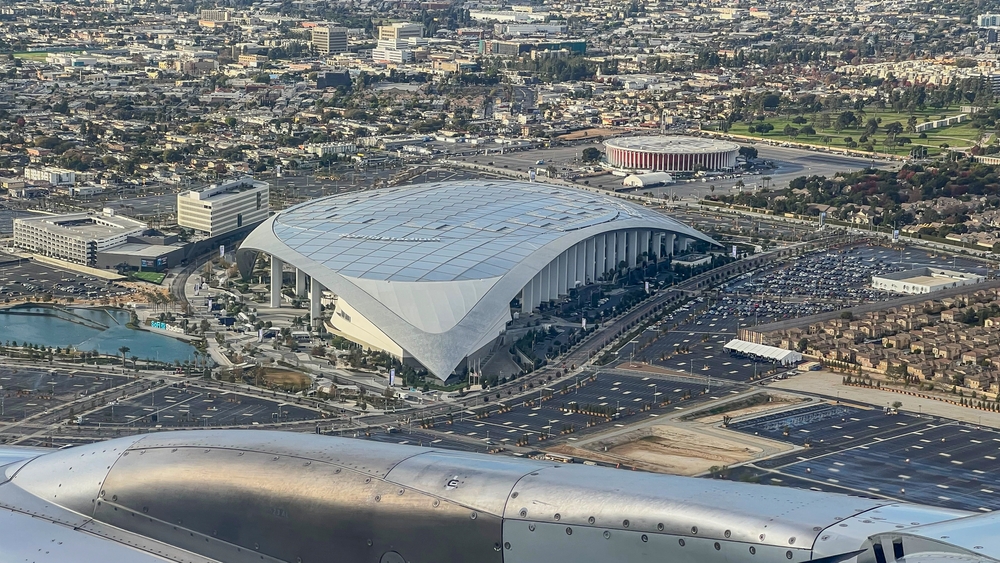
Protecting FIFA World Cup games from malign and reckless drone operators has become a critical concern for the U.S. government with the international soccer tournament—the world’s most popular sporting event—just six months away. Eleven stadiums across the U.S. will host 78 World Cup matches played between June 12 and July 19, 2026.
Drones hovering in restricted airspace over U.S. athletic events is a problem that predates the coming World Cup.
In January 2025, M&T Bank Stadium in Baltimore was the site of a National Football League (NFL) playoff game between the hometown Ravens and the Pittsburgh Steelers with more than 70,000 spectators in attendance. Suddenly, a drone appeared over the field. The game was temporarily halted because of concern the UAV posed a threat to players and fans. It was the second year in a row in which a drone flew over the Baltimore stadium during an NFL playoff game.
In both cases, the UAV operator was capturing photos of the action, not trying to cause damage. In both cases, the operator was charged with a federal crime. Though drones are used by broadcasters for filming some sporting events, including the Tour de France bicycle race, the FAA and NFL have a zero tolerance policy for UAVs—all drones are banned within three miles of a stadium from one hour before kick off to one hour after the game ends. Any filming or photography using drones must be completed one hour prior to the game’s start.
In November, the White House Task Force on the FIFA World Cup 2026 co-hosted a forum on countering UAVs with the Commercial Drone Alliance (CDA) and DRONERESPONDERS. With federal, state, and local officials in attendance, the thorny questions surrounding counter-drone measures for the World Cup were addressed.
While there are “so many amazing, beneficial uses for drones, the same technology can also be misused,” CDA CEO Lisa Ellman told Commercial UAV News following the forum. “We've seen that in the context of the careless, the clueless, and the criminal operating drones over events, and so the focus of this is to enable airspace awareness, enable broad use of detection technology and then the mitigation piece is really a last resort.”
Mitigation is the most difficult issue to tackle. While the Departments of Homeland Security (DHS) and Justice (DOJ) have authority to engage in counter-drone action, state and local governments are strictly prohibited from such activities. Congress has repeatedly attempted, to no avail, to pass legislation to expand counter-drone authority. And the FAA still has not issued a long-delayed Section 2209 Notice of Proposed Rule Making (NPRM) on regulations to establish defined boundaries for operating drones over critical infrastructure.

Currently, any counter-drone action taken—whether non-kinetic (hacking, jamming, taking over) or kinetic—falls under federal criminal statutes regarding interference with an aircraft. A local police officer would violate the federal Aircraft Sabotage Act if he or she took out a drone. With no distinction under U.S. law between a UAV, a commercial airliner, or a helicopter, interfering with a drone in flight could lead to 20 years in prison.
Federal Funds
Legislation passed by Congress earlier this year created a $500 million C-UAS grant program aimed at providing funding to “enhance state, local, tribal and territorial capabilities to detect, identify, track or monitor UAS,” according to the U.S. government. “The program helps combat the unlawful use of UAS that pose a threat to the safety and security of the American people, communities and institutions.”
Half of that money will be distributed in 2026 and the other half in 2027, with a particular emphasis on protecting the World Cup in 2026 and the Summer Olympics in Los Angeles in 2028.
“Through this program, recipients and subrecipients may use federal funds to purchase fixed or portable systems that can detect, track, identify and mitigate UAS threats consistent with applicable laws,” according to the federal government.
“The government is really putting their money where their mouth is and funding these efforts, which we think is fantastic,” Ellman said. “We're all working together for a successful process in order to protect the World Cup and the Olympics.”
In addition, the Federal Bureau of Investigation (FBI) in November established the National Counter-Unmanned Training Center (NCUTC) in Huntsville, Alabama. The center “will serve as the nation’s premier hub for preparing law enforcement and security professionals to detect, assess and counter emerging UAS threats,” according to U.S. Rep. Dale Strong (R-Alabama), who represents the Congressional district in which the NCUTC is located. He added the FBI center will “directly support security preparations for upcoming global events hosted in the United States, including the 2026 FIFA World Cup and the 2028 Summer Olympics.”
People Problem
Ryan Wallace, an Embry-Riddle Aeronautical University professor of aeronautical science, outlined the challenge of identifying and countering unauthorized drones during September testimony before the U.S. House of Representatives.
“The misuse of unmanned aircraft is not fundamentally a technology problem, but rather a people problem,” he said. “What makes this problem particularly challenging is the unique aerial capabilities that UAS provide to operators—capabilities previously limited only to those with the resources and training to operate manned aircraft. The accessibility, affordability and automation have now placed these capabilities within reach of anyone with a few hundred dollars.”
Wallace noted there are more than 2.8 million UAVs in the U.S., two-thirds of which are recreational and easily accessible. “Today, drones outnumber manned aircraft [in the U.S.] by nearly 13-to-1,” he said.
“While entrepreneurs recognize the value and opportunities that unmanned aircraft bring to business, these advantages are not lost on the criminal elements of society, who also seek technological advantage,” Wallace explained.
Addressing “unauthorized and malicious UAS activity” involves “detection, tracking and identification enabling early warning, airspace situational awareness and monitoring, and risk-driven response decision-making; and counter-UAS, often referred to as mitigation, which refers to a system or device used to disable, disrupt or seize control of a UAS.”
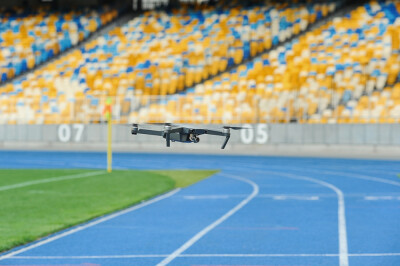
Critical to the latter are clear "rules of engagement, procedures [and] equipment to respond to or mitigate a potential aerial threat.”
That is where the issue gets complicated. Wallace noted that “all drone incidents are local incidents first. Often, the first response to these incidents will be sworn officers from one of the nation’s 17,541 state and local law enforcement agencies. Most of these agencies lack formal training for dealing with drone incidents, and even fewer are equipped with tools to support the detection, tracking and identification of UAS.”
Perhaps most significantly, “currently, no state or local law enforcement agencies are equipped and authorized to forcibly take down a UAS threat without the compliance of the operator, who may be positioned miles away from the aerial vehicle,” he said.
Pushing Congress
The White House is pressing Congress to finally take action and pass counter-drone legislation to extend mitigation authority to properly-trained and equipped local law enforcement agencies, noting it is not feasible for DHS and DOJ to be able to protect all 78 World Cup games across 11 venues. But multiple efforts in Congress to pass counter-drone legislation have failed despite the bipartisan nature of several of the attempts.
Concerns have repeatedly been raised about the potential of a drone taken out of the sky to, for example, crash into stadium specators—a result that could make the counter-drone action worse than the potential threat.
Testifying before Congress earlier this year, Catherine Cahill, director of the Alaska Center for UAS Integration at the University of Alaska Fairbanks, warned lawmakers that allowing kinetic actions poses dangers.
“Examples of kinetic solutions include: nets, collisions with other UAS, projectiles and lasers, among others,” she said. These solutions, she added, “have the potential to adversely impact authorized UAS, manned aircraft [and] people or property on the ground … If a counter-UAS system operator disables or destroys a UAS, the UAS, or fragments of the UAS, will fall on whatever is below them or is located wherever they finally crash. This could cause human injuries or fatalities, property damage [and] risk to other systems.”
According to multiple reports, one option discussed at the November task force forum is to get around the lack of legislation by having the FBI train local law enforcement through the NCUTC and then temporarily deputize state and local officials to conduct counter-drone activity in specific circumstances, such as protecting World Cup stadiums during matches. Counter-drone technology could be purchased with the federal grant money.
Former U.S. Sen. Norm Coleman, who represented the 11 World Cup cities at the forum, told reporters that trained local law enforcement could “in effect” be deputized by the FBI, though he added it would be “cleaner” if Congress cleared expansion of counter-drone authority via legislation.
Embry-Riddle’s Wallace said it “is essential to ensure that both UAS detection and mitigation efforts do not create or exacerbate hazards within the National Airspace System through spectrum interference with navigation or communication infrastructure, create collision hazards or impede air traffic management functions.”
Further complicating matters is the prospect of UAVs being potentially used by television networks broadcasting World Cup games, as well as law enforcement deploying drones for surveillance purposes around stadiums.
“One of the challenges that has existed in the drone space for years now is how do you tell it’s a good drone versus a bad drone,” CDA Policy Director Liz Forro told Commercial UAV News. “We have plenty of ideas, one of which is there probably needs to be a ‘white list,’ particularly for public safety drones. Public safety using drones is obviously one of the good outcomes from drones.”









Comments