


In October 2025, Munich Airport suspended operations overnight after detecting unauthorized drone activity. Elsewhere in Europe around that same time, other major airports were also temporarily shut down for similar reasons. These incidents made headlines as security threats, but more broadly, they represent something more significant for the commercial drone industry: catalysts for building the infrastructure that could ultimately help enable scaled operations.
Every unauthorized drone near an airport or critical facility creates public anxiety that threatens the industry's growth. Yet the counter-UAS systems being deployed to address these concerns are, hopefully, simultaneously laying the groundwork for the comprehensive airspace management capabilities that commercial operations will require. If things work as hoped, this could help create the foundation for BVLOS flights, urban delivery networks, and ultimately, advanced air mobility.
A recent report published by Commercial UAV News, entitled Counter-UAS in Europe: From Security Threat to Commercial Opportunity, outlines the state of C-UAS technology in Europe, some of the reasons why the technology has become so important in the industry, and why commercial and industrial operators should care. You can download the report for free by following the link below, and learn more about it under that.
Recent incidents demonstrate why European stakeholders are taking drone security seriously. In November 2025, unidentified UAVs entered restricted airspace around Belgium's Doel Nuclear Power Plant. Multiple major airports faced disruptions from drone activity in the latter half of 2025 alone. These incidents are symptoms of a broader challenge as drones become ubiquitous in modern skies.
The regulatory response reveals complexity, but also opportunity. Unlike purely aviation safety matters that fall under EASA's mandate, C-UAS regulation follows the principle of subsidiarity, meaning that actions are to be taken at the lowest level of government possible before higher levels intervene. In practice, this creates a fragmented landscape where different countries employ different strategies. Germany recently approved military intervention for neutralizing unauthorized drones over critical infrastructure. The U.K. is shifting from reactive responses to proactive policy frameworks. Spain bases its regulation on real-world testing and standardization.
Despite this fragmentation, EU-funded initiatives like COURAGEOUS are working to develop standardized test methodologies across Belgium, Greece, and Spain. The goal is to create common frameworks for evaluating C-UAS systems, making deployment decisions easier and fostering the interoperability that cross-border operations will require.
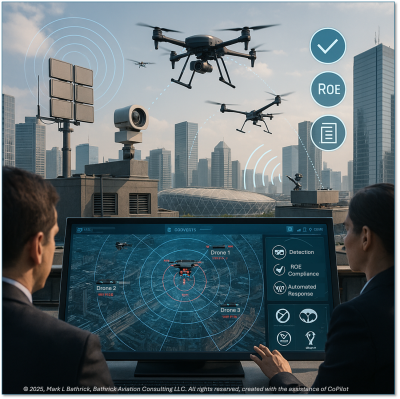
At its core, any C-UAS system must detect drones, identify whether they're threats, and when necessary, neutralize them. For commercial operators, the identification layer is where the business intersects directly with security infrastructure.
This is where Remote ID becomes critical. EASA's regulations now require Direct Remote ID for most drones; C-UAS systems receive these signals and cross-reference them against authorized flight plans and geofencing data. In theory, this allows security operators to distinguish legitimate traffic from genuine threats. In practice, integration remains complex, especially in busy airspace with multiple authorized operations.
Consider a hypothetical. A utility company conducts a BVLOS power line inspection near a major airport with all necessary authorizations and proper Remote ID broadcast. When a C-UAS system detects an unauthorized drone elsewhere at the airport, security personnel activate RF jamming. That jamming affects all drones in range, potentially forcing the legitimate inspection drone into emergency landing procedures over difficult terrain.
As C-UAS deployment accelerates around sensitive sites, commercial operators face increasing potential for unintended interference. The solution lies in coordination between C-UAS systems and authorized flight databases through U-space integration. Network Remote ID then becomes particularly important. It integrates your operation into the digital airspace management infrastructure on which C-UAS operators increasingly rely.
There is opportunity here, too, though. The infrastructure being deployed for threat detection can simultaneously support routine airspace management, traffic coordination, and compliance monitoring, and this dual-use potential is where the most promising business models are emerging.
An airport's C-UAS deployment, properly integrated with flight authorization systems, can simultaneously protect against unauthorized incursions while facilitating approved drone operations for inspection, delivery, or other commercial services. Detection networks installed primarily for security can verify that commercial drones operate within authorized zones, broadcast proper Remote ID, and follow approved flight plans.
European companies are leading this convergence. Dedrone, now owned by Axon, operates at over 900 sites globally, including dozens of European airports. Robin Radar's partnership with Thales integrates specialized detection systems into comprehensive C-UAS platforms.
The European Commission has proposed that, beginning in 2028, the European Competitiveness Fund will support the development and deployment of European civilian, dual-use, and defense drone and counter-drone solutions. Defense-tech startups working on dual-use technologies are attracting significant investment attention, recognizing that the same capabilities serving security needs can enable commercial operations.
For commercial operators, the critical shift is from a compliance mindset to strategic integration. Success requires proactively engaging with C-UAS providers, establishing coordination protocols with facility security teams, and building operational workflows that treat airspace awareness as a core capability. Companies positioning themselves at the intersection of commercial operations and security infrastructure will find significant competitive advantages as markets mature.
The incidents driving C-UAS investment are now serving as signals that airspace management must evolve, and that the infrastructure being built can simultaneously enable the commercial applications the industry is working toward.
To learn more about this critical and growing space, be sure to download a free copy of our latest report at the link below.








Comments