

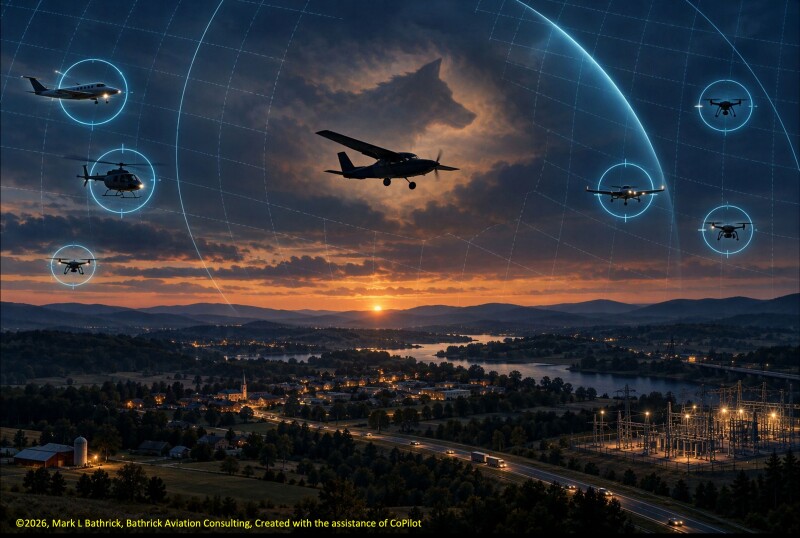
The hardest aircraft to defend against may be the one doing everything right.
That problem is most acute in the airspace where the nation is now building its low-altitude awareness system. Most pilots flying there are legitimate, but the rules allow some manned aircraft to fly without transmitting anything, and that matters to everyone whose job is to decide what an unfamiliar contact is. Earlier pieces in this series examined the rule itself, the rules of engagement (ROE) for counter-drone action, and the quality of the data behind those decisions. This one adds two things: the view from the defender’s seat, where a legally silent manned aircraft becomes an unknown that must be resolved before anyone can act, and the threat vector that view exposes, a manned aircraft converted to fly remotely or autonomously that looks like everyone else. Its focus is security; the safety and economic costs of legal silence are real but deserve separate treatment.
Low-altitude air domain awareness is being designed to find the anomalous. Yet current federal rules allow manned aircraft flying under visual flight rules (VFR) in uncontrolled airspace, which is estimated to make up approximately 96 percent of America’s low-altitude airspace, to operate routinely and silently: without ADS-B Out, the broadcast that automatically reports an aircraft’s identity and position, and without filing a flight plan. That creates a plausibility gap. An aircraft that looks and behaves like the lawful majority produces no anomaly to flag, so a system built to notice anomalies cannot, by itself, separate a lawfully silent manned aircraft from one that is silent for illegitimate reasons. Better drone detection does not change that. Understanding why begins with how hard the defender’s job already is.
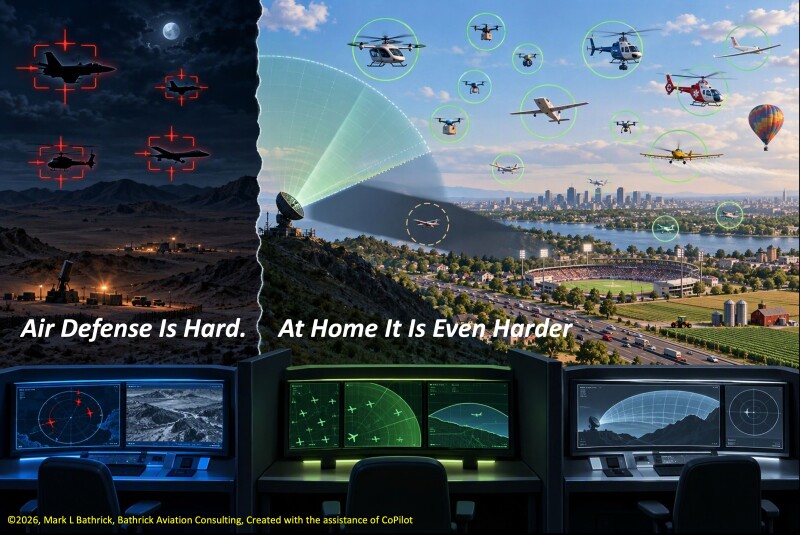
Air Defense Is Hard. At Home It Is Even Harder
I’ve experienced this problem from three unique vantage points:
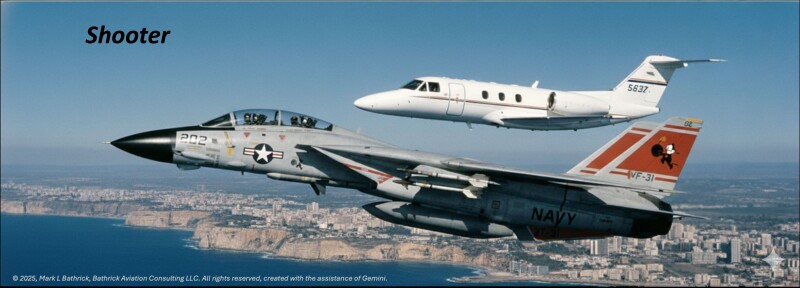
- The Shooter: As a Navy fighter pilot, I was a potential shooter in the counter-air equation. Sorting out who was who was always the most challenging task.1
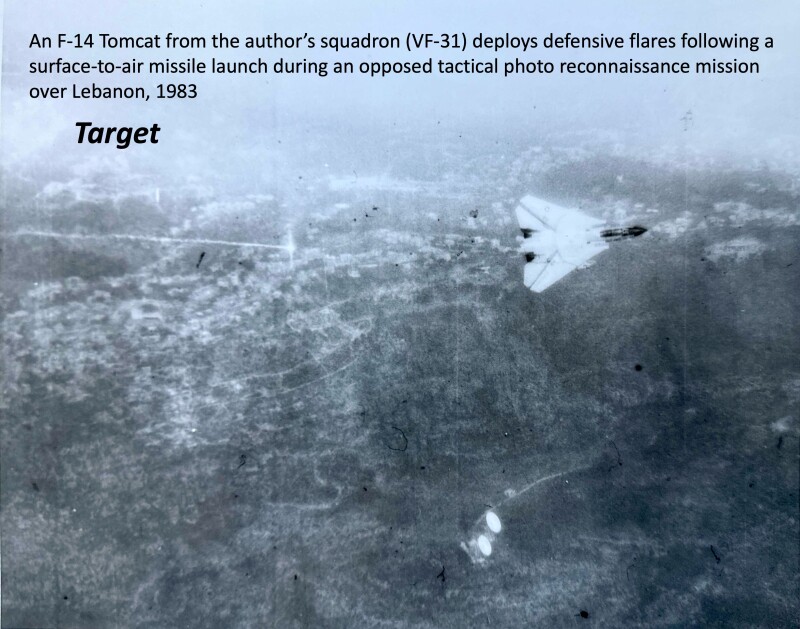
- The Target: As a naval aviator, I have also been on the receiving end, taking fire from hostile forces and, on more than one occasion, nearly taking it from “friendly” forces.2
- The Protector: As the senior executive for aviation for the U.S. Department of the Interior (DOI), I helped safeguard an agency responsible for approximately 500 million acres, including national icons like the National Mall and critical infrastructure.3

Air defense is often described as a contest of sensors and weapons. From all three vantage points, it looks more like a contest of time and certainty. A protector must detect a contact, classify it, decide whether it is a threat, and obtain the authority to act. Every one of those steps draws on the same few minutes, and every one carries its own risk. Act on too little information, and you may engage something harmless. Wait for more, and you may be too late.
Detection Is Only the First Step
That is why I describe domestic air defense and counter-unmanned aircraft systems (C-UAS) work as a technology and decision stack, not a sensor. The diagram below distills what I learned across a career spent as the shooter, the target, and the protector: the 12 levels a successful domestic air defense system must climb, from raw detection to iterative improvement.
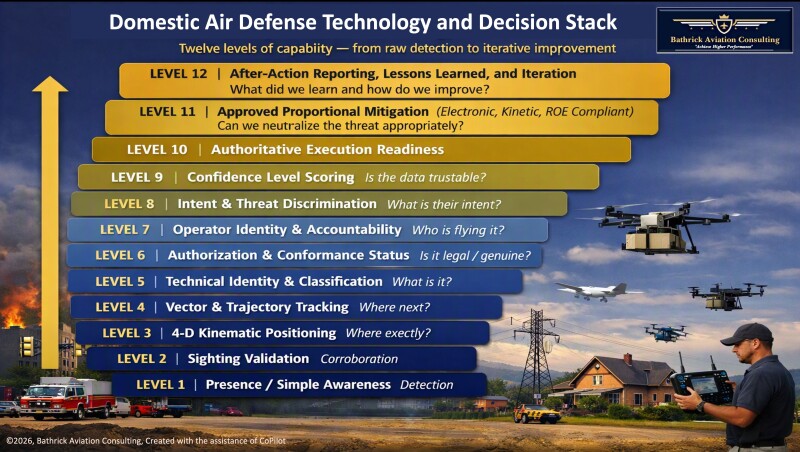
Look at where the effort actually sits. Levels 1 through 4 (presence, sighting validation, precise position, and vector and trajectory) are what most of today’s sensors do well. Detection is where the technology is strongest and where the industry spends most of its energy. But detection alone cannot tell a decision-maker whether to act, or what cumulative confidence that advice carries.
The levels that matter most come next: technical identity and classification (Level 5), authorization and conformance status (Level 6), and operator identity and accountability (Level 7). Only then can anyone credibly address intent and threat discrimination (Level 8) and judge how far the data can be trusted (Level 9). Execution readiness and approved, proportional mitigation (Levels 10 and 11) must rest on that foundation, and the stack closes with the discipline to learn and improve (Level 12).
As a potential shooter, I know that the middle of this stack is where tragedies are prevented or caused.4 Identity and intent are what separate a justified mitigation from a catastrophic error. A system that is excellent at Levels 1 through 4 and weak at Levels 5 through 8 is not a defense. It is a way to arrive at a bad decision faster.
Why the Homeland Is Harder
In deployed combat operations, the working assumption is often that all contacts should be presumed hostile until determined otherwise. Procedures declared for a defined geography and ROE written for a defined threat profile give the defender a framework for acting on that assumption, and the cost of a mistaken call is understood and accepted in advance.
Over the United States, the assumption is exactly reversed. On any given day, the vast majority of aircraft and operators in the low-altitude National Airspace System (NAS) are law-abiding and conforming, and that mix is growing more diverse: crewed and uncrewed commercial operators, general aviation pilots, hobbyists, delivery and logistics operators, public safety crews, farmers and agricultural applicators, flight students, weekend flyers, and, increasingly, advanced air mobility and autonomous aircraft. The task is not to find the needle in a haystack of threats. It is to find a rare, bad actor in a sea of legitimate activity, without disrupting, endangering, or terrorizing the people we are there to protect.5
That raises the cost of every mistake. A wrong call in a combat theater is a tragedy.6 A wrong call over an American neighborhood, stadium, or highway is a tragedy with legal, political, and public-trust consequences that can set back an entire industry. The laser engagement of a Customs and Border Protection drone in Texas earlier this year, discussed below, shows what unresolved identity can cost even when no crewed aircraft is involved. I explored the ROE side of this problem in Drone Defense at Home and the data-quality side in Beyond the Box and America’s Low-Altitude Awareness Gap.7 Both point to the same constraint: the harder it is to resolve identity, the less time and confidence decision-makers have to act lawfully and proportionately.
The institutional and physical environment adds to the burden. The organizations that might respond answer to different authorities: the FAA manages the airspace, the Department of War (DoW) defends it, and the Department of Homeland Security (DHS) and law enforcement protect people and infrastructure on the ground, each under different legal limits on what it may do.8 And at low altitude, radar coverage is limited by terrain and the curvature of the Earth, so a defender may first learn of a contact when it is already close.9
This is also where the legacy rules we have written for our own airspace work against us.10 Every aircraft that is legally allowed to fly without transmitting its identity becomes an unknown contact that authorities must detect, correlate, identify, and assess before they can respond. Each of those steps lives in the lower and middle levels of the stack, and each takes time. The people with the most to lose from that delay are the law-abiding majority who could be mistaken for the exception.
That is the part of the problem we created for ourselves. Nearly all of the pilots flying silently are doing exactly what the rules allow, and that is precisely the point: every legitimate aircraft permitted to stay silent makes the unlawful one harder to discern.11 A better sensor will not fix that, because what is missing is not a track but an identity.
Awareness requires identity, not just detection
Detection tells you that something is there. Awareness requires knowing what it is, who operates it, whether it belongs, and what risk it poses, which is the work of Levels 5 through 8 in the stack above. That distinction is easy to state and hard to design for. Radars, radio-frequency sensors and cameras generate tracks.12 A decision-maker needs tracks that carry identity and confidence.13
Most detection logic is built around deviation: an aircraft in the wrong place, on the wrong track, at the wrong time, without the expected transmission. That is a reasonable starting assumption, because the cooperative majority makes the exception visible. It is also an assumption, and it fails against an object that looks like the majority. A track on a familiar pattern, flown by an aircraft that transmits nothing because it is not required to, produces no deviation to flag.14 15 The missing signal is not the absence of data. It is data the system has no rule for interpreting.16
The rule that makes silence legal
I wrote about the underlying rule in the June 2025 piece, The Elephant in the Airspace. The relevant text is 14 CFR 91.225. Electronic conspicuity (ADS-B Out) is required in Class A, B, and C airspace; above the ceiling and within the lateral boundaries of Class B or C airspace up to 10,000 feet MSL; within 30 nautical miles of the listed Mode C veil airports up to 10,000 feet MSL; in Class E at and above 10,000 feet MSL (excluding the airspace at and below 2,500 feet above the surface); and over part of the Gulf of Mexico.17 Outside those areas, there is no ADS-B Out requirement.18 That includes much of the Class E airspace below 10,000 feet MSL and most uncontrolled Class G airspace, which is estimated to comprise 96 percent of the low-altitude airspace where drones and advanced air mobility (AAM) aircraft will be prevalent.19
When the airspace boundaries behind these rules were first drawn decades ago, the equipment needed to make every aircraft electronically visible was heavy, power-hungry, and expensive. Some aircraft had no electrical system to power it, and relatively few aircraft operated in uncontrolled airspace, so the benefit of universal equipage did not justify its burden. Both sides of that calculation have changed. The equipment barriers have largely been overcome: compact, battery-powered electronic conspicuity devices now make universal equipage technically and economically feasible, even for aircraft without electrical systems.20 Meanwhile, drones, AAM aircraft and a growing mix of operators are filling the low-altitude airspace, and the awareness system now being built did not exist then. The rationale for the exemption has largely eroded, yet the rule remains.21
Federal policy is already sorting aircraft by whether they speak
In August 2025, the FAA and TSA proposed a rule to normalize beyond-visual-line-of-sight (BVLOS) drone operations, which would create a new Part 108 and, with it, a Part 146 for automated data service providers (ADSP).22 23 As proposed, Part 108 operators would have presumptive right-of-way over manned aircraft, except when the manned aircraft is broadcasting ADS-B Out or an approved alternate electronic conspicuity device, in Class B or C airspace, when taking off or landing at an airport or heliport, or over Category 5 population areas.24 The FAA defined a non-cooperative aircraft as one not actively broadcasting its location by one of those means.
In plain terms, the proposal uses conspicuity as a sorting criterion. An aircraft that broadcasts keeps its traditional protection. One that does not may be expected to yield. The FAA received roughly 3,100 comments on the proposal, more than half of which touched the right-of-way provisions, and in January 2026 it reopened the comment period specifically to ask seven questions on electronic conspicuity and right-of-way.25 26
As of mid-November 2026, reporting places the final rule at the White House Office of Information and Regulatory Affairs, where it has been since July 10, with no announced publication date.27 The final text may change the right-of-way approach. And a sorting criterion that rewards broadcasting is not a requirement to broadcast. But it shows that conspicuity is already a variable in federal low-altitude policy. The open question is whether it is treated as a design requirement of the awareness architecture or only as an incentive in one rule.
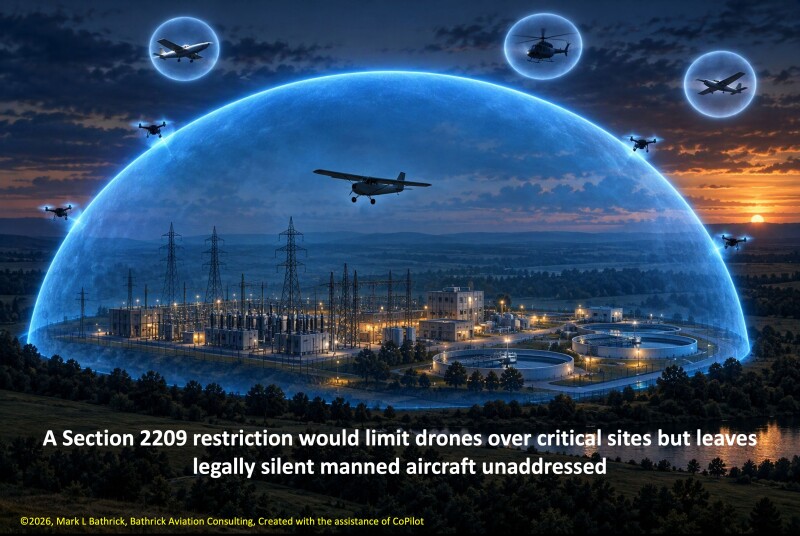
The security side of the same policy surface leaves the question open, and in one respect widens it. The FAA’s Section 2209 proposal, published May 6, 2026, would create a process for critical infrastructure operators to request unmanned aircraft flight restrictions over their facilities.28 By its own title, summary, and the FAA’s description, it governs only unmanned aircraft; its restrictions limit drone operations and are not a physical or electronic barrier.29 Nothing in it would prevent a crewed aircraft from overflying a designated site. And where that site lies beneath uncontrolled airspace outside the areas where ADS-B Out is required, a crewed aircraft could fly over it lawfully while transmitting nothing. A facility could win a federal restriction against drones and still have “electronically invisible” manned aircraft passing overhead, with no rule asking them to identify themselves or to state their intent through a flight plan (under VFR).
An unknown contact that breaks no rule
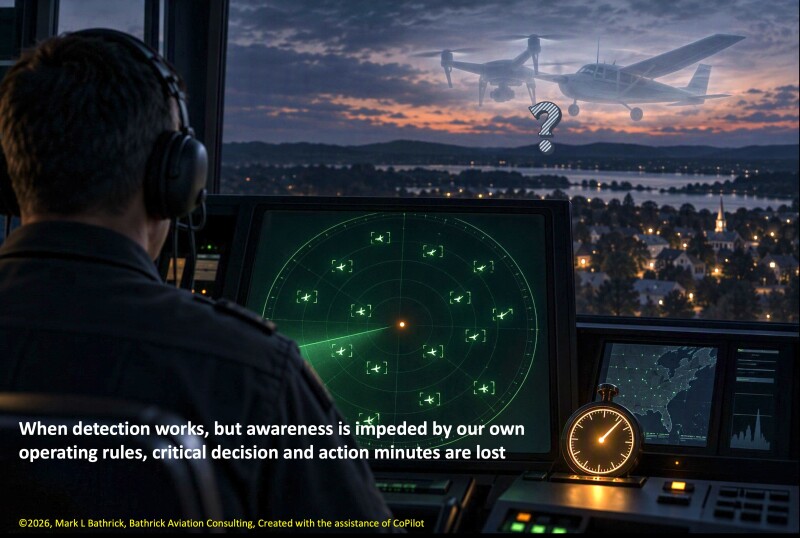
Consider the seat of a watch officer or an authorized state, local, tribal, or territorial (SLTT) C-UAS operator in this illustrative scenario. A small aircraft is on a routine track with no flight plan, no transponder, and no ADS-B Out, in airspace where current federal rules permit all three. Nothing it is doing is unlawful. The clock is running, and neither identity nor intent can be resolved from the data in hand. Detection has worked. Awareness has not.
The cost of unresolved identity is not hypothetical, and it runs in both directions. The first is acting on a contact before it is identified. On February 11, 2026, the FAA announced a 10-day closure of El Paso airspace and lifted it within hours.30 According to AP reporting, a laser had been used near Fort Bliss without coordination with the FAA.31 Two weeks later, the military used a laser against what it called a "seemingly threatening" drone, which lawmakers said belonged to Customs and Border Protection, and the FAA closed additional airspace.32 These are drone cases, and they tell us less about manned aircraft than about what happens when counter-drone action outruns identification and coordination. The lesson transfers: authority without identity is risky, and identity without authority is inert.
The second is mistaking the legitimate for the threat, and here manned aircraft are at the center. During the late-2024 drone scare over New Jersey and the Northeast, the FBI received more than 5,000 reported sightings. The FBI and DHS said that, on review of available imagery, many of the reported drones appeared to be manned aircraft operating lawfully.33 A joint DHS, FBI, FAA and Department of Defense (now the Department of War) statement later concluded that the sightings included lawful drones as well as manned fixed-wing aircraft, helicopters and stars mistakenly reported as drones. The pattern repeated in November 2026. After USAF Security Forces responded to suspected unauthorized drone activity over RAF Lakenheath on November 13, a ferry pilot told the BBC the alert was triggered by his formation of three light aircraft, only one of which had its transponder on.34 The Air Force has not confirmed his account, and the incident occurred in the United Kingdom. Two days later, Moldova’s civil aviation authority said three light aircraft over Chișinău, reportedly the same flight, had been filmed and shared online as drones. In each case, lawful manned aircraft appear to have been taken for potential drone threats.35 Whichever way the error runs, unresolved identity costs the same precious minutes and erodes the same public trust.
Law enforcement and air defense do have tools for unknown aircraft, including temporary flight restrictions, radar, and intercept. The weakness I am pointing to is narrower. At low altitude, where radar coverage may be thin or blocked by terrain, and outside the areas where ADS-B Out is required, those tools rest on two things the system cannot take for granted: first, knowing there is something to resolve, and second, telling a lawful manned aircraft from a drone, or from a threat, before the clock runs out.36 37 That second task assumes an aircraft that looks manned is flown by someone aboard, and that assumption is weaker than it appears.
Conversion is old. What is new is who might attempt it
Turning a manned aircraft into an unmanned one is not new. It is nearly as old as powered flight itself. In 1917, less than fourteen years after the Wright brothers flew at Kitty Hawk, the Navy provided Curtiss N-9 seaplanes to Elmer and Lawrence Sperry, who fitted them with a gyroscopic automatic pilot for flight trials; by March 1918, a Curtiss-built “aerial torpedo” had taken off and flown with no one aboard.38 Between the wars, the Navy flew a Curtiss N2C-2 under radio control from a mother aircraft.39 In World War II, the Army Air Forces’ Operation Aphrodite and the Navy’s Operation Anvil stripped war-weary B-17 and PB4Y-1 bombers, fitted them with radio control and television cameras, and flew them as remotely guided flying bombs.40 Converting retired fighters into full-scale aerial targets continued for decades afterward.
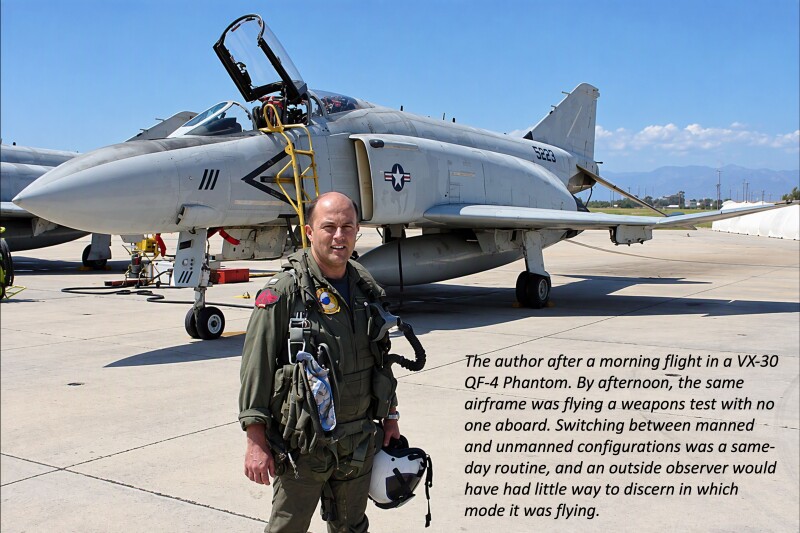
I saw firsthand how easily such a conversion could be made, in both directions, and how versatile optionally piloted aircraft could be. After commanding a deployed F-14 squadron, I was given the opportunity to command the Navy’s Air Test and Evaluation Squadron Thirty (VX-30), a mixed squadron of flight test aircraft that included QF-4 Phantoms; the squadron operated both as manned aircraft and as remotely piloted targets and high-risk weapons test platforms. The configuration change was quick: I could fly a QF-4 from the cockpit in the morning and watch that same aircraft fly that afternoon with no one aboard, controlled from the ground. To anyone observing in flight, both sorties would have looked the same. Capability can change between sorties; appearance does not.
Recently, conversions of manned aircraft to optionally piloted or unmanned variants have seen a resurgence. Multiple outlets report that Ukrainian forces have converted light and ultralight aircraft into unmanned strike platforms.41 Ukrainian press reports describe one unit that flew 102 sorties using aircraft built from commercially available ultralight kits and claims 78 successful strikes.42
The same interchangeable capability is now being demonstrated, openly and lawfully, in U.S. airspace. In November 2023, Reliable Robotics flew a Cessna 208B Caravan with no one on board from Hollister, California, under an FAA-approved test, with a remote pilot supervising from a control center about 50 miles away; its system automates taxi, takeoff, and landing.43 Joby Aviation has flown its own autonomy-equipped Caravan in Air Force exercises, including daily sorties across the Hawaiian Islands in July 2025 that were remotely operated from Guam, with a safety pilot aboard who made no inputs.44 In September 2026, a Joby autonomous Caravan flew 3,199 miles from California to North Carolina’s Outer Banks with zero control inputs from its onboard safety pilot, supervised remotely from as far as 2,323 miles away.45 Their relevance here is what they demonstrate: one of the most common utility aircraft in the world can be made to fly itself, and nothing on the outside of the airplane announces the change.
Conversion, in other words, is no longer exotic. That does not make it likely. But it does change what the label “manned aircraft” can promise. An aircraft that can be flown from the cockpit one day and from the ground the next can cross much of the nation’s low-altitude airspace without a transponder, ADS-B Out, or a flight plan, looking and sounding like any other light aircraft. That is a C-UAS threat vector the current regulations leave open, and one that has received little visible attention in public C-UAS policy discussions.
The wolf that learned to walk like the elephant
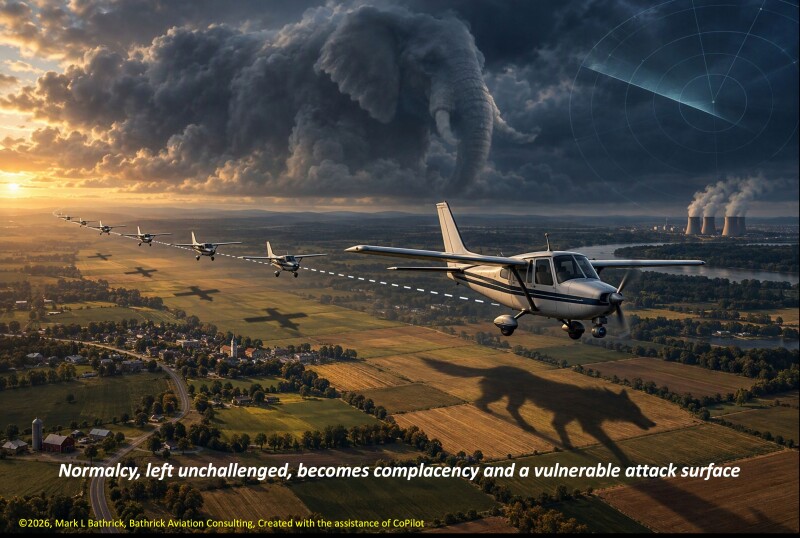
In The Elephant in the Airspace, I described the Class G rule that lets manned VFR aircraft fly without electronic conspicuity as the elephant in the airspace: large, obvious and politely ignored. A red-team view asks what that elephant could hide. Military planners have long understood that the aim of deception is often not invisibility but plausibility. An actor who wants to avoid scrutiny does not need to evade the awareness system. It only needs to look like something the system has already agreed not to question. Routine flights on a familiar pattern build normalcy, and normalcy breeds complacency. If a later flight on that same pattern were made by an aircraft converted to fly remotely or autonomously, nothing it transmitted would signal the change, because it was never required to transmit anything. That is the wolf that has learned to walk like the elephant.
This is an analysis of what the rules permit, not evidence that anyone is planning it. The overwhelming majority of VFR operators are legitimate. That is exactly why the pattern would be hard to see, and why those operators should be treated as partners in closing the gap, not as suspects.
“Aren’t drones the real threat?”
A skeptic will say the real threat is drones, and mostly, I agree. Drones are cheaper, easier to obtain, and harder to attribute. A covert conversion of a manned aircraft would be harder to execute reliably. If I had to rank the likelier tool, I would rank drones first.
But the likelier tool is not the only one that matters, and the rule that lets manned aircraft stay silent weakens the drone fight too. First, it adds self-inflicted uncertainty. Every legal, silent manned aircraft is another track to resolve before a decision-maker can act, and that time can either let a real threat get closer or push a rushed call against the wrong aircraft. Second, a system that identifies drones well but leaves manned aircraft silent shows an adversary which category it is least able to resolve, and it risks teaching its own operators that manned aircraft in this airspace need not be accounted for.
Requiring every aircraft to identify itself would not stop a determined actor, who could switch a device off, spoof it, or ignore the rule, and it may push some threats elsewhere. Its value is different. It lets the law-abiding majority sort themselves out of the problem and turns non-conformance into a first-order signal, so decisionmakers can climb the stack faster and with more confidence.
Closing the blind spot, we approved
The nation is building its low-altitude awareness and defense architecture on top of a blind spot its own rules approve. Across the uncontrolled airspace where the low-altitude economy is taking shape, manned aircraft may legally fly under VFR without a transponder, ADS-B Out, or a flight plan. Nearly all of them are flown by law-abiding pilots. That is exactly what makes the gap hard to see, and because an awareness system cannot flag what the rules treat as normal, it is a security gap that must be closed by design rather than left for detection to solve.
Every silent aircraft without a flight plan is an ambiguity the decision stack must resolve (what it is, who is flying it, and what it intends) with nothing from the aircraft itself to help. That ambiguity is paid for in minutes spent correlating tracks, making calls, and seeking authority while the contact keeps moving. Uncertainty under pressure is how errors happen, whether a real threat gets too close or a lawful aircraft is mistaken for one.
It is also a latent threat vector. A manned aircraft can be converted to fly remotely or autonomously, and under current rules it can fly a familiar route, transmit nothing, and look like everyone else. Because the silence itself is lawful, exploiting the gap requires no visible rule-breaking, only blending in. A weakness that nefarious actors could use in the future is one we should close now, while it is still a design choice and not an after-action finding.
This article has focused on security, but the same elephant carries other costs that deserve their own discussion. Letting it continue to roam freely also has negative safety and economic prosperity implications for the growing commercial and public safety UAS ecosystem, whose operators need to know what else shares their airspace to fly safely and at scale.
The decision
"The future of aviation is unmanned," Dr. Sebastian Gorka, the White House senior director for counterterrorism, told the American Drone Leadership Summit in July, "and it will remember whether the United States chose to lead or react."46
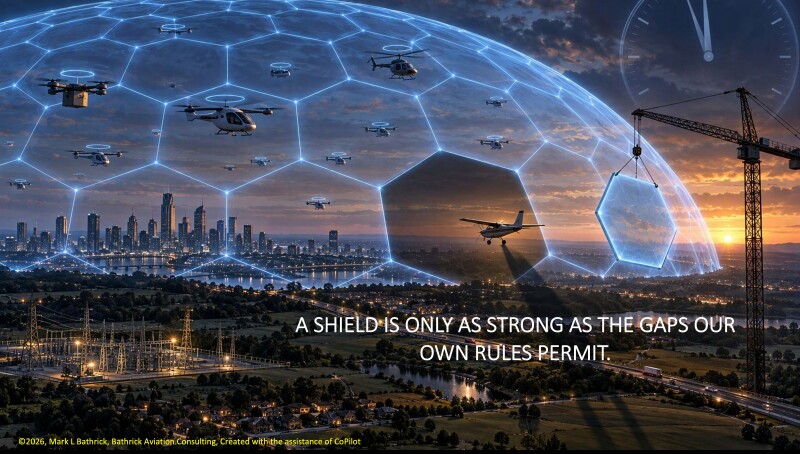
Government leaders face a design choice. They can build the national low-altitude awareness system around the aircraft that are easy to see, and deal with the legally silent ones later. Or they can treat identity as a requirement of the system itself, scoped and phased so that it is achievable.
The security case made here adds urgency to two arguments I have made before: the policy path in Reclaiming the Skies and the architecture in America Has the Pieces. Both turn on the same choice: treating a legally silent aircraft as a gap to close rather than a condition to accept.
The hardest aircraft to defend against may be the one doing everything right. Keeping the rules as they are is not a neutral choice. It is a decision to leave every response to an unidentified aircraft slower, riskier, and harder to defend.









Comments