

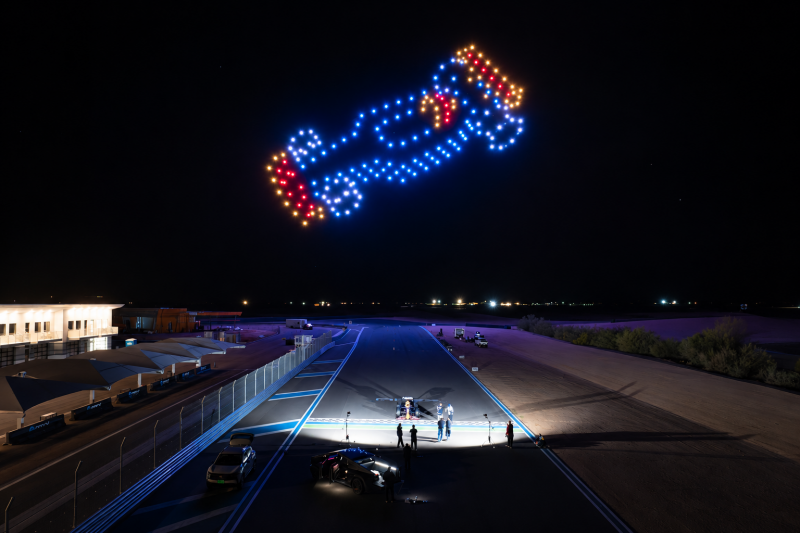
Every Friday night between the end of May and early August, guests at the JW Marriott Desert Ridge resort were treated to a themed light show in the sky above them, with designs matching the resort’s programming for the given time period. The lights were created with 100 coordinated drones and were the payoff of two years of building for Pulse Drone Light Shows. The Arizona-based company was still relatively new to the scene, and their recurring shows – 11 in total – went so well that, after the contract ended, a hotel representative texted to ask whether the drones were flying that Friday. The next Monday, the resort’s marketing director asked Pulse to return, and the company later came back to open the resort’s winter programming with a larger show.
Unlike many in this industry, the founders of Pulse didn’t start with drone experience and look to see where they could apply it professionally. Instead, cousins Zach and Griffin Crown, the CEO and CTO, respectively, came from largely unrelated backgrounds in sales, data analytics, and other tech fields. The closest connection to this field was from Griffin, who worked in VR, and Erik Merkow, the company’s CRO, who had prior experience in the FPV space.
Zach credits the jump into the drone light show business to his uncle, Griffin’s father, who told the pair matter-of-factly, “you guys are doing something with drones.” They looked into possibilities, eventually settling on light shows due to the work’s technical and creative aspects.
“We found that drone light shows were very technical, but also had this artistry to them that was super eye-catching,” Zach said.
Today, the company says it is the only Arizona-based drone show company, with that locality being a large part of their business model. Although they work nationwide, much of their business is right at home in Arizona, allowing travel costs to be cut dramatically. They have five in-house staff as well as a pool of contractors for setup and piloting.
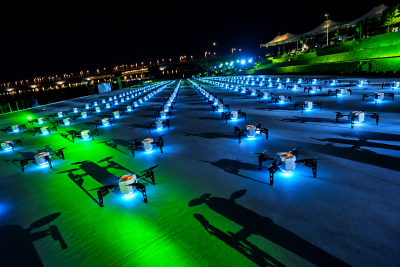
As one can likely imagine given the group’s relative lack of experience within this specific industry, there was a learning curve in the company’s early days on both the technological and regulatory side. Regarding the former, Griffin had a background in CAD and documentation, which provided a nice basis for creating the procedures to make their shows happen. Beyond that, the trio mentioned working closely on training with their manufacturing partner, Uvify. The road to their current processes, Griffin explained, took a long scaling path.
“Our first flight, we brought out two drones and all we were trying to do was make them chase each other for a little bit,” he recalled. “It took us like 12 hours of trying to get it to work until 4:00 in the morning, and then we moved from there. We did 20, and then we did 50, and then we did 100, and then we did 100 with a new, fancy staggered takeoff. You just kind of learn as you go.”
The technology was just one side of the learning curve, though. Those in the aviation industry know that regulatory compliance is always going to be a major learning curve, and there was significant time spent learning about this side of the business. Merkow noted that, prior to joining the company, he had received his Part 107, and his knowledge from the study materials helped in this part of the growth. In fact, it was participating in groups with local Part 107 pilots where he first saw opportunity, noticing a relative lack of sales and marketing experience among drone show companies.
Fast-forward to the present day, and Pulse has a sustainable business model that is split between one-off shows and recurring events, such as the series of shows at the JW Marriott. The recurring model has plenty of advantages for both customers and Pulse, though that repeat business only applies to roughly half of their overall customer base. That said, it depends on the specific customer, with municipalities and local institutions coming back about three-quarters of the time while private, corporate events tend to make up the one-off business. The company prices its shows per drone, with 100 marking the minimum.
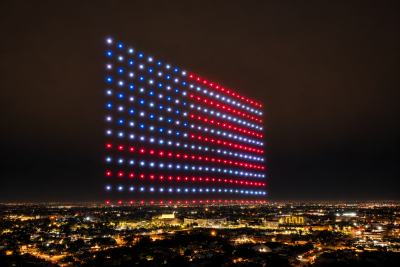
It doesn’t come as much of a surprise that July 4 is the peak time of year for those in this side of the UAS industry, with Merkow describing it as their Super Bowl. This past year was an even bigger example of that demand given the coinciding America250 celebrations across the U.S. Thanks to their network of contractors, Pulse is able to conduct multiple shows on the same night, with up to 10 being possible. And given the move away from fireworks for many areas around the country – the city of Tucson, for example, announced plans to move away from fireworks on July 4 starting in 2027 – that demand is only expected to increase. Pulse, for their part, acknowledge that fireworks and drone shows can also coexist rather than serving as a pure replacement.
Even with the extensive growth pattern, however, there are still challenges ahead for Pulse and the industry as a whole. One of the major potential issues on the horizon for Pulse and many others across the commercial industry is any final decision from the FCC around its proposed “military-grade” ban. Among other things, the Commission wraps swarm-based capabilities up in its “military-grade” definition, an obvious impediment to the drone light show industry. For Pulse’s part, they are constantly communicating with their contacts at Uvify about the potential rule.
More specific to Pulse, there is also the matter of operating in Arizona, particularly in the summer. While battery performance issues are typically more associated with cold weather, the team takes precautions where possible when operating in extreme heat, as local temperatures can get as high as 115 degrees in the heart of the summer. Griffin noted that the company has some summer-specific SOPs, including bringing batteries out for pre-flight, then returning them to air-conditioned environments before getting ready to fly.
And of course, as the entire industry is learning right now as drone delivery proliferation picks up across the U.S., getting the public on your side needs to be a constant point of focus. For Pulse, safety is often the biggest point that needs to be explained to folks. The company has a series of redundancies to ensure that shows can run locally if communications are lost, as well as geofencing, return-to-home capabilities, and manual disarming to guard against any other potential issues.
Looking ahead, Pulse is considering a new potential revenue stream: advertising drone shows. Merkow, who describes the model as being “almost like billboards in the sky,” notes that this application is largely unproven, but they are hoping it can diversify their business model a bit ahead of 2027. Given a start from an uncle’s vague advice of getting into the drone market, Pulse has come quite far in its two years of operating. Now, the next phase of growth will come down partly to proving out an unproven revenue stream and navigating what can only be described as an ever-evolving regulatory environment.









Comments