
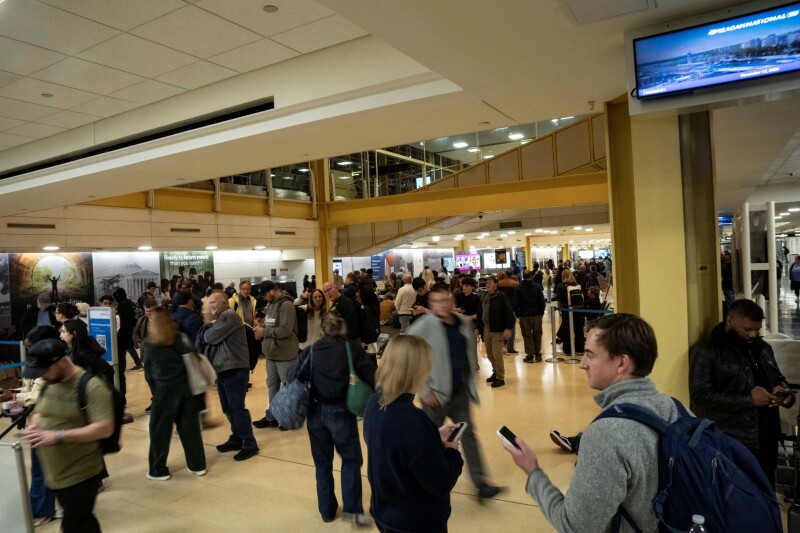
On Friday, November 13, the FAA took the extraordinary step of ordering a nationwide ground stop of all departing planes after telecommunications problems disrupted air traffic control (ATC) facilities across the U.S. For more than four hours, scheduled departing aircraft remained on the ground while the FAA allowed approximately 3,500 aircraft already airborne to reach their destinations safely.
By Sunday, the FAA reported that instability had affected 17 of its 22 Air Route Traffic Control Centers, spreading into several terminal radar facilities. The agency identified excessive network traffic associated with equipment at two locations, Amarillo, Texas, and El Dorado, Arkansas, as possible sources of the disruption. The investigation continues.
For commercial aviation, the consequences were immediate. Thousands of flights were canceled, airlines struggled to reposition aircraft and crews, and passengers faced disruptions that extended into the weekend.
But what about drones? Did the FAA's unprecedented decision affect commercial uncrewed aviation? And, more importantly, what would happen if a similar incident occurred five years from now, when thousands of autonomous aircraft might be operating BVLOS across the country?
Were Commercial Drones Grounded on Friday?
The first question is whether the nationwide ground stop applied to aircraft operating under Part 107.
The FAA's initial announcement referred to a nationwide ground stop at all U.S. airports, following communications failures at multiple ATC centers. That language raises an important distinction between airport departures managed by air traffic control and small uncrewed aircraft operating under Part 107.
.jpg.small.400x400.jpg)
A Part 107 operator flying in Class G airspace generally does not need an ATC clearance. In controlled airspace, however, the operator must obtain the appropriate authorization, frequently through the Low Altitude Authorization and Notification Capability (LAANC).
Consequently, a ground stop directed at conventional aircraft departures does not necessarily prohibit every drone flight in the country. The precise operational effect depends on the restrictions issued and the airspace involved.
The FAA has yet to provide a comprehensive public accounting of the incident's effects on commercial drone operations, and experts and non-experts alike are exploring many theories. Did LAANC continue operating normally? Were existing authorizations honored? Did drone operators working near controlled airports receive additional restrictions? Were emergency drone missions affected?
These questions deserve answers because commercial uncrewed aviation increasingly shares the National Airspace System (NAS) with traditional aircraft.
An interesting operational distinction also exists. A commercial airline relies on ATC throughout much of its flight, while a small drone conducting a visual-line-of-sight inspection in uncontrolled airspace can operate with considerably less dependence on centralized FAA infrastructure.
This difference matters most when examining the future of BVLOS.
Part 108 and the Problem of Infrastructure Dependence
The FAA's proposed Part 108 framework anticipates a future in which routine BVLOS operations become increasingly common. Such operations could include long-distance infrastructure inspections, agricultural applications, package deliveries, mapping missions, and emergency response.
These aircraft will require reliable systems to detect other traffic, maintain communications, manage flight paths, monitor weather and respond to unexpected conditions.
Some of those capabilities will reside onboard the aircraft. Others may depend on ground-based infrastructure, commercial communications networks, third-party surveillance services and digital systems coordinating multiple operators.
Friday's incident provides a practical example of the consequences of shared infrastructure failure.
According to the FAA, excessive data traffic overwhelmed parts of its telecommunications network, destabilizing radar and communications feeds. The agency responded by stopping departures while controllers safely managed aircraft already airborne.
The response demonstrated the value of established contingency procedures. It also exposed the potential consequences of a technical failure spreading through interconnected systems.
For BVLOS operations, the equivalent questions are unavoidable. What happens when a drone loses access to a critical surveillance service? Can the aircraft continue safely if a network providing traffic information becomes unavailable? Who decides whether an operation should continue, return to its launch point, or land at a predetermined location?
And perhaps most importantly, who has the authority and technical capability to suspend thousands of autonomous operations simultaneously?
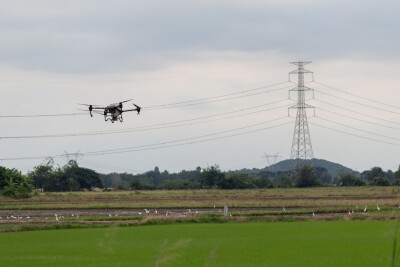
The answers will depend on aircraft capabilities, operating environments, risk assessments, and the eventual requirements of Part 108/Part 146, especially for Automatic Data Service Providers (ADSPs) that will rely heavily on connections to the FAA ATC system.
A nationwide disruption of conventional air traffic control does not necessarily imply a nationwide failure of drone systems. Nevertheless, the incident illustrates why operational independence, redundancy, and contingency planning deserve particular attention as BVLOS operations expand.
Can the FAA Support an Autonomous Future?
There is another dimension to Friday's events.
On November 10, just three days before the ground stop, the FAA announced the nationwide expansion of its Strategic Management of Airspace, Routes and Trajectories (SMART) system, an artificial intelligence-assisted tool intended to improve traffic management across all 22 air route control centers.
The timing immediately generated speculation about whether the new system contributed to the disruption.
On Sunday, November 15, the FAA explicitly denied any connection, explaining that SMART aggregates information but does not feed data into the air traffic control system. Investigators instead identified telecommunications network instability associated with legacy equipment and recent router work.
No established evidence currently links SMART to Friday's outage.
Nevertheless, the incident raises broader questions about integrating new technologies into aging aviation infrastructure. Every technology connected to uncrewed aviation is recent and is considered state-of-the-art for an industry trying to get off the ground. Mixing these two generational realities may be a bigger task than originally anticipated.
The FAA is simultaneously confronting several enormous challenges: modernizing conventional air traffic control, integrating increasingly autonomous aircraft, developing a regulatory framework for routine BVLOS operations, and accommodating the anticipated growth of advanced air mobility. Each initiative introduces new technical requirements and dependencies.
The commercial drone industry has spent years arguing that technological capabilities are advancing faster than the regulations governing their use. Friday's disruption suggests another potential obstacle: the capacity of the underlying national infrastructure to accommodate the next generation of aviation, which is already fully digital.
For drone manufacturers, ADSPs and BVLOS operators, this raises an important strategic consideration. Systems designed to operate independently during temporary failures may have significant operational advantages over architectures that depend continuously on centralized services.
The final Parts 108 and 146 rules will help determine how these capabilities are evaluated and what contingency procedures operators must demonstrate.
Friday's nationwide ground stop lasted only a few hours, but its consequences extended far beyond the airports where aircraft remained parked.
For the uncrewed aviation industry, it offers an opportunity to examine a fundamental assumption about the future of flight: as more aircraft become autonomous, how resilient must the infrastructure supporting them become? The answer may determine how quickly commercial BVLOS operations can scale safely across the United States.
The most concerning aspect of the November 13 grounding event for our industry is how willing and open the FAA is to issue Parts 108 and 146 when the reality of current operations under technology that was developed in the 1950s allows drones, eVTOLs, and traditional aircraft to coexist in the NAS while maintaining the excellent operational safety record of the last 15 years.
For an industry that is so heavily dependent on the release of one specific regulation, the event of this past Friday is a sign that the FAA might not be ready to allow BVLOS flights anytime soon, and that might affect how we move forward in the next few months and perhaps years.












Comments