

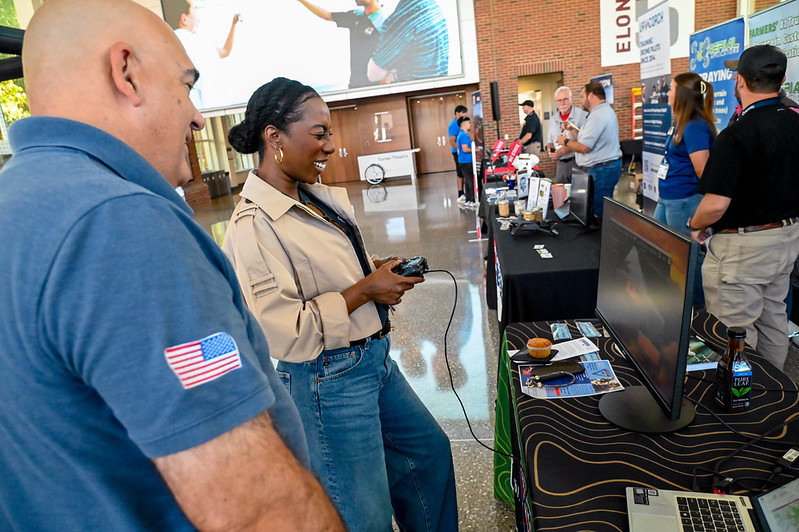
Regional drone events are important complements to the big national and international shows. They connect operators, service providers, and the emerging workforce together in a way that otherwise would not be possible. One great example of these connections happens at Elon Drone Day. This event is a free, educational event that serves as a public information hub for the drone industry. It draws working pilots’ educators, and curious beginners to learn about new advancements in the industry and make valuable connections with leaders in the industry.
Put on by Elon University’s School of Communications and held on campus, this annual event featured a keynote presentation on the relationship between AI and preflight checklists, and sessions with topics ranging from agriculture advancements to mapping for disaster response. Outside conference sessions, vendors from the drone delivery, education, public safety, and regulatory bodies shared their knowledge with attendees.
To learn more about this event, Commercial UAV News caught up with Randy Piland, Teaching Professor of Visual Communication at Elon, and event organizer, to learn more about the event.
Despite the event being held by the university, the attendance demographic has fewer students and more local drone service providers. This year’s event brought in 167 registrants, and their experience levels speak volumes about how important these kinds of events are. Piland explained that 78 attendees are Part 107 pilots, 39 were recreational pilots, and 50 had no drone experience whatsoever.
“Thirty-five of those registered were from the North Carolina Department of Transportation. They’re engineers. They do surveying and engineering in the field on roads and bridges in the state. They’re our biggest audience, and they keep coming back. I’ve had a few people that have been to every single event,” said Piland.
Elon University has two drone specific courses called Drones & Society: Innovation and Accountability, which teaches students the moral outlines of drone use and public acceptance. The other is called Drones 101: Takeoff to Career Paths, designed to show students how drones are shaping different career fields such as media and emergency response. So, for a school that isn’t necessarily teaching the next generation of pilots, why host a drone event?
“Being in the School of Communications, our purpose is to communicate to those that want to learn more about drones and drone technology and the industry as a whole,” Piland explained. “We felt like we could be a hub for disseminating information about drones and safe practice of drones, and what changes are coming up.”
The program reflects that mission. This year’s keynote came from Dr. Bhattachara of Fayetteville State University, a researcher who has led work on artificial intelligence in the drone space. The topic fit Elon’s university-wide push to bring AI into education.
Other sessions kept that conversation going. A North Carolina A&T graduate student showed how to do drone mapping with low-cost, open-source tools. An agriculture panel built on a single farmer’s talk from the previous year, covering spraying, seeding, and how multispectral imaging can show farmers where to expect yield and where soil is short on nutrients. A talk on invasive species rounded out the lineup, along with an industry update on how Aloft and other platforms are connecting to drones.
“One kind of led to interest to the next and the next,” Piland said. “They all kind of merged together pretty well.”
The vendor floor follows the same philosophy. Piland stressed the event is purely educational, and the exhibitors reflect that. The FAA staffed a table to answer questions about regulations, and the North Carolina Department of Transportation brought its command center van, loaded with technology and several drones. Asheboro City Schools, a regional winner in the U.S. Drone
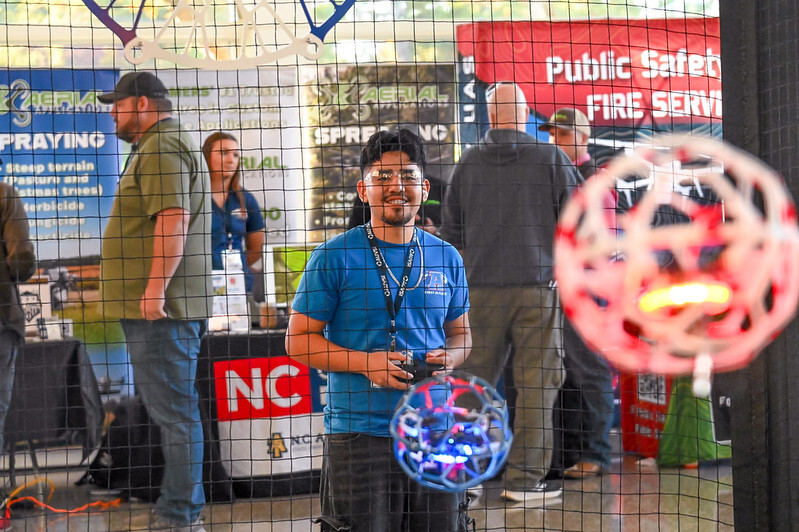
Soccer League, ran a demo that Piland said drew a crowd. Will Stair, a local builder who 3D prints his own drones, showed a test board that checks every component of a drone when it’s plugged in.
“The buzz in that room when they have their demo is really exciting,” Piland said. “It always draws people to it.”
Training providers also participated. UAV Coach and Pilot Institute offered Part 107 training courses as door prizes, and NC State gave away Trusted Operator Level 1 and Level 2 training certificates.
The Takeaway
Drone Day has no sales targets and no formal drone program behind it. What it offers is a place for regulators, operators, educators, and newcomers to meet at the same time. Piland says the event has also shaped Elon itself. People now associate the university with drones, and that has pushed it to offer more.
“Out of these drone days, it just made me think that we have to offer something at some point,” he said. “Because we’re getting tagged as, ‘They have this big drone event over at Elon.’”
For an industry that changes as fast as drones do, that kind of regional gathering may be where many people first find their way in.




Comments