


The Gap Between Diagnosis and Action
My August article, America’s Low-Altitude Awareness Gap: The Path to Safer, More Secure, and More Prosperous Skies,1 described a nation entering the low-altitude economy without the air domain awareness (ADA) needed to govern it: reliable knowledge of aircraft, operators, and risk. It established the need and proposed a framework. This article addresses implementation: What do we do about it, and how do we build it?
Drone delivery companies target one million daily operations by 2029.2 3 BVLOS operations are moving toward routine adoption, and C-UAS capabilities are expanding across military installations, public venues, and critical infrastructure. The governance, infrastructure, and shared awareness needed to connect them remain incomplete.
The central challenge is clear: How can the United States efficiently, effectively, lawfully, affordably, and sustainably close its low-altitude air domain awareness gap?
The practical challenge is to connect proven capabilities without creating new silos. The Collaborative Low-Altitude UAS Integration Effort (CLUE), developed by the Air Force Research Laboratory (AFRL), demonstrated in live air traffic control, and advancing toward Department of War (DoW) deployment, offers a government-tier starting point.4 Integration must address legal, regulatory, policy, contractual, proprietary, cultural, governance, cybersecurity, workforce, affordability, and sustainment barriers. Civil operators need useful awareness and workable participation without protected-data exposure or disproportionate costs. Governance must lead engineering, not follow it.
The Executive Order and What Has—and Has Not—Changed
President Trump's June 6, 2025, Executive Order 14305, "Restoring American Airspace Sovereignty," established the Federal Task Force to Restore American Airspace Sovereignty, chaired by the Assistant to the President for National Security Affairs (APNSA).5 It directed FAA action on Section 2209 critical-infrastructure drone restrictions, stronger civil and criminal enforcement by the Attorney General, and Task Force review of operational, technical, and regulatory UAS frameworks.
On May 6, 2026, nearly a decade after Congress mandated action, the FAA published a 181-page NPRM proposing 14 C.F.R. Part 74: a petition process for permanent Unmanned Aircraft Flight Restrictions (UAFRs) over critical infrastructure, with Standard and Special designations.6 That is regulatory progress, not a final rule or fielded awareness capability. The evidence here does not establish that broader Task Force work has produced a persistent, interoperable national ADA architecture.
The order's intent is sound. Sovereignty requires persistent, layered, governed awareness not a rule, task force, or event operation alone. That architecture does not yet exist nationally.
The border tests the distinction between restricting airspace and governing it. On October 16, 2026, DOT, DoW, and DHS announced drone restrictions one nautical mile north of the U.S.–Mexico border, from the surface to 400 feet above ground level.7 CBP authorization requests require at least 48 hours’ notice. October 19, 2026, reporting described AUVSI’s questions about surveys, infrastructure inspections, agriculture, and newsgathering, alongside calls for predictable approvals and consistent planning information.8 Necessary security restrictions still need workable authorization, shared awareness, and accountable coordination for legitimate operations to coexist.9
Event Security Is Not a National Capability
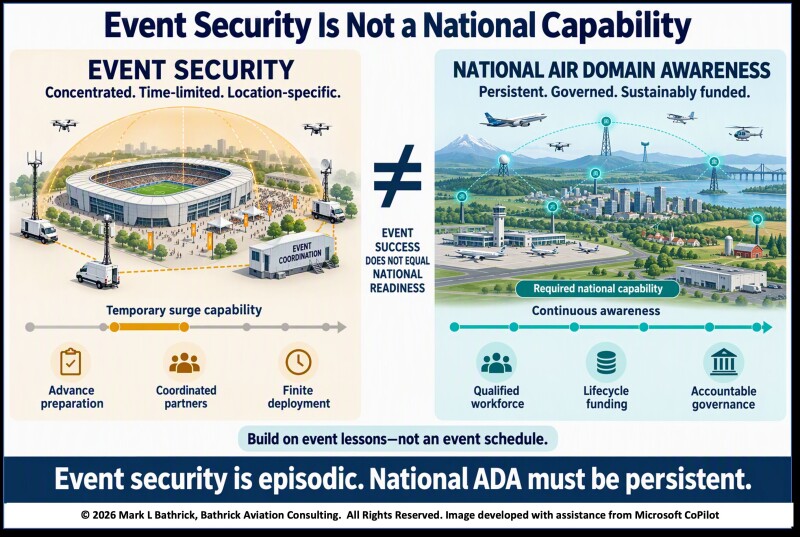
World Cup 2026 partners seized more than 700 unauthorized drones across stadiums and fan zones in what the Transportation Secretary described as the most comprehensive U.S. airspace-security and drone-mitigation effort.10 FAA, Department of Homeland Security (DHS), FBI, and Justice coordinated temporary flight restrictions (TFRs) extending three nautical miles around venues to 3,000 feet above ground level, supported by C-UAS capabilities, grants, training, and over a year of joint preparation.11
That achievement relied on concentrated federal capabilities, defined geography and timing, and extensive planning. Afterward, many assets were withdrawn, leaving local governments and law enforcement to do without or consider acquiring systems that may exceed their operating, maintenance, staffing, training, and lifecycle budgets. Event security is episodic; national ADA must be persistent. A surge capability is not a sustainable national solution.
The Continuing Evidence: What Unexplained Sightings Reveal
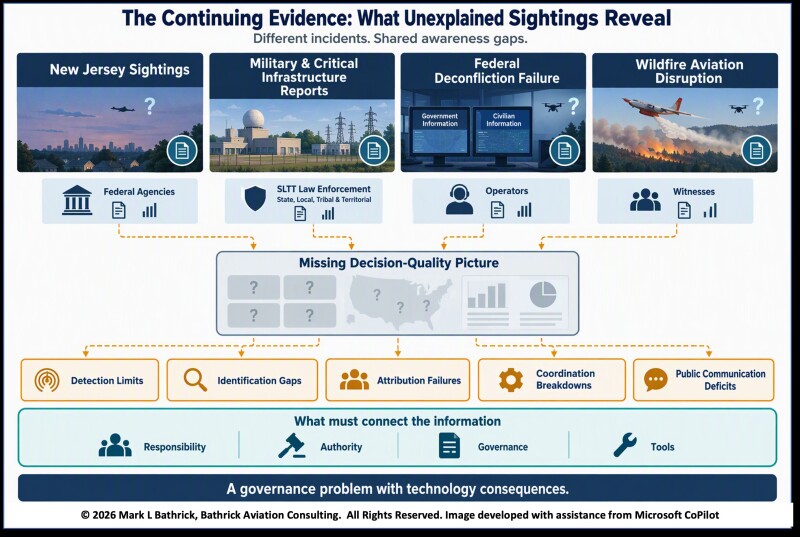
New Jersey’s late-2024 sightings generated over 5,000 reports. Federal agencies assessed a mixture of lawful drones, aircraft, helicopters, and misidentified stars—not timely identification of every contact.12 The All-domain Anomaly Resolution Office’s (AARO) FY 2025 report recorded 50 notifications of drone activity near U.S. nuclear infrastructure, weapons, and launch sites, compared with 18 in the FY 2024 report, a 177.8 percent increase that underscores the need to distinguish recognition of a drone from knowledge of its operator, authorization, and intent.13 At Fort Hancock, failed federal deconfliction led a DoW system to engage a CBP drone;14 in Los Angeles, an unauthorized drone’s collision with an aerial firefighting aircraft disrupted wildfire response.15
These cases expose detection, identification, attribution, coordination, and public-communication gaps. Connecting information held by federal agencies, state, local, tribal, and territorial (SLTT) law enforcement, operators, and witnesses requires aligned responsibility, authority, governance, and tools. What can an existing integrated capability contribute and where do its limits begin?
CLUE: Proven, Bounded, But Not Yet National
My work on operators, C-UAS rules of engagement,16 and systems-of-systems architecture17 points to one design challenge: civil and DoW awareness requirements are intertwined, but connecting them must not improperly merge authorities, missions, or sensitive data.
CLUE development began at AFRL’s Information Directorate in 2016, followed by MacDill Air Force Base testing in 2022 and Defense Innovation Unit/Pentagon acquisition demonstrations.18 It fuses radar, C-UAS, and other sensor data for air traffic controllers, security forces, and UAS operators. DoW’s approximately 20 percent share of U.S. air traffic control (ATC) services gives it relevance beyond installations. Live ATC assessment establishes operational relevance, not a complete national tier.
Demonstrated deconfliction, sensor fusion, and civil-military sharing do not resolve every national requirement. These include confidence scoring, detection of non-participating aircraft lawfully lacking electronic identification, formal cross-tier release authority, and governance for lawful, sustainable public and commercial contributions to a common operating picture (COP). Deployment must also prevent proprietary agency and industry sub-tiers from fragmenting that picture.
The 9/11 Commission Warning the Low-Altitude Domain Cannot Afford to Ignore
The 9/11 Commission Report identified the structural failure that allowed the September 11, 2001, attacks to succeed despite the presence of relevant information across government: "We learned of fault lines within our government, between foreign and domestic intelligence, and between and within agencies. We learned of the pervasive problems of managing and sharing information across a large and unwieldy government."19 The Commission's recommended remedy was equally clear: "unifying the many participants in the counterterrorism effort and their knowledge in a network-based information-sharing system that transcends traditional governmental boundaries."20
Today’s threats and technologies differ from the pre-9/11 environment. Security capabilities not widely available twenty-five years ago include zero trust, continuous verification, role-based and attribute based access controls (RBAC, ABAC), encryption, provenance tracking, audit logging, and segmented release. Malicious actors remain a small minority and generally outside trusted systems; verification must not treat legitimate operators as adversaries. Public trust, privacy, accountability, and bounded authorities are operational requirements.
FAA, DoW, DHS, FBI, original equipment manufacturers (OEMs), air navigation service providers (ANSPs), delivery operators, Remote ID networks, and sensor providers hold pieces of the picture. No entity combines the responsibility, authority, governance, and tools to assemble them nationally in real time. Proprietary telemetry, sensitive agency feeds, and commercially retained traffic data risk perpetuating “need-to-know” fragmentation instead of the “need-to-share” culture advocated by the 9/11 Commission.21
Disconnected federal tiers recreate the Commission’s fault lines; proprietary industry sub-tiers impede unified confidence scoring and real-time hazard detection. The governing principle: one federal tier, one industry contribution layer, no hidden sub-tiers, and a fused national picture calibrated to each user’s authority and need. This is a lesson already learned at considerable cost.
The Two-Tier Architecture: One Picture, Not Indiscriminate Access
A lawful, scalable national ADA architecture requires two tiers connected through governed exchange.
Tier 1 is an unclassified, privacy-preserving civil ADA common operating picture aligned with safety, public-safety, and commercial needs. It receives authorized telemetry, derived hazard products, and minimum-necessary situational data from civil and commercial sources, including Remote ID (RID) broadcasts, flight-intent declarations, and commercial sensor observations. It does not receive raw C-UAS feeds, restricted CLUE code, classified intelligence, or other sensitive government data.
Tier 2 is a controlled, mission-limited government ADA and C-UAS COP operating under applicable statutory authorities. It integrates CLUE, C-UAS sensor feeds, law-enforcement awareness, and intelligence-derived products. It does not share raw feeds, sensitive telemetry, protected algorithms, or intelligence sources and methods across the tier boundary without formal release authority.
Release authority, provenance, auditing, revocation, fail-closed enforcement, zero-trust access, and role-based and attribute-based controls underpin lawful, accountable, resilient exchange. "One picture" means interoperable awareness, not universal raw-data access. Every crossing must be authorized, attributed, logged, and revocable. Governance must precede deployment and scaling, or expansion will reinforce fragmentation rather than eliminate it.
This architecture bridges the safety and awareness objectives explored in electronic conspicuity and BVLOS coordination,22 the security and sovereignty challenges examined in C-UAS rules of engagement,23 and the cross-domain digital infrastructure requirements of the low-altitude economy.24
Five Potential Strategies: A Portfolio of Options, Not a Predetermined Winner
Five complementary strategies address different integration functions; none is sufficient alone. They work bidirectionally: approved CLUE-related capabilities benefit civil users, while authorized public and commercial data contribute under their legal, regulatory, proprietary, and contractual constraints. The national system is a governed ecosystem, not simply CLUE expanded outward.
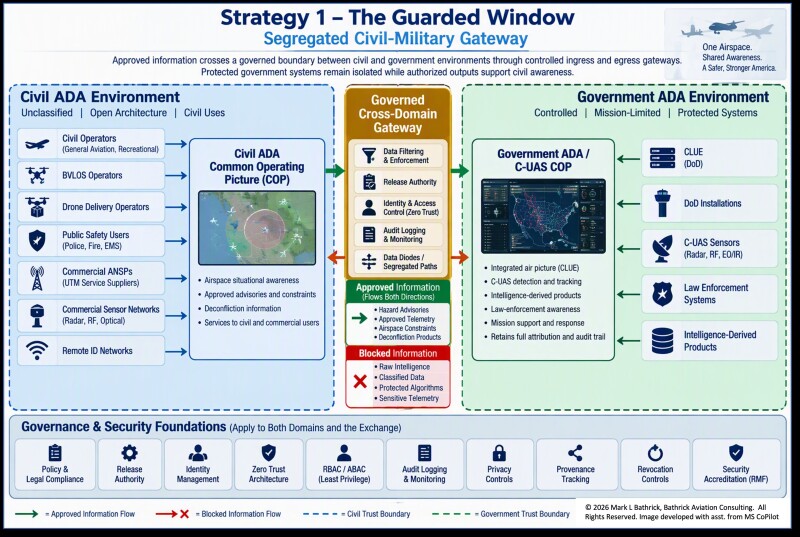
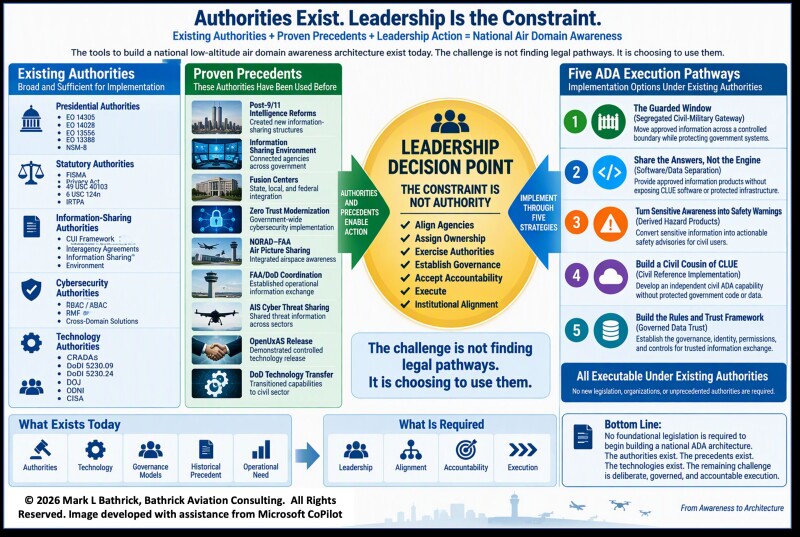
Strategy 1 — The Guarded Window (Segregated Civil-Military Gateway). Separately controlled pathways exchange approved civil inputs and government-derived products while keeping CLUE and protected government systems intact. Civil participants include operators, public-safety users, service providers, and commercial sensor and Remote ID networks; government sources include CLUE, installation systems, C-UAS sensors, law enforcement, and intelligence-derived products. Release, filtering, and auditing summarize controls supported by identity, access restrictions, privacy, provenance, revocation, and security safeguards. Approved telemetry, advisories, constraints, and deconfliction products may cross; raw intelligence, classified data, protected algorithms, and unreleased sensitive telemetry remain protected. The approach supports controlled integration but requires substantial cross-domain engineering, accreditation, governance, and sustainment.
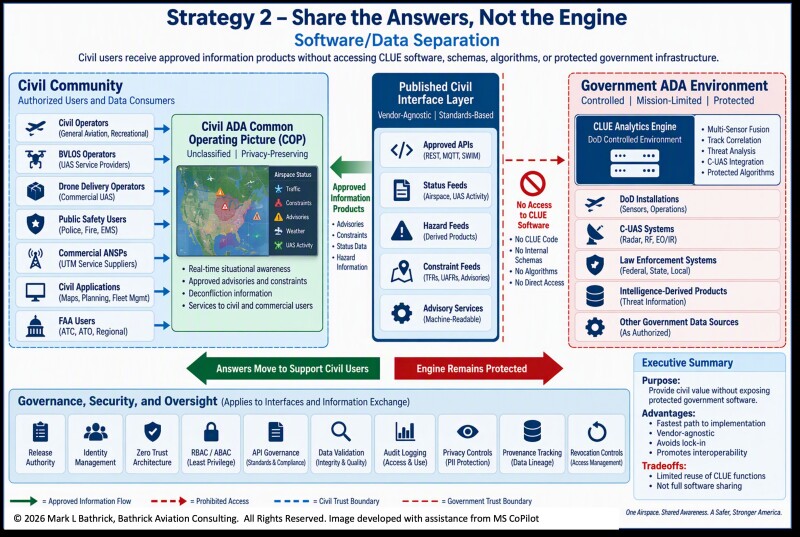
Strategy 2 — Share the Answers, Not the Engine (Software/Data Separation). Vendor-agnostic civil interfaces provide approved telemetry, status, constraints, and advisories to operators, public-safety users, service providers, and civil applications. CLUE code, internal schemas, algorithms, and technical documentation remain protected. Release authority, identity and access controls, validation, auditing, privacy, and security govern the exchange. The approach supports interoperability and reduces vendor lock-in but does not provide full reusable CLUE functionality.
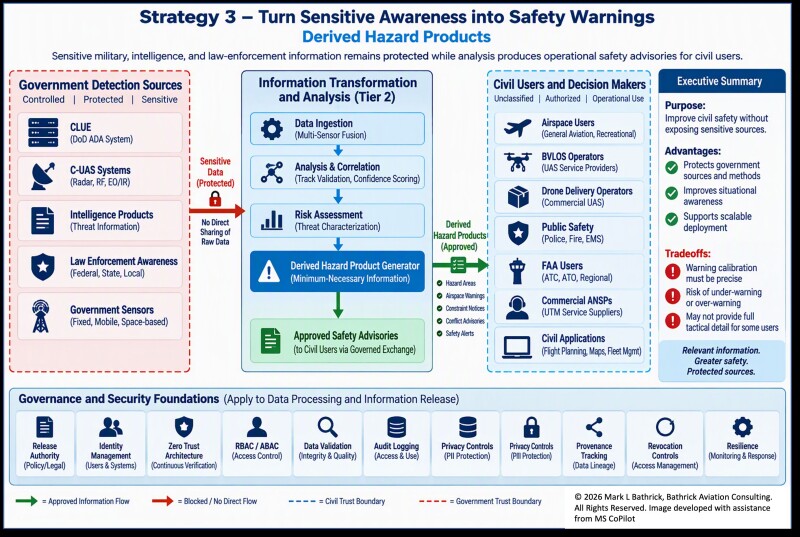
Strategy 3 — Turn Sensitive Awareness into Safety Warnings (Derived Hazard Products). Protected military, intelligence, law-enforcement, and C-UAS information remains in Tier 2 while analysis produces minimum-necessary hazard areas, constraints, and safety advisories for authorized civil users. Validation and formal release controls govern what crosses the boundary; sensitive raw data and sources remain protected. The approach can improve civil awareness without exposing the underlying information, but warnings must be calibrated to avoid under-warning, excessive restrictions, or misleading generalization. It is a complementary integration mechanism, not a complete national awareness system.
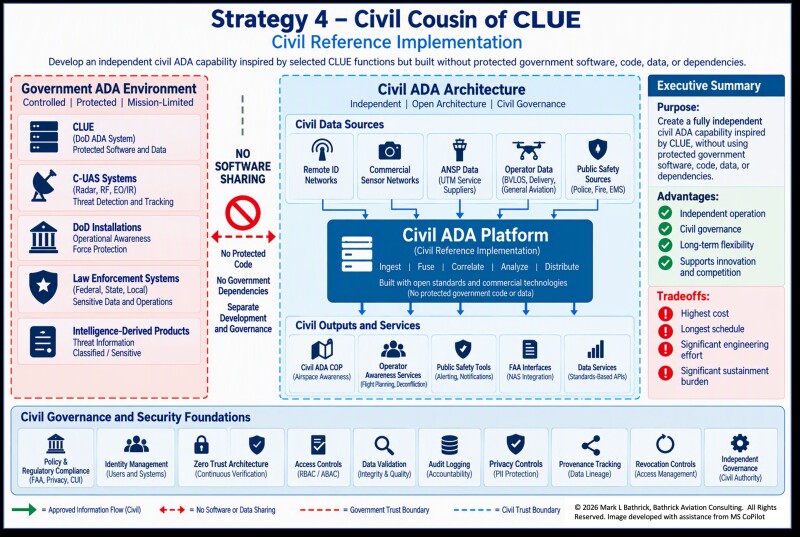
Strategy 4 — Build a Civil Cousin of CLUE (Civil Reference Implementation). Authorized civil sources, including Remote ID, commercial sensors, ANSP data, operator records, and public-safety information—support a separately developed civil platform and common operating picture (COP). Selected CLUE-like functions are independently implemented without restricted government code, protected data, or dependencies. This separation does not prohibit appropriately authorized information exchange through complementary strategies. The option offers independent civil capability, but requires evaluation of software rights, engineering, cybersecurity, funding, schedule, and lifecycle sustainment.
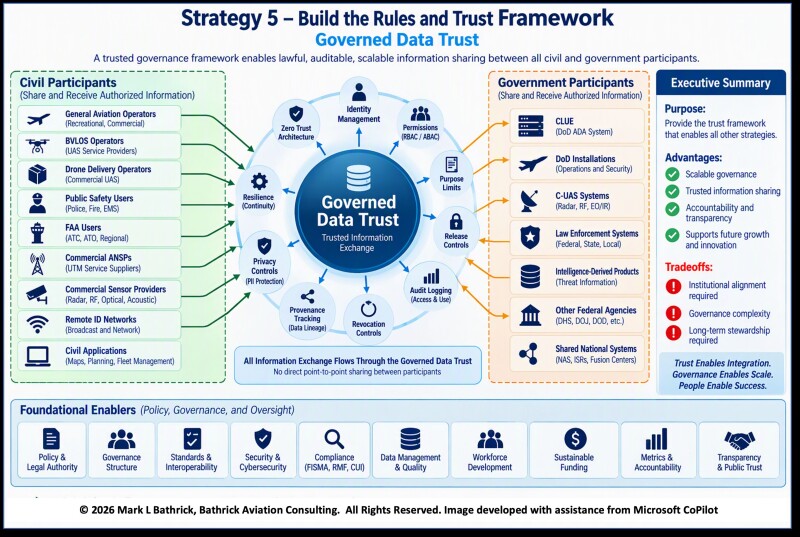
Strategy 5 — Build the Rules and Trust Framework (Governed Data Trust). A common governance framework controls authorized exchange between civil and government participants through multiple policy-enforced interfaces. Identity, permissions, purpose limits, release decisions, auditing, and revocation govern access without requiring a single database or centralized repository. Privacy, provenance, zero trust, resilience, and fail-closed protections support accountable operation; protected government information remains subject to applicable release restrictions. The framework enables the other strategies but does not itself provide sensing, fusion, or operational decision support. Its implementation requires institutional alignment, sustained stewardship, and lifecycle support.
These strategies are not mutually exclusive and should be assessed as a portfolio against legal authority, operational value, security, privacy, interoperability, affordability, scalability, sustainment, and public trust.
Making the Architecture Tangible
On a weekday afternoon near a mid-sized city’s water treatment facility, an ambiguous track appears. A Remote ID broadcast matches no registered flight plan; CLUE at a DoW installation twenty miles away shows a corresponding track. Police receive a citizen report, while a delivery operator records a flight thirty minutes overdue.
Today those clues remain in separate commercial, DoW, dispatch, and proprietary systems, with no owner assembling the picture. Delayed coordination can leave the aircraft gone, identification opportunities lost and reports unreconciled.
Governed exchange sends approved telemetry and derived hazards through an audited Tier 2–Tier 1 pathway. Civil users and public safety receive confidence-scored advice; the delivery operator gets warnings, not underlying C-UAS data. Police can coordinate within their authority. The DoW track remains protected with attribution and auditability. No protected raw data crosses; the decision trail remains accountable and traceable.
That is the difference between awareness and architecture.
Scaling Path: Gates Before Growth
A national scaling pathway, approximately 140 DoW installations in Phase 1, 100 major civil airports in Phase 2, and 400 remaining towered fields in Phase 3—is a potential planning concept that must be validated through evidence and governance before becoming a program of record. Each phase must satisfy readiness criteria: verified legal authority, system accreditation, adequate sensor coverage, demonstrated interoperability, release-authority mechanisms, a qualified workforce, sustainable lifecycle funding, and demonstrated public value. Deployment volume alone is not success. Governance must lead every stage.
Affordability, Sovereignty, and the Toll-Road Trap
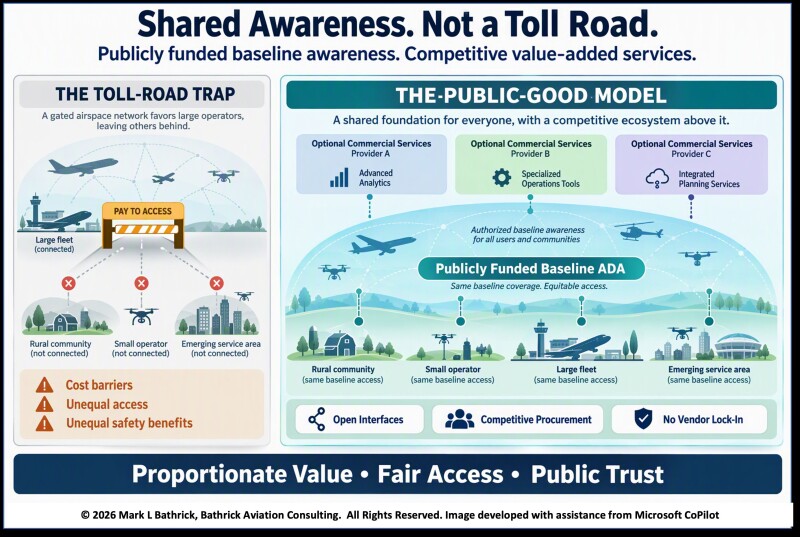
National ADA must not become a toll road for large operators alone. Excluding smaller operators, rural communities, or emerging service areas would concentrate economic benefits and distribute safety risks inequitably. Fund baseline awareness as a public good; distinguish it from commercial value-added services. Procurement must prevent vendor lock-in and preserve domestic industrial competition.
My Part 108/Part 146 compliance analysis25 connects disproportionate costs to eroded public trust.26 The architecture must earn its place operationally and commercially, not simply be imposed.
Border-access uncertainty shows that barriers include approval criteria and response times, not just fees.27 Clear, proportionate access procedures must accompany affordable awareness, or a formal authorization pathway may still exclude lawful users.
Authorities Exist. Leadership Is the Constraint.
In most cases, new authorities are not required to begin.
Presidential directives, statutes, acquisition authorities, privacy frameworks, and Department of War release and accreditation processes provide pathways. Executive Order 14305 established the Task Force’s operational, technical, and regulatory mandate.28 Controlled Unclassified Information (CUI) rules govern safeguarding and dissemination, not independent disclosure permission. Zero trust, identity and access controls, cross-domain solutions, release decisions, privacy reviews, system authorizations, and interagency agreements implement secure exchange. Each still requires a documented legal and operational basis.
Post-9/11 reforms, the Information Sharing Environment, fusion centers, cybersecurity modernization, cross-domain architectures, and whole-of-government UAS security efforts demonstrate institutional barriers can be addressed through clear leadership priorities and accountability.
Existing authorities largely permit evaluation and pilots; authorization and scaling still require legal, release, accreditation, and funding decisions. The Federal Task Force to Restore American Airspace Sovereignty should exercise its coordinating mandate³ by naming implementation owners, readiness gates, funding responsibilities, and public reporting requirements. Participating agencies retain their statutory missions and decision authority.
The harder obstacle is institutional, not statutory. Federal and SLTT leaders must align architecture, exercise release authority, and establish privacy, cybersecurity, and public-trust safeguards before fragmentation hardens, resolving issues within existing powers and identifying additional permission or funding needs.
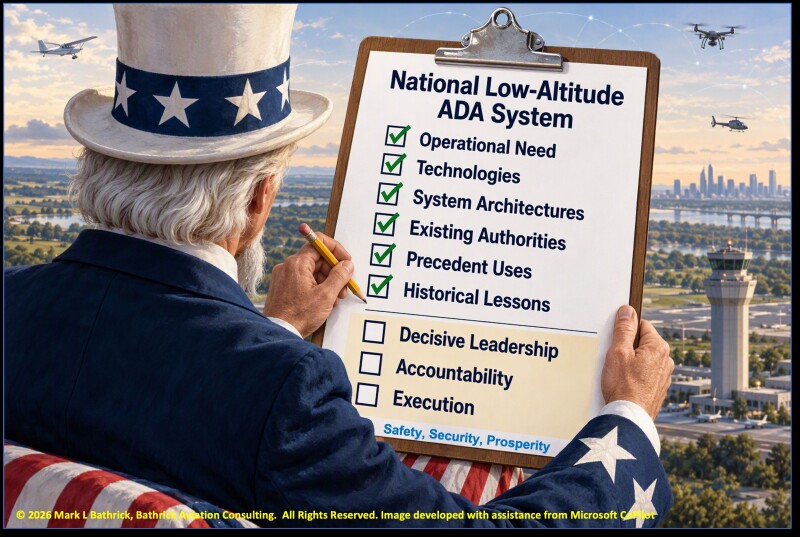
After a decade of emphasizing what government cannot do, the question is what it can do now: align available authorities, technologies, and operational need behind one national objective.
The low-altitude awareness gap is no longer primarily a problem of invention. It is a problem of execution.
One Airspace. Shared Awareness. Governed Trust.
Commercial and public-safety operations are scaling; threats are evolving. Neither urgency nor speed substitutes for architecture and governance.
The 9/11 lesson is institutional—not an equivalence of threats. Responsibility, authority, and tools must turn information into decisions, with governance advancing alongside deployment.
Build on CLUE’s demonstrated capabilities, emerging governance, Executive Order 14305’s regulatory progress, and World Cup coordination lessons, not a blank sheet. Governed two-tier exchange, release authority, public trust, accountable leaders, measurable outcomes, and public reporting must turn those pieces into persistent national capability.
This domain will be governed. The only question is whether it will be governed with foresight or retrospect.
References
1 - Mark L. Bathrick, "America's Low-Altitude Awareness Gap: The Path to Safer, More Secure, and More Prosperous Skies," Commercial UAV News, August 25, 2026, https://www.commercialuavnews.com/air-domain-awareness-low-altitude-blind-spot.
2 - Uber Technologies, Inc., “Uber and Zipline Partner to Bring Drone Delivery to Millions of Americans,” August 17, 2026, https://investor.uber.com/news-events/news/press-release-details/2026/Uber-and-Zipline-Partner-to-Bring-Drone-Delivery-to-Millions-of-Americans/default.aspx.
3 - Miriam McNabb, “Uber and Zipline Target One Million Drone Deliveries a Day by 2029,” DRONELIFE, August 17, 2026, https://dronelife.com/2026/08/17/uber-and-zipline-target-one-million-drone-deliveries-a-day-by-2029/.
4 - Courtney Albon, “Pentagon Trials Drone-Spotting Air Traffic Suite at US Bases Worldwide,” Defense News, July 9, 2025, https://www.defensenews.com/unmanned/2025/07/09/pentagon-trials-drone-spotting-air-traffic-suite-at-us-bases-worldwide/. Air Force Research Laboratory, “AMC, AFRL Pioneer UAS Traffic Management System at MacDill Air Force Base,” July 15, 2024, https://www.afrl.af.mil/News/Article-Display/Article/3838213/amc-afrl-pioneer-uas-traffic-management-system-at-macdill-air-force-base/
5 - Executive Order 14305, "Restoring American Airspace Sovereignty," June 6, 2025, The White House, https://www.whitehouse.gov/presidential-actions/2025/06/restoring-american-airspace-sovereignty/. Published in the Federal Register, Vol. 90, No. 111, June 11, 2025, pp. 24719–24721.
6 - Inside Unmanned Systems, "FAA Releases Section 2209 NPRM, Two-Tier Framework for Drone Restrictions Around Critical Infrastructure," May 7, 2026, https://insideunmannedsystems.com/faa-releases-section-2209-nprm-two-tier-framework-drone-restrictions-critical-infrastructure/; Federal Aviation Administration, Notice of Proposed Rulemaking, "Unmanned Aircraft Flight Restrictions," Docket No. FAA-2026-4558, RIN 2120-AL33, 91 Fed. Reg. 24650 (May 6, 2026), https://www.federalregister.gov/documents/2026/05/06/2026-08943.
7 - Federal Aviation Administration, “DOT, DoW, DHS Join Forces to Protect Southern Border Airspace,” October 16, 2026, https://www.faa.gov/newsroom/dot-dow-dhs-join-forces-protect-southern-border-airspace.
8 - Miriam McNabb, “Federal Agencies Announce New Drone Flight Restrictions Along U.S.-Mexico Border,” DRONELIFE, October 16, 2026, https://dronelife.com/2026/10/16/drone-flight-restrictions-us-mexico-border/.
9 - Federal Aviation Administration, “DOT, DoW, DHS Join Forces to Protect Southern Border Airspace,” October 16, 2026; FAA, Domestic Notice, dom26047_gen, southern-border UAS authorization procedures; Jim Magill, “New Border Drone Restrictions Raise Questions for Commercial Operators,” DRONELIFE, October 19, 2026: https://dronelife.com/2026/10/19/border-drone-restrictions-commercial-operators/. FAA announcement: Southern-border airspace announcement: https://www.faa.gov/newsroom/dot-dow-dhs-join-forces-protect-southern-border-airspace.
10 - Federal Aviation Administration, "Successful Counter-Drone Efforts Helped Keep Millions of Fans Safe During FIFA World Cup 2026, With More Than 700 Drones Seized," July 22, 2026, https://www.faa.gov/newsroom/successful-counter-drone-efforts-world-cup-2026.
11 - Federal Aviation Administration, "FAA Establishes 'No Drone Zones' for FIFA World Cup 2026 Stadiums, Fan Events and Base Camps," May 28, 2026, https://www.faa.gov/newsroom/faa-establishes-no-drone-zones-fifa-world-cup-2026-stadiums-fan-events-base-camps.
12 - DHS, FBI, FAA & DoD, “Joint Statement on Ongoing Response to Reported Drone Sightings,” Dec. 17, 2024, reporting more than 5,000 tips, approximately 100 leads, deployment of advanced detection technology and visual observers, and an assessment that sightings included lawful drones, manned aircraft, helicopters, and stars, https://www.faa.gov/newsroom/dhs-fbi-faa-dod-joint-statement-ongoing-response-reported-drone-sightings.
13 - New Space Economy, “What Does the FY 2025 AARO UAP Report Reveal About Unidentified Anomalous Phenomena?” July 21, 2026, https://newspaceeconomy.ca/2026/07/21/what-does-the-fy-2025-aaro-uap-report-reveal-about-unidentified-anomalous-phenomena/.
14 - Drew F. Lawrence, "Troops downed Customs and Border Protection drone in Texas after agency didn't coordinate flight with military task force," DefenseScoop, February 27, 2026, https://defensescoop.com/2026/02/27/military-shoots-down-cbp-drone-near-southern-border/.
15 - U.S. Dept. of Justice, U.S. Attorney’s Office, Central District of California, “Culver City Man Agrees to Plead Guilty to Recklessly Crashing Drone into Super Scooper Firefighting Aircraft During Palisades Fire,” Jan. 31, 2025, https://www.justice.gov/usao-cdca/pr/culver-city-man-agrees-plead-guilty-recklessly-crashing-drone-super-scooper.
16 - Mark L. Bathrick, "Drone Defense at Home: Closing the CUAS Rules of Engagement (ROE) Gap," Commercial UAV News, November 25, 2025, https://www.commercialuavnews.com/drone-defense-at-home-closing-the-cuas-rules-of-engagement-roe-gap.
17 - Mark L. Bathrick, "Beyond the Box: How C-UAS Companies Can Win in the Era of the 'System of Systems,'" Commercial UAV News, December 22, 2025, https://www.commercialuavnews.com/beyond-the-box-how-c-uas-companies-can-win-in-the-era-of-the-system-of-systems.
18 - Courtney Albon, “Pentagon Trials Drone-Spotting Air Traffic Suite at US Bases Worldwide,” Defense News, July 9, 2025, https://www.defensenews.com/unmanned/2025/07/09/pentagon-trials-drone-spotting-air-traffic-suite-at-us-bases-worldwide/. Air Force Research Laboratory, “AMC, AFRL Pioneer UAS Traffic Management System at MacDill Air Force Base,” July 15, 2024, https://www.afrl.af.mil/News/Article-Display/Article/3838213/amc-afrl-pioneer-uas-traffic-management-system-at-macdill-air-force-base/
19 - National Commission on Terrorist Attacks Upon the United States, The 9/11 Commission Report: Final Report of the National Commission on Terrorist Attacks Upon the United States, July 22, 2004, p. xvi, https://www.9-11commission.gov/report/911Report.pdf.
20 -National Commission on Terrorist Attacks Upon the United States, The 9/11 Commission Report, p. 416, https://www.9-11commission.gov/report/911Report.pdf.
21 - National Commission on Terrorist Attacks Upon the United States, The 9/11 Commission Report, p. 417, https://www.9-11commission.gov/report/911Report.pdf.
22 - Mark L. Bathrick, "Reclaiming the Skies: Accelerating Universal Electronic Conspicuity for America's Low-Altitude Aviation Safety, Security, Prosperity, and Leadership," Commercial UAV News, July 17, 2025, https://www.commercialuavnews.com/reclaiming-the-skies-accelerating-universal-electronic-conspicuity-for-america-s-low-altitude-aviation-safety-security-prosperity-and-leadership.
23 - Mark L. Bathrick, "Drone Defense at Home: Closing the CUAS Rules of Engagement (ROE) Gap," Commercial UAV News, November 25, 2025, https://www.commercialuavnews.com/drone-defense-at-home-closing-the-cuas-rules-of-engagement-roe-gap
24 - Mark L. Bathrick, "From Silos to Systems: Why America's Transportation Future Demands a Cross Domain Digital Infrastructure Strategy," Commercial UAV News, April 22, 2026, https://www.commercialuavnews.com/from-silos-to-systems-cross-domain-digital-infrastructure-transportation.
25 - Mark L. Bathrick, "How Drone Companies, Public Safety Agencies, and Individual Pilots Can Thrive Under Part 108, Part 146, Section 2209, and the New Enforcement Era," Commercial UAV News, May 26, 2026, https://www.commercialuavnews.com/lead-turn-part-108-part-146-section-2209-drone-compliance.
26 - Mark L. Bathrick, "Earning the Right to Operate: Public Trust in Emerging Aviation and Autonomous Systems," Commercial UAV News, March 23, 2026, https://www.commercialuavnews.com/earning-the-right-to-operate-public-trust-emerging-aviation-autonomous-systems.
27 - Jim Magill, “New Border Drone Restrictions Raise Questions for Commercial Operators,” DRONELIFE, October 19, 2026, https://dronelife.com/2026/10/19/border-drone-restrictions-commercial-operators/.
28 - Executive Order 14305, "Restoring American Airspace Sovereignty," June 6, 2025, The White House, https://www.whitehouse.gov/presidential-actions/2025/06/restoring-american-airspace-sovereignty/. Published in the Federal Register, Vol. 90, No. 111, June 11, 2025, pp. 24719–24721.











Comments