

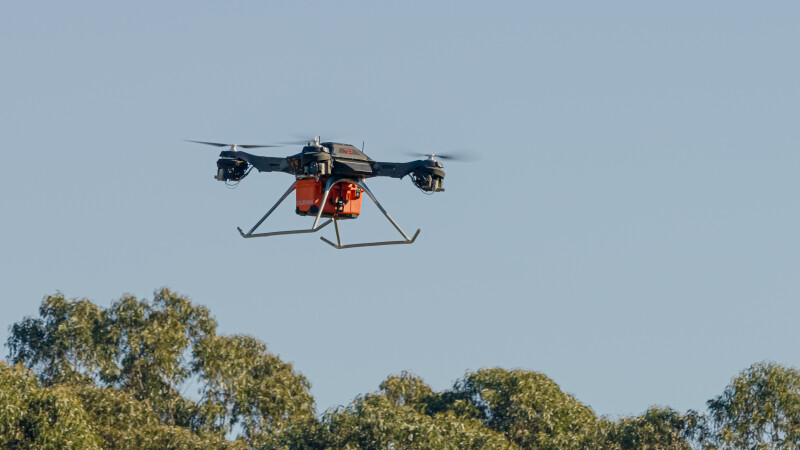
For decades, Australia has represented a unique challenge for aviation. An enormous country with vast distances between population centers, extensive mining operations, isolated communities, and some of the most inhospitable terrain on Earth, the country has always depended on aviation to connect its people and industries. Now, an American drone manufacturer believes it has an aircraft particularly well suited to these conditions.
On October 15, California-based Parallel Flight Technologies (PFT) announced a strategic distribution agreement with Drone Forge, an Australian company specializing in uncrewed systems integration and support. Under the agreement, Drone Forge will distribute PFT's Firefly heavy-lift aircraft throughout the Asia-Pacific (APAC) region, initially concentrating on Australia and its territories.
The announcement is significant for two reasons. First, it marks another step in an American drone manufacturer's international expansion as the U.S. tries to strengthen its domestic uncrewed aviation industry. Second, it involves an aircraft that challenges a fundamental assumption of the small drone revolution: electric batteries aren't necessarily the best solution for every mission.
In a recent conversation with Sarah Abdi, head of business development at PFT, she explained why the company chose to enter the region through Australia.
"We saw an opportunity to expand into the Asia-Pacific region, and with Drone Forge, we have a strong partner to support that growth through regional distribution and service. We anticipate Firefly aircraft on the ground in Australia in 2027, as well as broader activities across the region," Abdi said.
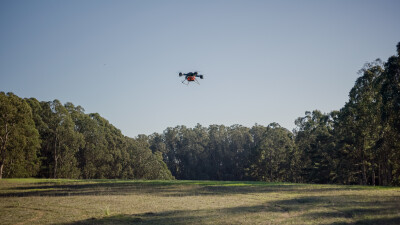
That last detail is particularly interesting. The agreement is not simply about appointing a distributor and waiting for orders. According to Abdi, PFT is already planning to position aircraft in the region, suggesting a shift from commercial announcements to actual deployments.
Drone Forge will initially handle sales, customer integration, and regional operational support, with plans to expand its capabilities in maintenance, service, and training. Potential applications span mining, maritime operations, critical infrastructure, emergency response, and defense. However, most of these industries share a common denominator: long distances, difficult access, and the need to carry useful payloads without constantly returning to base.
The Hybrid Alternative to Batteries
Since the commercial drone revolution began, batteries have been both an advantage and a limitation.
Electric propulsion made small multirotor aircraft relatively simple to operate, mechanically less complex, and practical for thousands of applications that previously required helicopters or fixed-wing aircraft. But anyone who has operated a drone carrying a substantial payload knows that endurance decreases rapidly as weight increases.
PFT has taken a different approach.
Its Firefly aircraft uses a patented Parallel Hybrid Electric Multirotor (PHEM) propulsion system that combines fuel-based power generation with electric propulsion. The objective is to retain the operational advantages of a multirotor while overcoming some of the endurance limitations imposed by batteries.
According to the manufacturer, Firefly can carry up to 100 pounds (45 kilograms) for about 1.4 hours, with endurance up to ten times that of comparable all-electric aircraft. The system can also supply up to 2 kilowatts of continuous electrical power to onboard payloads.
These are manufacturer-stated capabilities, and actual performance will depend on operating conditions, aircraft configuration, and payload. Nevertheless, they point to a different category of commercial UAS.
Imagine a mining operation in remote Western Australia, where inspecting infrastructure may require traveling considerable distances over difficult terrain. Or a maritime operation where the aircraft must carry equipment from shore to a vessel without the convenience of battery-charging equipment at the destination.
For these applications, the traditional advantages of a battery-powered multirotor may be outweighed by the need for endurance and payload capacity.
Abdi believes Australia's geography makes it an especially attractive market for Firefly.
"Australia’s vast distances and austere locations make it a strong fit for Firefly. Its combination of heavy lift and long endurance can help bridge those gaps, especially where infrastructure is limited and operating conditions are less than ideal," she explained.
There is an interesting distinction here. For years, the commercial drone industry has concentrated on making aircraft smaller, lighter, and easier to deploy. Parallel Flight is pursuing a different objective: increasing the useful work an uncrewed aircraft can perform in a single mission.
Hybrid propulsion introduces its own challenges, including mechanical complexity, fuel logistics, maintenance requirements, and potentially different operating costs. Firefly’s modular design keeps the underlying mechanical complexity largely invisible to the user. The commercial question is not whether hybrid propulsion is universally better than batteries. It is whether certain missions justify those trade-offs.
In a country the size of Australia, that calculation could differ sharply from one made by a contractor operating a small drone over a construction site.
From American Innovation to International Operations
Another dimension of this announcement deserves attention: regulation.
Earlier this year, PFT received an FAA exemption under Section 44807, providing a pathway for commercial operation of its aircraft in the United States, subject to applicable conditions and authorizations.
But an FAA exemption does not automatically permit the same aircraft to operate commercially in another country. Australia has its own regulatory framework administered by the Civil Aviation Safety Authority (CASA), and bringing a new category of aircraft into that environment requires additional work.
According to Abdi, PFT is already addressing this issue.
"We’re building on our FAA exemption and working with Drone Forge to navigate Australia’s CASA requirements. Their local knowledge and support are important as we prepare to bring Firefly to Australia," she said.
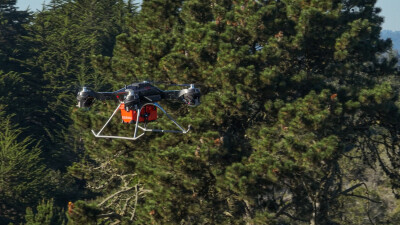
This is an important distinction. Selling an aircraft internationally is one thing; ensuring that customers can legally operate it is another.
For manufacturers developing larger and more capable uncrewed aircraft, regulatory acceptance can become as important as technical performance. An aircraft may have impressive endurance, sophisticated navigation, and the ability to carry heavy payloads, but without the necessary approvals, those capabilities have limited commercial value.
This is where the Drone Forge partnership could prove particularly useful. A local distributor familiar with Australian customers, operating conditions, and regulatory processes could reduce the difficulties of entering a foreign market.
The industry also faces a broader question.
For years, much of the American drone debate has centered on the dominance of Chinese manufacturers, particularly DJI, and the challenges domestic companies face in competing with them.
But perhaps the future of American drone manufacturing does not depend entirely on producing a direct competitor to DJI's most popular aircraft.
Perhaps it depends on identifying applications where different aircraft architectures can provide capabilities conventional small electric drones cannot deliver economically.
PFT's approach illustrates that possibility. Rather than competing primarily in the market for compact photography, inspection, and mapping drones, the company is pursuing missions involving substantial payloads, longer endurance, and difficult operating environments.
Australia and the wider Asia-Pacific region provide an interesting testing ground for that strategy.
The appointment of Drone Forge does not guarantee commercial success, and the real measure of the partnership will be aircraft deliveries, regulatory approvals, customer adoption, and sustained operations.
But it is worth watching as an American drone manufacturer attempts to turn a distinctive technological capability into an international commercial advantage.
In an industry that has spent years debating how American drone manufacturers can compete globally, the answer may not be to build another version of the same drone, but to build an aircraft that can perform an entirely different job under difficult conditions.









Comments