

For companies working in the commercial UAS space, whether they are suppliers or operators, there are two general paths to take once they begin scaling. Although each is valid in its own right, it’s a decision all companies have to make at some point. One option is to home in on a specific vertical or application and do everything possible to corner that market. The advantage here is building authority and expertise, which gives a clear edge over competitors. The other path is to diversify applications, taking knowledge learned in one field and applying it to a new one. While the institutional knowledge may not be the same, bringing a new perspective can potentially solve problems competitors have while diversifying one’s own income streams.
There isn’t a clear, black-and-white answer as to what path is the best one for today’s industry. The “right” choice is going to depend on the company. Adrian Allen, the founder of LunaLite Drone Show Technologies, is an example of the second path. In his career, he’s moved from traditional production work into drone light shows, and now into a new venture in the uncrewed cargo delivery space with the upcoming launch of Luna Air Cargo. Recently, Commercial UAV News spoke with Allen and Luna Air Cargo’s COO, Alan Gabriel, about that path, why cargo delivery seemed like a viable next step, and what they hope to see happen more broadly for the commercial drone space across the Caribbean.
Allen’s foray into the commercial UAS industry is a relatively recent one, at least in terms of a primary focus on drones. For most of his professional career, Allen worked in the production space, producing “probably thousands” of commercials, TV shows, and films. As part of that work, he and his team flew drones to capture aerial shots, but they were a tool, not the main focus of operations.
As was the case for many people around the world, the COVID-19 pandemic led to a change. At that point, Allen said, the team decided to end their production business “cold turkey” and look into a new way of storytelling. That led to the creation of LunaLite Drone Show Technologies, which officially launched in 2023. For him and his team, it seemed like a natural progression.
“We just figured, we know how to handle drones, and we know how to tell great stories,” Allen told CUAV News. “So, drone light shows were the next major shift.”
A workflow around single-drone flights to capture aerial photography or videography is a completely different animal compared to that of a drone light show that includes hundreds of drones flying autonomously in a predetermined pattern. That autonomy was a learning curve, but one that he recognized was going to be important for any path forward, and he said was ultimately not as challenging as one might initially assume.
“As the economy and the global space are shifting to more autonomy, and not just with drones, we figured that it may be a learning curve that is [worth pursuing],” Allen said. “So, we quickly became certified in the space and have been operating hundreds to thousands of drones autonomously at any given time.”
That ability to complete these shows safely is unsurprisingly the most important part of pitches to any potential clients, and it’s something Allen has been able to prove throughout his time in the space. Among other shows, they’ve done projects for Nike, the FIFA World Cup, Marriott Bonvoy, and Patek Philippe.
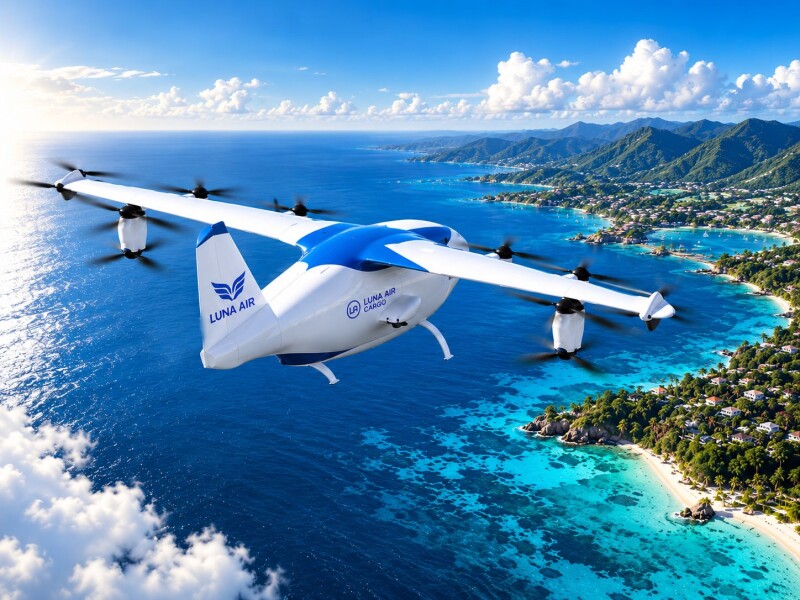
Now, Allen is expanding into cargo delivery with the upcoming launch of Luna Air Cargo, which aims to serve hub-to-hub delivery needs in the Caribbean. While it seems like a fairly significant shift, it may not be quite as large a leap as one might initially perceive, given the team’s knowledge of both autonomous flights and their reputation in the region.
“The Caribbean knows LunaLite as experts within the autonomous drone operations space,” he said. “For years, we’ve always known that the gap for moving cargo throughout the Caribbean space, interisland and intraisland, has been a major challenge. So we tied everything together, and we figured that we want to be the ones to help launch autonomous drone cargo services in the region.”
The operations, which are expected to start in November 2026 in Saint Vincent and the Grenadines, will be working with governments and logistics companies rather than individuals. In other words, this differs from the doorstep delivery services currently making headlines across the U.S. Instead, according to Gabriel, the plan is to take cargo ranging from general packages to medical materials to disaster response materials and deliver between delivery hubs, including across islands. Allen and Gabriel already demonstrated a proof-of-concept in the town of Chateaubelair, St. Vincent, too, deploying a drone between two hubs that shortens a 90-minute drive to a less-than-10-minute flight.
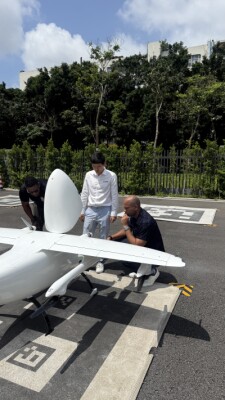
Since the team isn’t in the manufacturing space, one of the first objectives for Allen was to find a manufacturer who would be able to meet the demand they are trying to capture. The duo traveled to many manufacturing facilities around the globe before identifying Phoenix Wing as the best match. Working with them, they have adapted the Phoenix Wing Orca to launch their first cargo drone. Right now, Gabriel says the aircraft is rated for a 100-km range with a maximum payload of 15 kg.
Beyond the goal of providing faster and more convenient cargo delivery, both Allen and Gabriel also spoke to wanting to drive the broader UAS ecosystem across the Caribbean forward. As noted, the company will start in Saint Vincent and the Grenadines, which means they will be able to work just with the Eastern Caribbean Civil Aviation Authority (ECCAA). They have ambitions for scaling further in the region, though, which means they will have to work in a more patchwork regulatory environment. That brings greater complexity, but also an opportunity to showcase to leaders across the region that there is value in this technology, and not just for the private entities manufacturing or operating the aircraft.
“One of the ways [we can push local aviation authorities] is to pitch to them that there is an economic benefit,” Gabriel said. “It’s not just doing more work for somebody else to make money. The region as a whole benefits, and economies benefit from the regulators keeping pace.”







Comments