

Act I: The Strategic Macro Environment – The Sword and the Shield
In my previous article, I reasoned that operators can no longer afford to be reactive. They must "lead turn" emerging regulations to survive and thrive. That imperative now extends upstream into manufacturing and assembly.1 2 Operators cannot conduct compliant missions if the domestic manufacturing base fails to deliver compliant hardware. Accordingly, a significant share of the regulatory adaptation has shifted upstream to drone manufacturers.
The U.S. uncrewed aircraft systems manufacturing sector is undergoing a structural transformation. Driven by geopolitical tensions, domestic security and supply-chain concerns, and a federal push for scaled commercial operations, agencies are abandoning flexible post-market oversight in favor of strict pre-market compliance and supply-chain validation. For manufacturers, component suppliers, and builders alike, the days of coasting on "slapping a domestic label on a foreign-sourced kit" are over.
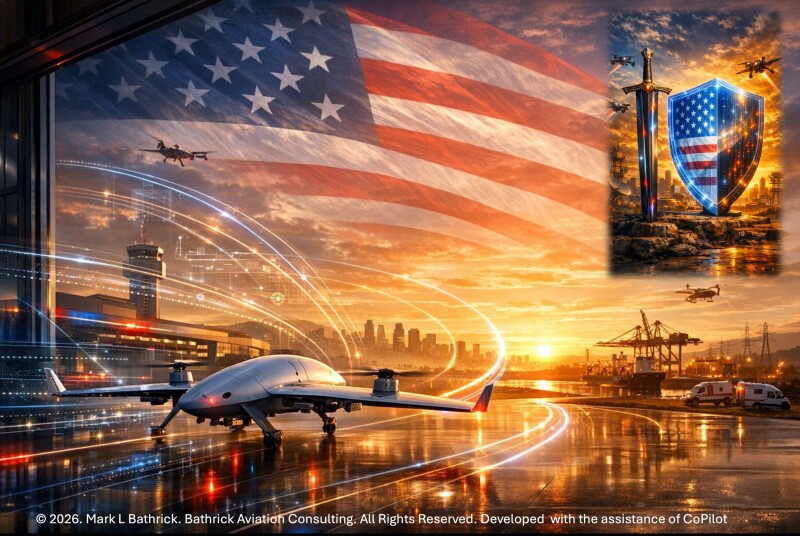
To navigate this new reality, executives must understand that federal drone policy is no longer only about airspace safety. It is also an instrument of national and industrial security policy. This dual strategy is best understood as the Sword and the Shield: an offensive push for domestic industrial dominance and a defensive fortification of sovereign airspace.
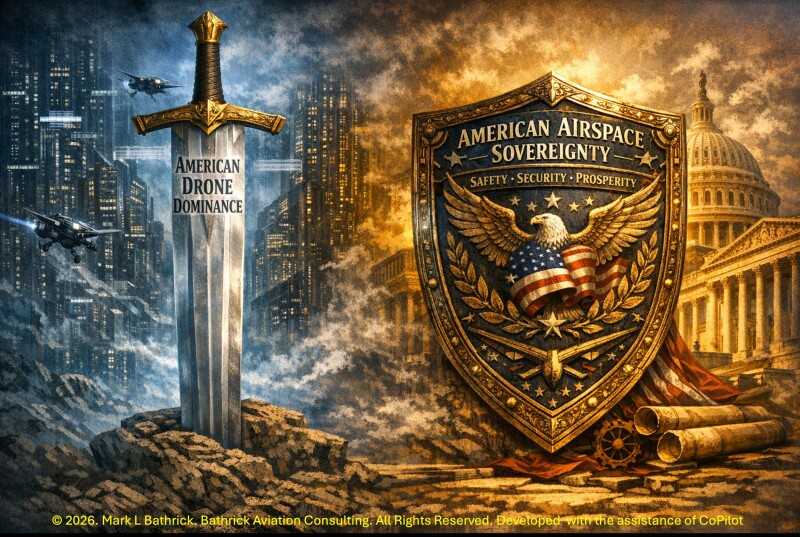
The Sword: Industrial Offense and Global Market Acceleration
The offensive vector of this strategy is codified in Executive Order 14307, "Unleashing American Drone Dominance." Issued as an industrial roadmap, EO 14307 aims to accelerate safe commercialization of domestic drone technologies while fortifying the U.S. industrial base.3 It directs agencies to use federal purchasing power to stimulate the domestic market and prioritize American-made drones.
For drone manufacturers, the "Sword" creates an immediate procurement squeeze. If your system relies on foreign-adversary assemblies, it is barred from federal purchase pools.
But the Sword also cuts a path into international markets. EO 14307 directs changes to export controls to accelerate sales of U.S.-manufactured civil UAS to allied nations and aligns FAA UAS Test Ranges with testing, development, and rapid scaling of American drone technology.4
The Shield: Air Domain Awareness, Security, and Zero-Trust Sovereignty
Acting as the defensive counterpart is Executive Order 14305, "Restoring American Airspace Sovereignty." If EO 14307 is the sword designed to win market share, EO 14305 is the Shield designed to blunt threats from malicious actors exploiting UAS technology around critical infrastructure, federal facilities, and mass gatherings.5
The Shield alters the technical baseline manufacturers must design toward. Under EO 14305, state, local, tribal, and territorial agencies are receiving federal support to buy drone detection, tracking, and identification systems. As C-UAS infrastructure spreads, compliance failures will no longer hide in plain sight. Remote ID (RID) reliability, resilient coordination, collision-avoidance architectures, and shared machine-readable visibility across the low-altitude air domain are becoming foundational.6 7 8 If a manufactured unit leaves your facility with intermittent, poorly configured, or unsecured tracking architecture, it can trigger law-enforcement scrutiny and flag the operator as a potential airborne threat.
The Shield also pushes manufacturers to build hardened security architectures into their software baselines. To prevent unauthorized overflights of protected infrastructure, builders are being driven toward tamper-resistant geofencing and verifiable end-to-end command-and-control (C2) encryption.9 Systems must withstand hacking, GPS spoofing, and signal hijacking. In this zero-trust environment, an unencrypted commercial drone is an airborne vulnerability.10
The Crucible for Manufacturers and Assemblers
Drone manufacturers and assemblers sit directly inside this macroeconomic crucible. You can no longer design an aircraft only for flight time, payload, or sensor utility. The modern drone is an enterprise data node, and its physical and digital architecture must reflect the realities of the Sword and the Shield.
If you rely on unverified foreign supply chains, you are moving straight into a defensive shield that will lock you out of federal, state, and critical-infrastructure markets. If you lead turn these requirements, aligning engineering, quality management, and sourcing with sovereign compliance, the offensive Sword of federal procurement and export support can clear a path to survival and growth.
In the next act, we examine how these macro forces are splitting the commercial drone space into a rigid two-tier market driven by the FAA’s BVLOS NPRM (Part 108), CMMC 2.0 cybersecurity mandates, and iterative NDAA procurement restrictions.11 12
Act II: The Regulatory Bifurcation – The Great Two-Tier Market Fracture
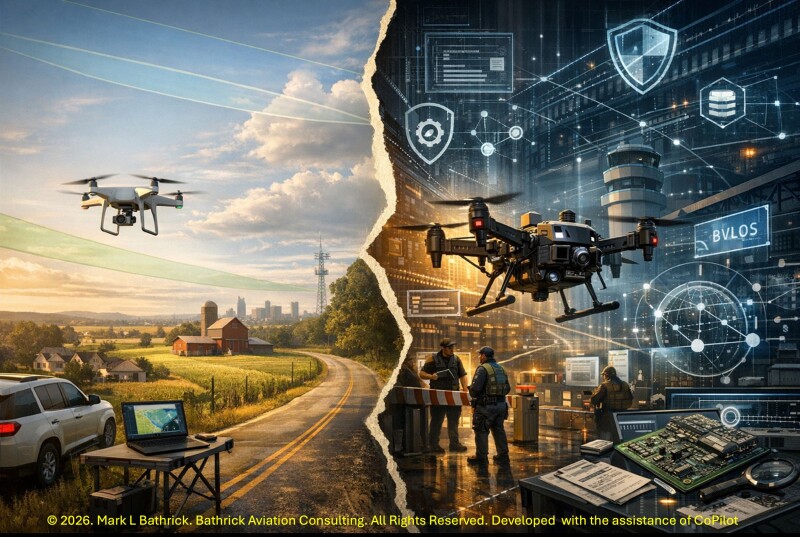
The macro environment created by the Sword and the Shield is not abstract; it is a regulatory wedge fracturing the UAS industry. We are witnessing the end of a unified commercial drone marketplace. For the past decade, the industry operated under a relatively flat framework dominated by FAA Part 107, focused mostly on pilot restrictions rather than manufacturing oversight. Under that umbrella, a garage assembler and an aerospace firm could build hardware under roughly the same operating conditions. Those days are gone.
Driven by commercial scaling and national-cyber and supply chain security mandates, the domestic marketplace has bifurcated into a rigid two-tier ecosystem. Category A covers consumer and prosumer operations: lower-friction missions like real-estate photography or basic agricultural mapping under standard Part 107 limits. Category B covers the enterprise, public-safety, and government markets: heavy-payload, high-reliability, long-range platforms for critical infrastructure inspection, defense operations, medical logistics, and urban delivery.
As I discussed in Part 108 and the Gig Economy of Drone Services, normalized BVLOS operations do not simply expand mission profiles; they redraw the competitive boundary between casual operators and capitalized, compliance-centric providers.13 14 15
This regulatory split is further cemented by the FCC’s June 2026 Public Notice (DA 26-588). Acting on a National Security Determination from the Department of War, the FCC updated its Covered List to remove a very narrow, tightly defined category of foreign-produced "toy drones." Rather than signaling a softening of the federal stance, this exception highlights exactly how granular federal risk management has become. By exempting only unsophisticated, sub-150-gram devices that entirely lack GPS, cellular connectivity, operational cameras, or data-gathering sensors, the government has explicitly defined the low-risk baseline.
For manufacturers aiming for Category B, this underscores the core reality of the current shift: the security concern is no longer about the airframe itself, but rather the data, connectivity, and payload capacities natively built into the platform.16 17 For any manufacturer or assembler seeking to compete in Category B, three regulatory forces are converging into a non-negotiable barrier to entry: FAA Part 108, CMMC 2.0, and continuous NDAA enforcement.18 Success in this tier depends not only on technical compliance but on proving institutional reliability to regulators, customers, and the public alike.
1. FAA Part 108 and the Shift to Airworthiness Declarations
The long-awaited Beyond Visual Line of Sight (BVLOS) Notice of Proposed Rulemaking, or Part 108, normalizes complex commercial operations at scale and upends how drones are designed, built, and validated. Rather than relying on traditional type certification for low-altitude drones under 110 pounds, the FAA proposes a framework that accepts airworthiness through industry consensus standards, including those published by bodies like ASTM or RTCA.19
Under Part 108, the legal burden shifts to the manufacturer through a formal Declaration of Compliance (DOC). Builders must design, build, test, and declare that their aircraft meet these standards. They must also define the operational boundaries of their systems, including wind, speed, weather, and battery endurance and operators must stay within those manufacturer-defined limits. Engineering logs thus become binding legal boundaries.
Most critically, Part 108 requires ongoing configuration control, comprehensive test records, and continued operational safety data sufficient to track fleet-wide failures over time. That level of quality discipline mirrors aerospace-grade frameworks and disqualifies casual assemblers who cannot provide verifiable product pedigree.20
2. CMMC 2.0: The End of Cybersecurity Self-Attestation
While the FAA is codifying physical airworthiness, the Department of Defense is tightening digital airworthiness through the Cybersecurity Maturity Model Certification (CMMC) 2.0 framework. The CMMC 2.0 final rule introduced verified assessments and formal legal accountability across the defense supply chain.21 Drone manufacturers, component builders, and assemblers handling Federal Contract Information (FCI) or Controlled Unclassified Information (CUI) can no longer rely on self-attestation or "good faith" cyber hygiene.
Under the active rollout, Level 1 and Level 2 assessments become real conditions of contract eligibility. For a drone builder, that means corporate IT, data storage, and software-development environments must be hardened against exfiltration of telemetry, payload data, and sovereign intellectual property.
If you build specialized UAS assemblies for government customers or prime contractors, you must survive third-party or government cyber audits. CMMC 2.0 makes cybersecurity a core manufacturing requirement, not a peripheral IT concern.
3. Continuous NDAA Enforcement and the 65 Percent Metric
The third force cementing this fracture is the continuous cycle of National Defense Authorization Act (NDAA) procurement restrictions. Updated through annual legislative cycles, these requirements bar federal agencies, federally funded public-safety entities (including grantees), and many critical-infrastructure operators from purchasing or operating UAS containing components from covered foreign adversary nations.22
For manufacturers and assemblers, compliance is governed by the strict 65%percent Buy American component-cost metric. To qualify for key federal and public-safety procurement pools, a builder must maintain an auditable bill of materials showing that at least 65% of total component cost originates in the United States or designated allied nations.
This requirement also drives separation of software and hardware assurance. Systems must use verified, clean-room software stacks and embedded firmware, even in components as basic as electronic speed controllers, and must be audit-ready to show that it does not call back to foreign servers or conceal latent backdoors.
The Executive Choice
This convergence has turned Category B into an exclusive tier. Drone builders now face a strategic choice: remain in the commoditized, low-margin Category A market, or invest the capital and operational discipline needed to survive in Category B.
Those who choose the enterprise and government path must understand that they are no longer just drone builders; they are aerospace contractors. The defining bottleneck is no longer aerodynamics or battery chemistry. It is the forensic reality of the supply chain. In Act III, we turn to that sourcing crisis, including the FCC’s 2027 exemption cliff and the Drone Dominance Program’s "Gauntlet" testing.
Act III: The Supply Chain Reckoning – The Death of "Assembled in the USA"
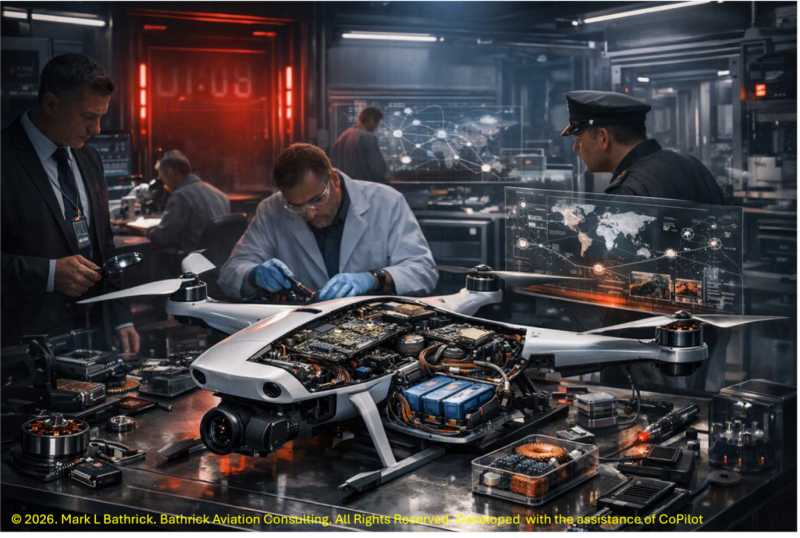
For years, a convenient fiction sustained part of the domestic drone industry. Under the banners of "Made in America" or "Assembled in the USA," many builders were effectively running repackaging facilities: importing foreign airframe kits, motors, controllers, and boards, assembling them domestically, loading software, and applying a domestic label.
The Sword, the Shield, and the new regulatory split have turned that practice into a corporate liability. Sourcing has become a forensic discipline. Two mechanisms are closing in on non-compliant builders and ending the era of superficial domestic assembly: the FCC’s 2027 exemption cliff and the Department of War’s "Gauntlet" testing framework.23 24
1. The 2027 FCC Exemption Cliff: A Regulatory Dead End
Acting under the Secure and Trusted Communications Networks Act, the FCC expanded its “Covered List” to bar the import, sale, or equipment authorization of UAS and UAS critical components produced by restricted foreign nations.25
The challenge lies in how broadly the FCC defines "UAS critical components." The restriction reaches not just the visible airframe or brand label, but the underlying silicon and hardware layers:
- Flight controllers, data transmission links, and core communication modules.
- Ground control stations, optical sensors, cameras, and GPS/navigation modules.
- Electric motors, lithium batteries, and Battery Management Systems (BMS).
To avoid immediate market disruption, the FCC issued a temporary exemption through December 31, 2026, for certain systems, including those on the DCMA’s Blue UAS Cleared List. But that clock is running down rapidly.26 27
The consequence is binary. Any manufacturer or assembler that has not scrubbed covered foreign equipment from its builds by December 31, 2026, risks losing access to new FCC authorizations. Without authorization, importing, marketing, or selling that hardware in the U.S. commercial market becomes unlawful. Future applications will require binding attestation that no critical components originate from a restricted nation.
2. The Drone Dominance Program and "The Gauntlet"
While the FCC blocks the commercial front door, the Department of War is using procurement leverage to tighten the defense back door. Through the Drone Dominance Program Supply Chain Framework (DDPSCF), it is pursuing large-scale prototype and production buying strategies that reward non-adversarial sourcing.
The objective is explicit: source small UAS free of foreign-adversarial components, subcomponents, and, increasingly, raw materials across every tier of the supply chain (ideally through onshoring these industries).
To win these contracts, manufacturers cannot simply sign a pledge; they must survive The Gauntlet, a series of physical tests and production-validation events designed to expose weak manufacturing readiness and root out supply-chain deception.
Government teams can tear systems down for forensic review, tracing subcomponent bills of materials beyond tier-one suppliers to individual chips, magnets, copper windings, and battery chemicals. If a single unverified adversarial component or raw material is found, the system can be disqualified.
At the same time, DoW has left open a faster procurement side door for commercial innovation. By using Other Transaction Authority (OTA) frameworks and federal consortia, compliant manufacturers can move more quickly than under traditional Federal Acquisition Regulation (FAR) constrained contracting. That opening matters because scalable aviation advantage increasingly goes to firms that can plug compliant aircraft, data services, and autonomy into broader digital infrastructure rather than merely sell stand-alone airframes. 28
Manufacturers can use recognized consortia such as NSTXL and vehicles such as S2MARTS to pursue prototype funding and production opportunities once supply-chain compliance is established.29
3. The Path to Sovereign Pedigree
The message to the domestic manufacturing base is clear: your supply chain is now as critical as your product. If your roadmap depends on cheap foreign components to preserve margin, your business model has an expiration date. Survival requires clean-room software, verified domestic or government-approved allied sourcing, and absolute component pedigree.
Achieving that visibility and configuration control is difficult, but for compliant and savvy manufacturers, “side doors” like OTA, Small Business Innovation Research (SBIR), Commercial Solutions Opening (CSO), Indefinite Quantity, Indefinite Delivery (IDIQ), Blanket Purchase Agreements (BPA), and the Tradewinds Solutions Marketplace exist. The next section examines a relatively new institutional channel designed to reduce standard market friction while supporting the growth in technology job opportunities for wounded warriors and other deserving Americans.
4. The Ultimate Regulatory Escape Hatch, The AbilityOne Statutory Mandatory Source
While the sovereign pedigree is an unforgiving technical baseline, another procurement side door has emerged. In March 2023, SourceAmerica established a Mentor-Protégé Program (MPP) under AbilityOne that allows for-profit companies, including drone manufacturers, to mentor approved nonprofit federal prime contractors such as Portco Inc., opening a long-protected procurement ecosystem.30 31 32 Similarly, in February 2026, National Industries for the Blind (NIB) established its own manufacturing focused Mentor-Protégé Program under AbilityOne for new business line development, which includes drone parts manufacturing.33 34
Under this model, the Mentor-Protégé team can market directly to government customers.35 The AbilityOne Mentor-Protégé Program is not a mere teaming vehicle, a small-business shortcut, or a proposal strategy.36 Instead, it provides a statutory rerouting of federal product and service demand, thereby expanding job opportunities for wounded warriors37 and other deserving Americans in high-technology fields, like drones.38 39 Once a drone product or service is placed on the AbilityOne Procurement List, federal agencies and supporting prime contractors are required by statute to source that requirement from the team.40 41
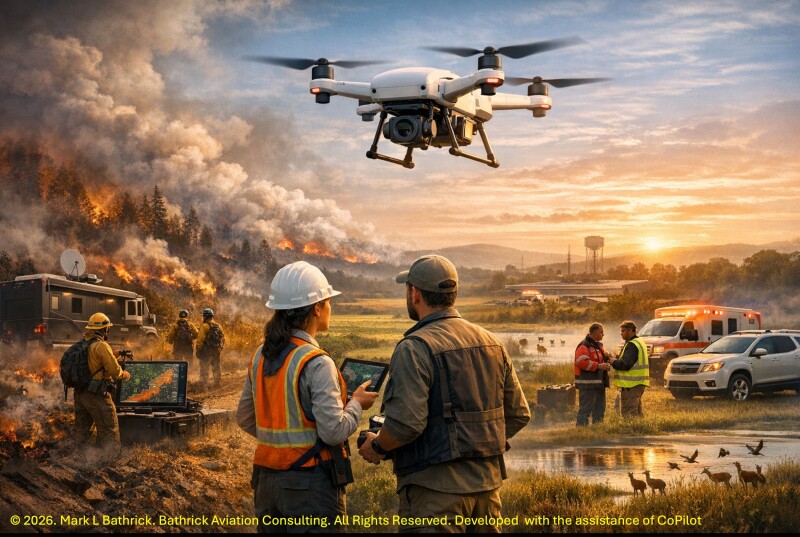
This structure can offer unique advantages: sole-source awards insulated from outside competition, limited protest exposure, and long-duration work so long as mission need remains and performance standards are met. mentor to pursue new federal opportunities together.42 The power of the model is its clean division of roles. The AbilityOne federal contractor serves as the prime contractor and statutory face of performance; the commercial drone company serves as mentor and subcontractor, contributing the aircraft, autonomy stack, mission playbooks, training systems, manufacturing know-how, and past performance needed to open advanced lines of business.
The result is a rare alignment of commercial leverage, procurement insulation, and social mission. The mentor can reduce business-development drag, blunt protest risk, preserve pricing discipline, and turn expiring or contested federal requirements into durable AbilityOne opportunities; the protégé gains new technical capacity and prime-contract responsibility; agencies gain a compliant mandatory-source solution; and disabled workers, including veterans with disabilities, gain access to skilled, mission-relevant jobs that look more like the future of defense and infrastructure than the past of sheltered work.43 For drone companies that understand it early, the SourceAmerica AbilityOne Mentor-Protégé Program is not merely a partnership option. It is a regulatory escape hatch from the ordinary federal procurement battlefield into a statutory demand channel that competitors may not be able to follow.
Act IV: The Executive Blueprint – The Sovereign Vetting and Compliance Framework
The overlapping waves of federal intervention detailed above, the Sword, the Shield, market bifurcation, and forensic sourcing create an existential choice for corporate leadership. Manufacturers, component builders, and assemblers cannot navigate this environment with reactive, ad hoc compliance. Compliance must be treated as a core engineering discipline and business asset.
The following Sovereign Vetting and Compliance Framework is intended both as an operational playbook for executives seeking to lead turn pending federal drivers and as a due diligence lens for procurement officials and investors evaluating a manufacturer’s readiness to compete in this market.
The Sovereign Vetting and Compliance Checklist
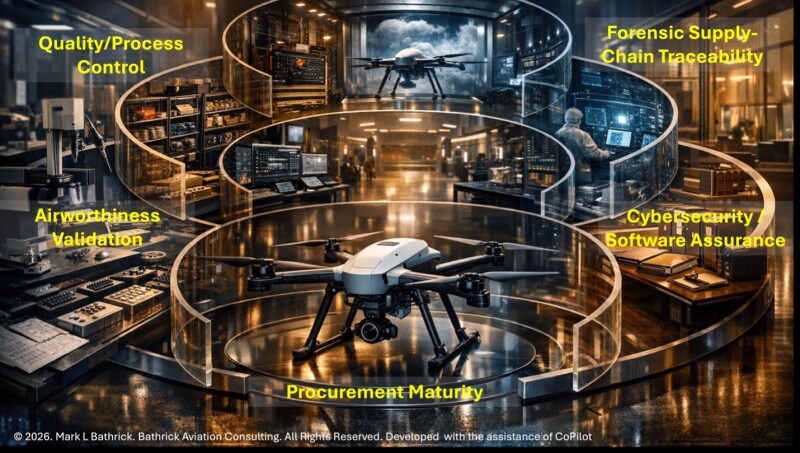
Phase 1: Aerospace Quality and Process Engineering (AS9100 Standard)
The structural baseline of any serious aerospace enterprise or defense UAS manufacturer is a mature Quality Management System (QMS). Done properly, this phase establishes the auditable data infrastructure needed to support later certifications.
- Configuration Control: Assign unique part and serial numbers to hardware, boards, and firmware iterations; require formal engineering change notices and regression testing for baseline changes.
- First Article Inspection: Implement AS9102-compliant first article inspections for internal assemblies and procured critical components before full-rate production.
- Continuous Airworthiness Tracking: Build a continued operational safety data pipeline to capture fleet failures, software bugs, and field maintenance logs in support of Part 108 recordkeeping.44
Due Diligence Vetting Query: Does the manufacturer possess current AS9100D certification, or a documented roadmap showing aerospace-grade process integration and configuration control?45
Phase 2: Forensic Supply Chain Remediation (NDAA, DDPSCF, & FCC Readiness)
With the FCC’s December 31, 2026, exemption cliff 46 approaching and stricter supply-chain scrutiny spreading, sourcing has become exacting and auditable. This phase ends superficial "Assembled in USA" marketing.
- Tiered Bill of Materials: Map a complete multi-tier bill of materials (BOM) tracing critical components to raw material origins and fabrication plants.
- 65% Financial Audit: Verify that at least 65% of total component cost originates in the U.S. or designated allied nations.
- Component Scrubbing: Identify and design out covered foreign components before the 2027 FCC deadline and secure verified replacement suppliers.
- Rapid Software Validation: Use faster defense innovation pathways to validate clean-room firmware and secure command links.47
- Data-Layer Positioning: Position edge-AI, hazard perception, and analytics capabilities for direct federal engagement where applicable.48
- Federal Scaling Paths: Use compliant partnerships to pursue high-value service work as well as hardware opportunities.49
- Dual-Track Hardware Strategy: Where appropriate, pair compliant commercial production with protected federal production channels.
Due Diligence Vetting Query: Can the manufacturer present a forensically auditable multi-tier BOM showing exclusion of adversarial components and tracing strong enough to withstand teardown scrutiny?
Phase 3: Hardware and System-Level Airworthiness (FAA Part 108 Alignment)
As civil drone policy shifts from ad hoc waivers to manufacturer-backed airworthiness declarations, builders must own the safety profile of their aircraft.
- Consensus Standards Testing: Design and stress-test aircraft against recognized standards such as ASTM International or RTCA.
- Declaration of Compliance: Execute and submit a DOC for each aircraft model intended for complex commercial or BVLOS operations.
- Operational Envelope Definition: Publish the aircraft’s operating limits and build safeguards that prevent operation outside those limits.
Due Diligence Vetting Query: Has the manufacturer submitted Part 108 DOCs, and can it produce empirical test logs supporting its published operating limits?
Phase 4: Enterprise Cybersecurity and Software Assurance (CMMC 2.0 & EO 14305)
Drones are airborne enterprise data nodes. Their software architectures must be insulated against exploitation, telemetry exfiltration, and malicious callback risk.
- Clean-Room Firmware Development: Maintain an insulated development pipeline and scan embedded firmware for hidden backdoors and external callbacks.
- C2 Encryption and Geofencing: Integrate strong encryption into command-and-control and telemetry links and use tamper-resistant geofencing for protected infrastructure.
- CMMC Corporate Hardening: Align corporate IT with CMMC 2.0 requirements to protect Federal Contract Information (FCI) and Controlled Unclassified Information (CUI) and preserve contract eligibility.
Due Diligence Vetting Query: Are the manufacturer's software pipelines, firmware stacks, and corporate IT systems audited and aligned with CMMC 2.0 and clean-room cybersecurity benchmarks?
Phase 5: Contract Vehicle and Procurement Maturity
The final pillar assesses whether a drone company has the contractual infrastructure to turn a compliant platform into scalable, repeatable government revenue.
- Pre-Vetted Contract Paths: Establish access to BPAs, OTA’s, schedule holders, or similar traditional “side door” contract vehicles that let agencies buy quickly.50
- Vehicle Capture Strategy: Position product lines on IDIQs and other multi-award vehicles where sovereign UAS demand will flow.
- Prime-Sub Structure: Where using AbilityOne MPP pathways, preserve a clean prime-sub structure and clear workshare responsibilities. The AbilityOne Federal Contractor Protégé serves as the Prime Contractor, executing at least 51% of the contract labor and assuming full operational responsibility for all AbilityOne workforce ratio compliance and reporting.51 The drone manufacturer acts strictly as a subcontractor, limited to up to 49% of the contract labor.52 Revenue is distributed directly based on this labor share, while profit-sharing terms remain entirely flexible and open to negotiation.
- Workforce Sourcing: Build disciplined and sustainable pipelines that support long-term program execution. In addition to the statutory acquisition advantages of the AbilityOne MPP conduits, it offers built-in workforce sourcing support. According to AbilityOne Commission Policy 51.403, any veteran receiving VA disability compensation (with a minimum VA disability rating of 10%) contributes to the required direct protégé labor ratio.53 This feature provides access to a substantial and technically skilled workforce, as indicated by VA data showing that there are currently 5.2 million U.S. veterans with a 10% or higher VA disability rating.54 55
- Contract Conversion Tactics: Where legally and strategically appropriate, move expiring or vulnerable work into more protected procurement channels (e.g., AbilityOne MPP). By building parallel AbilityOne channels with contractors like NIB and Portco, a company could diversify execution risk, expand qualified labor capacity, and position both manufacturing and service requirements for Procurement List treatment, shifting more of the business away from ordinary recompete pressure and into protected federal demand.
Due Diligence Vetting Query: Does the manufacturer possess a diversified portfolio of pre-qualified contract vehicles or protected procurement pathways suited to the maturity of its technology?
Executive Provenance: The Value of Standardized Vetting
The value of this framework is not theoretical. It reflects lessons distilled from a 46-year aviation career spanning military, federal civilian, and commercial sectors. During my years commanding major U.S. Navy aviation units, I introduced and adopted independent certifications that improved flight, ground, and industrial safety,56 increased aircraft availability, reduced costs and losses,57 and earned direct Presidential recognition.58
Later, as Director of the Department of the Interior’s Office of Aviation Services, I translated those same structured frameworks into the federal civilian drone space. By building an ISO 9001:2015-compliant QMS across DOI’s crewed and uncrewed aircraft ecosystem,59 I created the operational foundation behind the safety record and execution of the department’s "Drones for Good" program.60
That experience confirmed that standardized quality metrics and forensic process audits are among the strongest tools for reducing operational risk and scaling complex technology safely. It also reinforces a recurring theme in my work: durable drone market leadership will belong to organizations that can master compliance, public legitimacy, and systems integration, not just product performance.61 Investors, government program managers, and procurement officials should apply that same institutional rigor. If a manufacturer cannot clear the phases of this framework, it represents operational and financial risk. Those who proactively lead turn these requirements and meet the objectives of the Sword and the Shield are the ones best positioned to capture the sovereign low-altitude economy.








Comments