
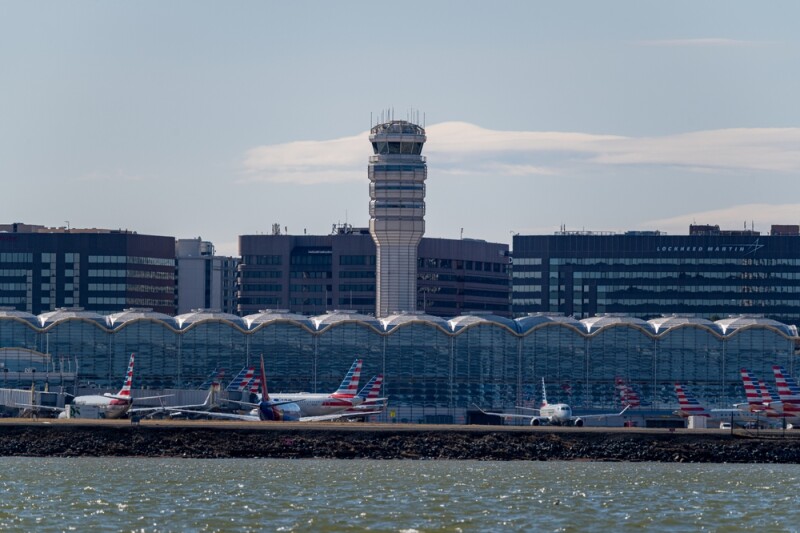
In a recent press release, the company uAvionix announced that it was adding 55 new airports to the Federal Aviation Administration (FAA) airport safety programs, and more specifically, uAvionix’s Flightline to the federal agency’ Surface Awareness Initiative (SAI).
As the industry waits for Part 108, the FAA has taken a decisive step forward in its ongoing effort to integrate crewed and uncrewed aviation into the National Airspace System (NAS). Today there are three ongoing airport programs at the FAA - the Approach Runway Verification (ARV), the aforementioned SAI and the Runway Incursion Device (RID) - that are designed to advance safety at airports, the beginning and end of every successful flight.
The announcement of additional control towers into uAvionix’s Flightline program is only one part of a much broader strategy. This expansion of surveillance infrastructure is significant, but it is far from the only initiative underway. In fact, the FAA is pursuing a multi-pronged approach that combines technology development, industry collaboration, and advanced air mobility planning to ensure that drones, air taxis, and traditional aircraft can safely coexist in the skies and in the vicinity of airports.
The SAI program itself is designed to enhance visibility and situational awareness for UAVs by integrating surveillance data into the broader air traffic management framework. By adding dozens of new towers, the FAA is effectively expanding the reach of this system, ensuring that more regions of the country can benefit from improved monitoring of low-altitude operations. This is particularly important as drone usage continues to grow, not only for recreational purposes but also for commercial applications such as package delivery, infrastructure inspection, and emergency response. Yet, while surveillance expansion is critical, it is only one piece of the puzzle. The FAA recognizes that the safe integration of uncrewed aircraft requires a comprehensive set of enabling technologies and regulatory frameworks.
One of the most important parallel efforts is the FAA’s Broad Agency Announcement (BAA) for UAV integration technologies. Through this mechanism, the agency is inviting industry stakeholders to propose solutions that address some of the most pressing challenges in uncrewed aviation. Among the focus areas are Uncrewed Traffic Management (UTM), which seeks to create systems equivalent to crewed air traffic control but tailored for drones and Detect-and-Avoid (DAA) technologies, which are essential for preventing collisions between crewed and uncrewed aircraft. The BAA also emphasizes the importance of reliable command and control (C2) links, electronic conspicuity solutions for low-flying aircraft without ADS-B, and research into noise and environmental impacts to ensure community acceptance. By encouraging industry participation, the FAA is leveraging private-sector innovation to accelerate the development of these technologies.
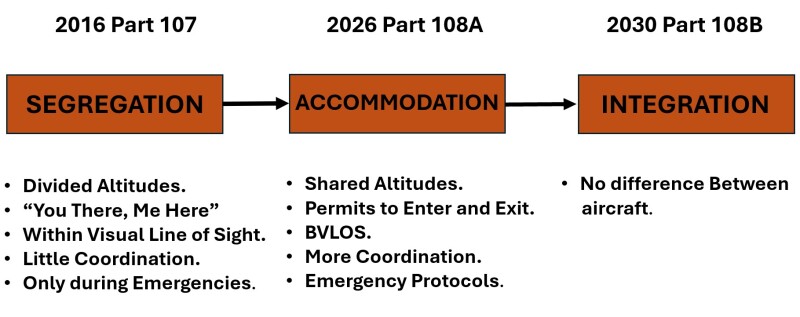
In lieu of the impending implementation of Part 108 which will allow Beyond Visual Line of Sight (BVLOS) operations, the federal agency seems to be accelerating its preparations for an imminent integration with traditional aviation.
Another noteworthy initiative is the FAA’s contract with AURA Network Systems which was announced earlier this year. This project focuses on demonstrating low-latency voice and data communications for UAV, ensuring that remote pilots can communicate with air traffic controllers as seamlessly as if they were on board the aircraft. This capability is critical for BVLOS operations, where traditional line-of-sight communication is not possible. Testing is being conducted at the Northern Plains UAV Test Site, with support from partners such as GrandSKY and the University of North Dakota. The success of this program would mark a major milestone in bridging the gap between crewed and uncrewed aviation, as it would allow drones to be integrated into existing ATC workflows without compromising safety.
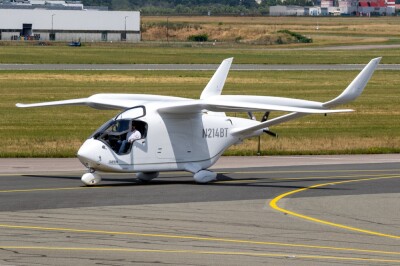
Beyond these technology-driven initiatives, the FAA is also laying the groundwork for Advanced Air Mobility (AAM), a concept that encompasses both Urban Air Mobility (UAM) and Regional Air Mobility (RAM). AAM envisions a future where air taxis, automated cargo drones, and other innovative platforms operate alongside traditional aircraft. The FAA’s aerospace forecast highlights AAM as a critical area of development, with frameworks being established to address certification, infrastructure, and operational standards. Urban Air Mobility focuses on short-range passenger transport within cities, while Regional Air Mobility extends automated operations to areas outside urban centers, including cargo delivery and emergency services. Both frameworks are designed to ensure that crewed and uncrewed aircraft can share airspace safely and efficiently.
The importance of these efforts cannot be overstated. The integration of drones and air taxis into the NAS represents a fundamental transformation of aviation, one that requires not only technological innovation but also regulatory foresight and community engagement. By expanding surveillance infrastructure, fostering industry collaboration through BAAs, validating communications technologies through contracts like the one with AURA and uAvionix, and preparing for AAM operations, the FAA is building a holistic foundation for the future of aviation. This approach acknowledges that no single initiative can solve the complex challenges of integration; rather, it requires a coordinated strategy that addresses safety, efficiency, and public acceptance.
For stakeholders in the aviation industry, these developments carry significant implications. Companies developing hybrid powerplants and hydrogen-powered drones, for example, will find that the FAA’s emphasis on BVLOS standards, detect-and-avoid technologies, and reliable C2 links directly intersect their operational needs. These long-range flying solutions designed for dual-use civilian and defense applications will greatly benefit from the FAA’s push toward performance-based standards and advanced communication systems. By aligning regulatory frameworks with technological innovation, the FAA is creating an environment where emerging platforms can be tested, certified, and deployed more rapidly.
From a policy perspective, the FAA’s initiatives reflect a recognition that the NAS must evolve to accommodate new paradigms of flight. Traditional air traffic management systems were designed for crewed aircraft operating at higher altitudes, but the proliferation of drones and the introduction of air taxis demand new approaches. Surveillance systems like SAI expand visibility at lower altitudes, while UTM frameworks provide the digital infrastructure needed to manage high volumes of uncrewed traffic. Communication systems such as those being tested by AURA ensure that remote pilots can interact with ATC in real time, while AAM frameworks anticipate the operational realities of mixed crewed and uncrewed environments. Together, these initiatives represent a forward-looking strategy that balances innovation with safety.
Looking ahead, the integration of crewed and uncrewed aviation into the NAS will likely unfold in stages. Initial efforts will focus on expanding surveillance and communication capabilities, followed by the establishment of BVLOS standards and the deployment of UTM systems. As these foundational elements are put in place, more advanced operations such as urban air taxis and regional cargo drones will become feasible. Ultimately, the goal is to create a NAS that is flexible enough to accommodate a wide range of aircraft types and operational models, from traditional commercial flights to autonomous drones and air taxis.
In my opinion, this ‘acceleration’ of the integration of crewed and uncrewed aviation will allow full integration by 2030 as indicated in the graph.
In conclusion, the FAA’s recent expansion of the uAvionix Flightline program is an important milestone, but it is only one part of a much larger strategy. Through initiatives such as the BAA for UAV integration technologies, the AURA communications contract, and the development of AAM frameworks, the FAA is pursuing a comprehensive approach to integration. These efforts reflect a recognition that the future of aviation will be defined by diversity, with crewed and uncrewed aircraft sharing the skies in ways that were once unimaginable.
By building the technological, regulatory, and operational backbone for this future, the FAA is ensuring that the NAS remains safe, efficient, and adaptable in the face of rapid change. By focusing on airports, the FAA, in partnership with private companies, increases safety and spatial awareness in the places where every flight starts and it’s supposed to end.







Comments