

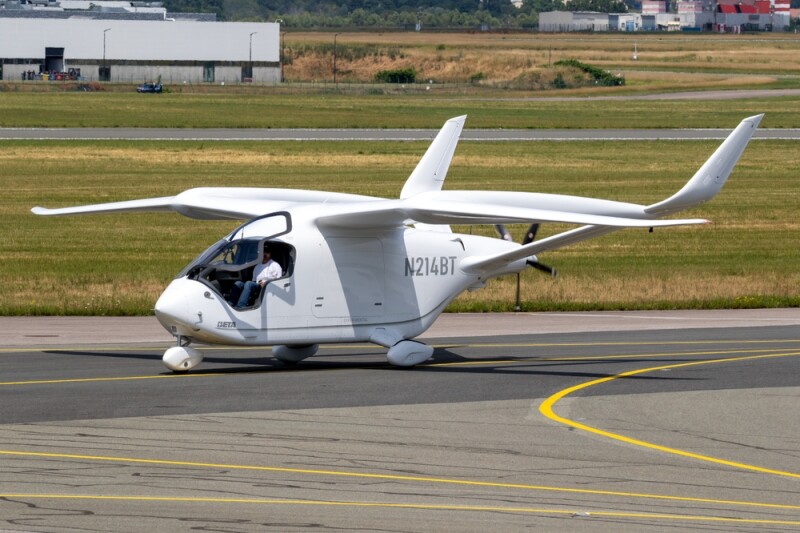
A December announcement from the United States government captured the attention of the entire commercial drone industry, with the FCC announcing the addition of all foreign-made drones and components to its Covered List. Amid all of the reaction to that news and subsequent clarifications from the agency, however, other news from the U.S. government fell out of the spotlight. Namely, on December 17, the Department of Transportation released The Advanced Air Mobility National Strategy: A Bold Policy Vision for 2026-2036.
The 70-page report, which was created by the Advanced Air Mobility Interagency Working Group, aims to define how the nation will approach AAM over the next decade, and crucially, how these aircraft will integrate with traditional crewed aircraft within the National Airspace System (NAS).
While most of what we think of as AAM, like flying taxis, are still years away from becoming a regular part of the NAS, now is the time to start thinking about how they will be integrated into an increasingly complex airspace. The strategies laid out in the report establish frameworks and standards that will affect the entire commercial drone space–even those working in sectors not generally considered to fit under the AAM umbrella–through airspace management models, infrastructure development, and regulatory approaches. This effect on the broader aviation sector is directly addressed by the report.
“Although AAM is not an all-encompassing solution and may not represent the largest segment of transportation by overall passenger or cargo volume,” the report states, “its wide-ranging applications have the power to serve as a catalyst by unlocking entirely new aviation services and reshaping how communities connect and thrive.”
The strategy is built on seven pillars that “support successful integration of AAM in the U.S. transportation system”:
- Airspace
- Infrastructure
- Security
- Automation
- Community Planning
- Engagement
- Workforce
Airspace Management: The Critical Issue for Today's Operators
Perhaps the most important area of this report for the broader commercial industry is how airspace will be managed in the future as these new classes of aircraft enter the NAS. Right now, UAVs generally operate in low-altitude spaces that have not traditionally been highly regulated. The report acknowledges as much, noting that, while the current expectation is for AAM aircraft to operate within the current regulatory and operational framework as governed by the FAA, the authors continue to say that “an evolution of this existing framework is needed” for a future where these aircraft are more prevalent.

One of the possibilities they lay out for a future environment is one that is integrated with “cooperative operating practices” within defined portions of the NAS that are supported by multiple service providers.
“Rather than a wholesale shift, this approach will support a transition to more distributed models and cooperative operations, enabled by approved systems and providers that are interoperable with the existing ecosystem,” the report states.
Most crucially for commercial operators, the report lays out a potential path toward third parties managing air traffic management and surveillance operations, all operating under the supervision of the FAA. Currently, this is simply a hypothetical, with the report recommending research into this possibility, but it would be a significant shift for the industry that could potentially open up new roles for organizations.
Today's Drone Operations as the Foundation
Critically, the report makes multiple references to the current state of drone operations and how it is using today’s drone sector as a basis for building this future strategy. Right in the beginning, while outlining where they envision air traffic management to be in 2030, they specifically call out that a system will be established for efficient management for AAM and “unmanned aircraft, such as drones that are already deployed.”
So, how does the broader commercial industry in the U.S. today prepare for the future laid out in the report? Reading the report in its entirety is a good place to start. It’s also important to understand the timeline laid out by the DOT in the report. They lay out that, by 2027, there will be “demonstrations and initial operations” within the AAM sector. By 2030, they expect new air operations in areas around the country, both urban and rural, with advanced, fully autonomous operations taking place by 2035.
There are a few actions that can be taken today to have a better understanding of the industry of tomorrow. The report, for example, recommends “ongoing and consistent” interagency coordination between governmental agencies. If these materialize, it’s vital for the industry to lean on regulatory contacts and keep tabs on what is happening within these working groups. Furthermore, the report recommends leveraging public-private partnerships, which can help participating organizations get a leg up on where the industry is moving within the U.S. and help shape critical systems that will impact the industry for years to come.
While flying taxis and other AAM capabilities may still seem part of a far-distant future, the reality is that many of these operations will be getting started in the next decade, and it’s time for both government agencies and others within the broader commercial UAV industry to think about how that future can be as beneficial as possible. As the federal government prepares to implement cooperative airspace management, enhanced infrastructure, and automation frameworks by 2030, drone operators who engage early with these developments will be best positioned to adapt. This report emphasizes interagency coordination and public-private partnerships to create clear pathways for industry participation, an opportunity for commercial operators to help shape the future rather than simply react to it.










Comments