
As the FAA moves toward finalizing Part 108, the industry is entering a decisive moment in the evolution of uncrewed aviation. The proposed rule is designed to unlock scalable BVLOS operations by establishing a regulatory framework for detect‑and‑avoid (DAA) performance, command‑and‑control link (C2) reliability, and remote pilot responsibilities. Yet one of the most persistent gaps in both the Notice of Proposed Rulemaking (NPRM) and the broader ecosystem has been the question of how remote pilots will maintain compliant, real‑time voice communications with air traffic control (ATC).
The FAA has made clear that remote pilots must be able to communicate with controllers with a level of clarity, latency, and reliability equivalent to crewed aviation. However, the agency has not prescribed a specific technical solution, leaving the industry to demonstrate viable architectures that meet the performance expectations embedded in DO‑377B.
This is where the new FAA‑sponsored report from AURA Network Systems and the Northern Plains UAS Test Site becomes strategically significant. The document details the performance of AURA’s hybrid voice‑relay service during BVLOS operations, showing that the system meets or exceeds the latency and intelligibility thresholds defined in DO‑377B. In effect, the announcement positions AURA as one of the first companies to demonstrate that it can satisfy the communications expectations implied by Part 108. For operators preparing for the regulatory shift, this kind of validated, aviation‑grade voice link is not just a technical achievement but a foundational enabler for future BVLOS approvals.
How the AURA Architecture Aligns with Part 108 Requirements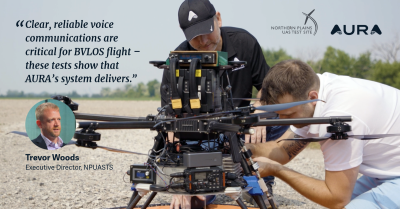
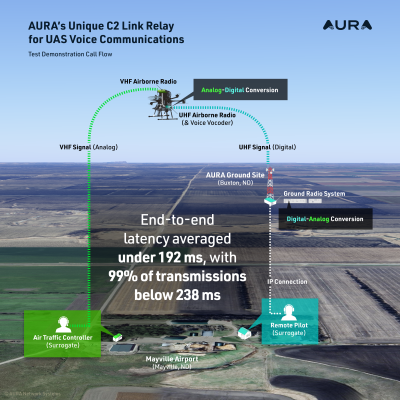
The FAA’s reliance on DO‑377B as the performance baseline for C2 links means that any system supporting BVLOS operations must demonstrate predictable latency, robust interference resistance, and compatibility with existing ATC infrastructure. AURA’s architecture was designed with these requirements in mind. The FAA‑sponsored testing documented average latency under 192 milliseconds, with 99 percent of transmissions below 238 milliseconds, placing the system well within the human‑factor tolerances expected for real‑time ATC communication. Voice clarity was validated using the POLQA standard, a globally recognized method for assessing speech quality under dynamic network conditions. The results confirmed intelligibility for both male and female voice samples across all scenarios, reinforcing the system’s ability to support the phraseology and timing expectations of ATC operations.
AURA’s hybrid UHF/VHF architecture is particularly relevant to Part 108. While the rule does not mandate a specific technical approach, it does require redundancy, resilience, and interoperability with legacy systems. By combining a UHF command‑and‑control link with a VHF voice relay, AURA preserves the operational norms of the NAS. Remote pilots can communicate with controllers using the same phraseology and timing as crewed pilots, while ATC continues to rely on familiar VHF workflows. This minimizes the need for procedural changes or new controller interfaces, aligning with the FAA’s preference for solutions that reduce operational friction.
The testing also emphasized terminal‑environment scenarios, which is notable because Part 108 anticipates BVLOS operations in airport‑adjacent airspace, transitional zones, and mixed‑traffic environments. These are precisely the areas where the FAA is most concerned about voice reliability. By demonstrating performance under these conditions, AURA is signaling that its system is not merely suitable for rural corridors or low‑density operations but is capable of supporting the more complex environments that Part 108 is expected to unlock.
How This Technology Eases Integration of Crewed and Uncrewed Aviation
One of the most significant barriers to integrating crewed and uncrewed aviation is the divergence in communication methods. Crewed aviation continues to rely on VHF voice as the primary means of interacting with ATC, while uncrewed aviation depends on digital command‑and‑control links. AURA’s system bridges this divide by enabling remote pilots to speak to controllers through a relay that preserves the sound, timing, and clarity of traditional VHF communications. This creates a common operational language between crewed and uncrewed aircraft, reducing the cognitive burden on controllers and eliminating the need for ATC to adopt new digital interfaces.
Predictable latency is another critical factor. ATC phraseology is built around timing expectations, and delays of half a second or more can disrupt a controller’s mental model of the airspace. AURA’s sub‑200‑millisecond performance ensures that remote pilot responses fall within the same temporal envelope as crewed aircraft, supporting smooth readbacks, clearances, and time‑critical instructions. This is essential for mixed‑traffic environments, where even small deviations in communication timing can have safety implications.
The system also strengthens the “equivalent level of safety” argument that operators must make under Part 108. By demonstrating that its voice link performs like a crewed aircraft radio, AURA provides operators with a concrete, FAA‑validated basis for asserting that their communications infrastructure meets the agency’s expectations. This is particularly valuable for operators seeking waivers, exemptions, or early compliance pathways ahead of the final rule.
Strategic Implications for the NAS
The implications of this technology extend beyond compliance. AURA’s deterministic, measurable voice‑relay performance aligns with the FAA’s long‑term vision for in‑time system-wide safety assurance (ISSA). As the agency moves toward architectures such as In-Time Aviation Safety Management Systems (IASMS) and ISSA, the need for reliable, low‑latency communication layers becomes increasingly important. AURA’s system provides one of the foundational elements required for these safety frameworks to function at scale.
The technology also supports the development of high‑density BVLOS corridors for cargo, inspection, and advanced air mobility operations. These corridors will require predictable C2 performance, seamless ATC interaction, and minimal controller workload. AURA’s architecture is one of the few that can scale without requiring ATC modernization, making it attractive for early corridor deployments.
Perhaps most importantly, the system reduces one of the FAA’s biggest concerns: the potential increase in controller workload associated with BVLOS operations. By enabling remote pilots to sound and behave like crewed pilots on the radio, AURA minimizes the operational differences that controllers must manage. This reduces friction, supports mixed‑traffic integration, and aligns with the FAA’s desire to introduce uncrewed operations without imposing new burdens on ATC facilities.
Bottom Line
The AURA/NPUASTS announcement is more than a technical validation; it is a strategic positioning moment for the BVLOS ecosystem. By demonstrating compliance with DO‑377B performance expectations, AURA is signaling that it can provide the communications backbone required for scalable BVLOS operations under Part 108. The system supports ATC workflows, reduces controller workload, and enables remote pilots to integrate seamlessly into the NAS. For operators preparing for the regulatory transition, this kind of aviation‑grade, FAA‑validated voice link is not just a capability but a prerequisite for the next era of uncrewed aviation and facilitates integration with traditional aircraft and ATC legacy methodology.










Comments