

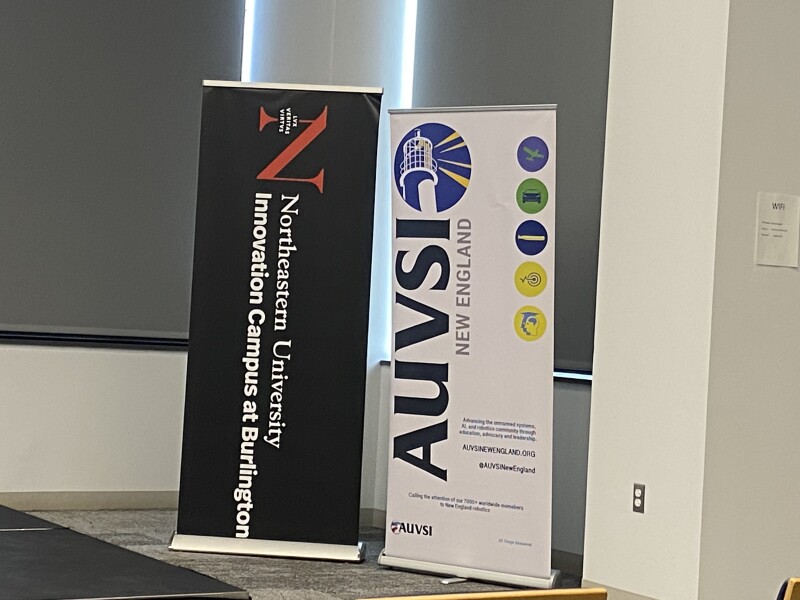
Last week, I had the opportunity to spend the day at Northeastern University’s Innovation Campus in Burlington, Massachusetts, for the AUVSI New England Next Generation Aviation Summit. The day-long event included panels and speakers talking about the current state of the uncrewed aviation sector, with this year’s event looking specifically at how recent executive orders have shaped the industry, and what practitioners and others in the industry need to know for the next stage of the industry. Much of the content focused on AAM and Counter-UAS, with some broader topics including the implications of Part 108 and routine BVLOS operations as well as the push for more domestic manufacturing for the industry.
It’s always difficult to sum up these types of events in a succinct manner, as there was a diverse range of thoughts and perspectives from speakers ranging from industry members to manufacturers to regulators within the FAA. With that being said, there were a few throughlines that stuck with me through the panel discussions and presentations. Below are my five biggest takeaways from my day with UAV industry leaders from across New England.
Part 108 is Getting Closer, but Its Ultimate Shape is Still Unclear
One of the most important messages that came through in the early parts of the event was that the long-anticipated Part 108 final rule is getting closer. Pamela Gomez, Director of UAS Safety and Integration within the FAA's newly reorganized Advanced Aviation Technologies Office, was the day’s first speaker and candid with the status: The rule has cleared internal FAA review and is now with the White House. "It has left the building," she said.
That being said, AUVSI President and CEO Michael Robbins, who spoke immediately after Gomez, offered a more cautious read on the rule itself. While he reported that the volume of BVLOS waivers and exemptions granted last year exceeded all previous years combined, a sign of significant momentum, Robbins warned that the draft rule didn’t fully reflect those operational lessons. In some respects, he argued, it could represent a step backward. In his view, the final rule needed to be performance-based and allow for the industry to evolve with the idea of creating new ways of reaching established standards, rather than being rigid in its requirements.
Robbins also flagged TSA's role in the joint rulemaking as a real concern. The agency's approach, he said, essentially transplanted airport security protocols onto UAS operations without accounting for the fundamental differences in risk profile. That issue remains unresolved heading into the final rule.
For operators, it’s important to recognize that the regulatory environment is shifting quickly, but it’s still unclear how the final rule will reflect today’s operations, and how that will map to the future.
Part 108 Will Professionalize the Industry
Closely tied to the BVLOS rulemaking conversation was a more pointed discussion about what Part 108 actually means for the operators who will have to comply with it. A panel on scaling advanced drone operations in New England was candid and important for operators to understand, with panelists emphasizing that this transition is going to be harder than most operators currently appreciate.
Rita Castonguay-Hunt, VP of Commercial Operations at ArgenTech Solutions, drew on her own experience navigating the FAA's operations-over-people rule as a cautionary tale.
"I really hope that with Part 108, we have a grace period and timelines to follow," she said. "We don't get rid of our BVLOS waivers right away. We need time for people to become compliant."
The concern is that without a clear transition pathway, operators who have built their businesses around existing waiver-based approvals could find themselves in limbo. The deeper issue, she argued, is an education gap.
"We have to get people up to speed. We have to get them to a true UAS program with aviation safety at its forefront."
Under Part 108, particularly for higher-risk operations, operators are effectively running a mini airline, with all the safety management systems, standard operating procedures, and organizational overhead that implies.
Stephen Michna, State Program Manager for UAS at Connecticut DOT, put it plainly: "If we don't prepare, it's going to look like a cluster."
Figuring Out the Supply Chain Issue
While the BVLOS conversation was one of the throughlines, the issues around supply chain and domestic manufacturing were right there alongside. A panel on domestic manufacturing and drone dominance featured some of the most candid admissions of the day, and the picture that emerged was one of an industry under serious pressure.
Much of that pressure traces back to the FCC Covered List and its unexpected scope. Robbins described his reaction to learning that the December 2025 action swept in all foreign-manufactured drones — not just Chinese-made systems — as a genuine shock. Michael Clatworthy, VP of Emerging Technologies at GreenSight, echoed that sentiment, noting that the internal assumption at his company was that "surely they don't mean Taiwan" when the language said foreign. As we know now, they did.
The practical implications are significant. Ryan Jarvis, CTO of Brecourt Solutions, was blunt about the current state of domestic component sourcing.
When asked what parts of the drone supply chain are hardest to source domestically, his response was: “All of it.” Motors, batteries, and AI compute modules are all constrained, compliant alternatives are limited, and lead times are unpredictable. "If I place an order for a hundred battery components right now, I may get six," he said.
The grace period on Chinese-sourced motors and batteries is running out. Clatworthy estimated roughly four months to the next compliance phase.
On a more optimistic note, the next generation of hands-on manufacturing talent was literally in the room: students from Brockton High School and Melrose High School showed off the work they are doing in robotics and the competitions in which they are participating, and quite successfully. This was an encouraging and much-needed reminder that the talent pipeline, while thin today, is being built with enthusiasm.
AAM is Moving from Theoretical to Practical
For those who have been watching advanced air mobility from a distance and wondering when the industry would move from concept demonstrations to something resembling real operations, the answer coming out of this summit was sooner than you think, and the eVTOL Integration Pilot Program is the mechanism that makes it possible.

Robin Grace, Chief of AAM Integration and Strategy at MassDOT Aeronautics, framed 2026 as a potential inflection point for the industry, driven largely by the eIPP program that came out of last year's Drone Dominance executive order. New England's own application wasn't selected, but the region landed as a co-applicant on Pennsylvania DOT's winning submission, meaning the use cases — including an airport feeder mission with Electra and a healthcare logistics mission with Joby — will still move forward.
Parker Vascik, Director of Product Strategy at Electra, was measured but optimistic about what this moment actually represents. "We're definitely at an inflection point," he said. "This isn't the big one — this is not the one that goes exponential — but we're now at the point that allows us to go from a bunch of OEMs having a sign saying 'have aircraft will fly' to 'where are the customers, let's go do initial operations.'"
The near-term business case that generated the most consensus was the airport feeder market. Logan Airport already has the infrastructure, the demand is measurable, and the model doesn't require significant greenfield investment to get started. Kevin Costello of VertiPorts by Atlantic pointed to FBO network electrification as the lowest-hanging fruit, leveraging existing aviation infrastructure rather than building from scratch.
Weather remains New England's specific challenge, with both panelists acknowledging that operational reliability in this region will require weather prediction capabilities that don't yet exist at the necessary resolution. That's a solvable problem, but it's on the critical path.
Counter-UAS in Public Safety
The closing panel of the day may have been the most timely. The conversation around counter-UAS technology has historically lived almost entirely in the defense world, but the combination of new federal authority, a major international sporting event on the horizon, and a rapidly expanding drone operating environment is pushing C-UAS squarely into public safety territory — and the people responsible for deploying it at the state and local level are still catching up.
Matt Kling, VP and General Manager of AI Systems at MatrixSpace, set the tone early. "Counter-UAS was still a very niche thing until very recently," he said. "It is no longer niche. And if anybody doesn't believe that, you've got to wake up. It is foundational to our national security."
The Safer Skies Act, passed as part of the FY26 National Defense Authorization Act, was the legislative development the panel kept returning to. For public safety operators specifically, the most significant change is the expansion of mitigation authority to first responders. Ryan Carr, Director of Innovation Applications at L3Harris, called it a fundamental shift: "The allowance for first responders to actually initiate mitigation — that really helps take the gloves off."
The FIFA World Cup this summer is shaping up as the first real stress test of that expanded authority at civilian scale — effectively eleven simultaneous Super Bowls, as Robbins put it earlier in the day, each requiring coordinated C-UAS coverage.
But Brian Grant of American Robotics offered the most grounded perspective on where the gaps actually are. "It's one thing to buy a system and say 'yep, there it is,'" he said. "It's another to say 'I'm going to take it out of the sky and make it not a threat.'" For public safety agencies, the technology is increasingly available. The harder work — training, interagency coordination, legal authority, and operational doctrine — is still being figured out in real time.











Comments