

Earlier this month, professionals from all corners of the UAV industry, on both the commercial and defense sides, came together for the annual XPONENTIAL conference and exhibition, put on by AUVSI. This year’s conference was in Detroit, an apt backdrop for this particular moment in the industry, given the large push toward domestic manufacturing for both defense and commercial airframes and components. We’ll have more on the fitting location for this year’s event next week, but the energy around what that city in particular could do for this industry truly was palpable throughout the week.
Beyond the city of Detroit, though, there were plenty more insights and takeaways from a week that included great panel discussions and meaningful conversations with familiar faces and new acquaintances across the industry. Below, you can find some of the topics that have been sticking with me since getting back to my home in Maine following the trip.
Building the Workforce
One of the biggest throughlines in conversations throughout the week, both on the exhibit hall floor and in panels, was the talent pipeline, and the numbers alone make clear why. At the end of last year, there were 3.5 million open STEM-related engineering jobs in the United States left unfilled, and the pipeline of students entering the field is not keeping pace with the number of experienced professionals aging out of it. RoboNation President Darrell Davidson put it plainly in a keynote address, telling the crowd: "The numbers don't really add up in our favor."
What made the workforce conversations particularly interesting, though, was where panelists identified the real gaps. Technical skills, by most accounts, are not the primary problem. Andrew Wolfe, the co-founder of Drone Brothers, summarized it well, saying that pilots "execute flawlessly," but many don't know to walk into a job site trailer and introduce themselves to the superintendent. Soft skills, professional readiness, and entrepreneurial thinking kept coming up as the harder gaps to close. As one panelist framed it, education and technology are simply "not keeping up with each other," with curriculum development running five to six months behind the technology it is trying to teach.
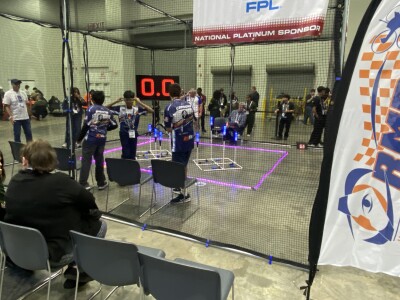
There is work being done to shape the next generation of this technical workforce, though. That was on display on the show floor at this year’s event, with a competition being held for middle and high school students flying drones, with both a “Capture the Flag” style game and an obstacle course race.
Embracing the Dual-Use Route
Supply chain security and the blurring line between commercial and defense technology ran as a throughline across keynotes and panel discussions alike. AUVSI President Michael Robbins drew on the history of Detroit and the Arsenal of Democracy – a phrase made famous by President Franklin D. Roosevelt – to make the stakes concrete. "The strategic advantage belongs to those who can manufacture, scale, and deliver when the stakes are highest." His message, and that of Assistant Secretary for Industrial Base Policy Michael Catanzariti, was that the United States has spent decades allowing that capacity to erode.
Chip War author Dr. Chris Miller sharpened the point, arguing that it is now "basically impossible to separate manufacturing supply chains from defense industrial preparedness from geopolitical power."
These sentiments cut through a lot of the feeling on the show floor at this year’s XPONENTIAL, with which the Michigan Defense Expo (MDEX) co-located, as the building up of this defense industry should have downstream effects on the commercial market. The commercial industry will be – and in many cases already is – looking for domestic alternatives for their future fleet needs. It’s clear that companies are looking to dip into both of these markets. This was made particularly evident by multiple conversations with defense-focused companies asking me questions – quite the role reversal for a journalist – about the commercial industry as they look to potentially serve that market in dual-use roles. While this certainly isn’t a new concept, look for it to be more commonplace over the coming years.
Artificial Intelligence
There is a lot of use already for artificial intelligence across a number of different industries. A conversation with Nitin Gupta at Flytbase’s booth hammered that point home, with Gupta mentioning a number of industries, including public safety, oil & gas, utilities, and construction, among others, as verticals that are already seeing their work transformed by technology like what his company is offering the industry.
As is the case for any technology-related conference these days, AI came up in nearly every session, though the conversations were more grounded than the hype cycle might suggest. On the utilities side, panelists from Dominion Energy, AEP, and the New York Power Authority spoke candidly about where AI is actually delivering value and where organizations are still finding their footing. AEP's Patrick Rackley offered one of the more honest assessments of the week: "Full disclosure, without data, we're flying by the seat of our pants."
The technology has real promise for moving inspection programs from reactive to proactive, but only when the underlying data management infrastructure supports it.
Kate Darling, author and social robotics researcher, offered the most philosophical take in a keynote talk, pushing back on the instinct to measure AI against human intelligence as the baseline. "The true potential of robotics and AI is not to recreate something that we already have," she said. "It is for us to be creative and think outside of the box and partner with these technologies in what we're trying to achieve." That framing felt like a useful corrective for an industry that can seemingly chases capability for its own sake.
BVLOS Operations
Last year’s Part 108 NPRM – and a final rule that is hopefully not too far over the horizon – gave the BVLOS panel plenty to dig into, and the panel did not shy away from the complexity ahead. We covered this panel during the event, but it’s worth hammering home the ultimate message.
The short version: some operators will be ready, many will not, and the absence of a formal phase-in period in the proposed rule is a real concern across the board. Rob Knochenhauer was direct: "Nobody in the industry is going to be ready for Part 108 on day one." What people do between now and the release of the final rule, though, will determine just how quickly people will be able to get on board.












Comments