

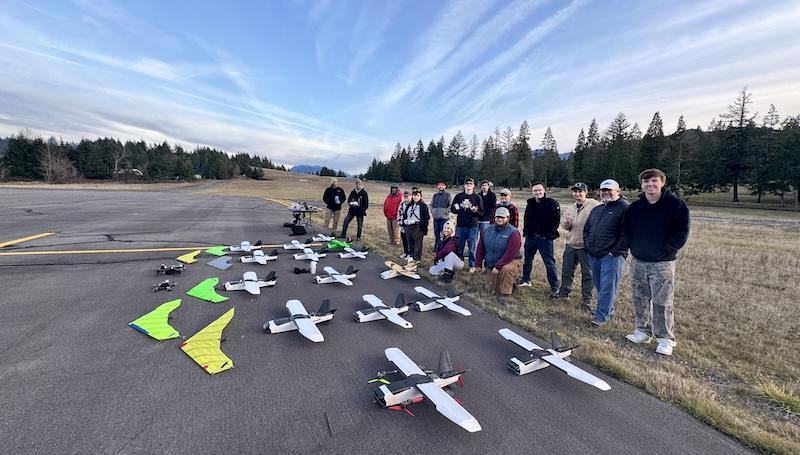
A rare opportunity to combine hands-on UAS training with wildfire mitigation has been a result of a Memorandum of Understanding between the Oregon Department of Aviation (ODAV) and Lane Community College (LCC).
Since the start of the partnership in 2024, students of LCC have been conducting experimental flights out of Oakridge Airport, testing new ways to detect, mitigate, and extinguish wildfires in the state.
To learn more about this partnership and its effects on the surrounding communities, Commercial UAV News spoke with Kenji Sugahara, director of ODAV.
During the conversation, it was clear that creating public trust was a major component weaved into the program’s curriculum. The Oakridge area is very rural, and the community isn’t used to drone operations, so gaining public trust was step one.
“The program is helping create that bridge between public safety and education. It makes a compelling story to the local community that they understand the drone operations are meant to help with their resiliency by preventing natural disasters,” explained Sugahara.
Treating the idea of public transparency as a prerequisite, LCC set up a meet-and-greet day at Oakridge Airport for the surrounding community to learn about their operations and see the flights themselves.
“At the very start of the partnerships, one of the things we did was hold a meet and greet day,” Sugahara said. “We invited the members of the public and the media to come out - even the mayor came! Students demonstrated some of the drones and activities we're planning on performing. This gave people an opportunity to see the drone operations for themselves, ask questions, and to see what projects we are working on.”
Why does this partnership matter to the public? The main goal of each entity is to create an updated wildfire mitigation system for the state. The current emergency plan consists of a network of cameras set up by the Department of Forestry that help detect fires and a singular aircraft to help look for a fire.
There are a few flaws in these systems that drone operations can help fix. For instance, the cameras are only capable of detecting a fire from afar and can’t inspect it closely to give responders critical information like its origin or size. A drone can fly closer to the fire than a plane and can get a better view of the fire than the ground-based camera. This leads to clearer information about the size and severity of the fire, informing fire crews of the best solution to extinguish it.
The Oregon Department of Aviation is working closely with the FAA to get the right approvals to run this project as a BVLOS operation, but Sugahara doesn’t see this as a big hurdle to the overall timeline. Rather, the bigger question at hand (and one for the whole UAS industry) is that of electronic conspicuity and how they will navigate that to ensure safe flights.
“I don't see [Part 108] as a huge regulatory hurdle,” Sugahara told CUAV News. “It'll be very interesting to see which pathway that it goes down. One of the things that I mentioned in our comments to the FAA was that we don't solely rely on electronic conspicuity, because instead layer it with other detect-and-avoid technology where you have multiple levels of mitigation. Electronic conspicuity one of them, but you also need redundancy in terms of ground-based sensors to also supplement it.”
This partnership aims to bring more than just wildfire fighting to Oregon. There is a long-term strategic vision to create a trained talent pool that attracts wildfire tech companies to Oregon and strengthens the state's overall emergency response capacity.
As Sugahara put it, “companies really want to locate where they have a talent pool, and this the first step in creating that talent pool.” And that is exactly what LCC is doing now.
Other schools in the area that focus on forestry and research compliment what students at LCC are learning in the drone program. This leads to a seamless intersection of skills for a workforce in wildfire management.
“On the research side we have Oregon State University that has a very big forestry program. If we can start feeding into those programs, then we have students who have been educated on drones, engineering, forestry, and technology, which leads to additional research happening on that side using these technologies,” said Sugahara.
“That, in itself, becomes very attractive to companies that want to get into that wildfire side. They have that ready resource of pilots who understand engineering and really can help create and ecosystem of wildfire fighting with advanced air mobility.”
“Just starting with the low-level community colleges, that is an easy entry point to and then from there, when the communities around these community colleges start seeing the benefits of not only the technology, but the Workforce Development and the education and all, there's a much higher acceptance rate of these new technologies as well.”
As wildfire seasons grow longer and more destructive, Oregon's proactive approach of layering drone technology with existing detection systems, pursuing BVLOS approvals, and cultivating a pipeline of cross-disciplinary talent will position the state as a potential national model. With Oregon State University's forestry expertise feeding into the ecosystem and wildfire tech companies increasingly drawn to where the talent is, the ripple effects of this partnership could reshape how the entire industry thinks about wildfire mitigation.
Ultimately, as Sugahara's vision makes clear, the work beginning at the community college level is the critical first step. When communities see the direct benefits of safer forests, better-equipped first responders, and local economic opportunity, acceptance of new technologies follows naturally. And that, in the long run, may be the program's most lasting contribution.









Comments