

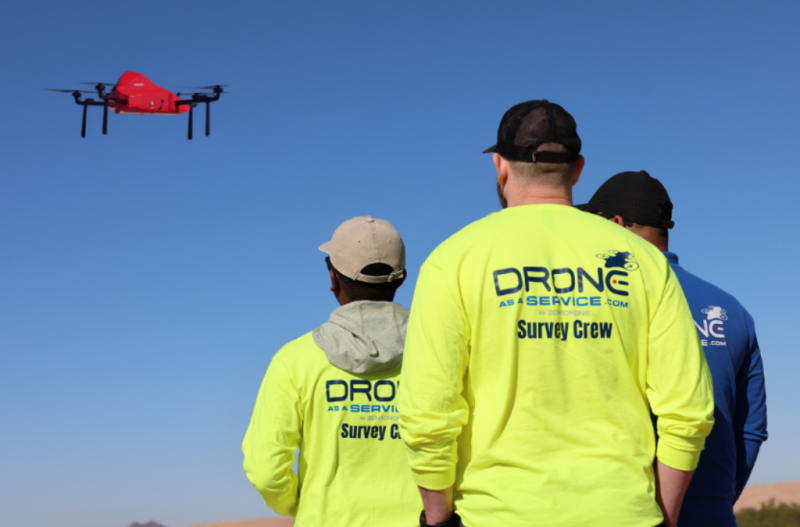
We know that drone-based work can provide considerable value to a variety of organizations across many different verticals, whether it’s a grower who needs their fields monitored, a construction owner who wants regular site check-ins, a business owner requiring security, or a utility that is looking for more efficient powerline inspections. For those looking to start taking advantage of the technology, one of the key questions to ask first is whether it makes more sense to have an in-house team flying the missions or to outsource to a third party.
The answer to that question will come down to specifics about the organization, but while having an in-house team might sound like the right answer for many at first, the truth is that this model doesn’t work for everyone. For many, a third-party offering will be more beneficial to their needs, offloading the expertise, regulatory compliance questions, and more to a third party while still benefiting from the data coming in from the UAS.
This is the topic of an upcoming webinar to be hosted on Commercial UAV News, which will be sponsored by ZenaTech. This 60-minute discussion will be moderated by ZenaTech creative director Mark Masterson and will feature insights from ZenaTech’s Phil Franklin, Linda Montgomery, and Tom Bellis, along with Cardinal Land Surveying’s Donald Rudy, to talk about the company’s Drone as a Service to talk about what they offer to organizations across multiple verticals, and the advantages that come from outsourcing drone operations rather than building an in-house program. Follow the link below for your free registration to the webinar, which will take place on October 6 at 1:00 PM Eastern Time.
Building an internal drone program involves more than buying an aircraft. Organizations need to budget for equipment, train and certify pilots, stay current with regulatory requirements, secure insurance, and maintain the fleet. For companies in less automated environments or with tighter budgets, those requirements can delay adoption for years. The webinar will review each barrier and explain how the Drone as a Service model addresses it. Under this approach, customers commission the drone services they need, when they need them, without purchasing hardware. The discussion will be organized around the three pillars of the model: accessibility, autonomy, and scalability. Speakers will also cover pay-as-you-go and subscription options that let businesses test drone solutions on a smaller scale and expand as results justify it, lowering the financial risk of getting started.
Drone as a Service combines local surveying and geospatial expertise with drone technology to deliver tailored solutions for more than 15 industries, including construction, mining, oil and gas, agriculture, utilities, logistics and public works. The service has built a network of 28 drone hubs across North America, Europe and Australia. Speakers will discuss how drone surveying can produce denser data than traditional methods, improve worker safety and return results faster. The session will also give attendees an overview of the platforms used to collect that data, including the IQ Square, IQ Quad, ZenaDrone 1000 and IQ Nano. The panel will cover how AI supports autonomous flight, data processing, inventory scanning, mapping, and change detection. Donald Rudy will add the perspective of a surveying firm that joined the network in 2025 and has integrated drones into its daily operations.
Outsourcing flight operations raises practical questions about the data those flights produce. The webinar will cover how customer data can be securely processed and stored, and how it can integrate with existing business, CAD, GIS, and warehouse-management systems. Panelists will also discuss the role of people as drone operations become more autonomous. Professional expertise and human oversight remain essential even as automation increases. The session will close by looking at how drones help organizations improve safety, efficiency, and decision-making while meeting aviation, environmental, and industry regulations. Attendees will also receive guidance on where to start with a service-based model and what to expect once they do, which gives organizations weighing in-house and outsourced options a clearer basis for that decision.
Complete your free registration today to reserve your spot for the live discussion. Registrants also receive an on-demand recording – so register even if you can’t make it live – as well as any presentation materials.









Comments