

Sponsored by Drone as a Service
For any organization that needs drone-based aerial data, whether in the form of a land survey, a building inspection, or an agricultural scan, there's a decision point that comes up early in the process: hire and train pilots in-house, or bring in a third party that already has the people, equipment, and processes in place.
It's not always an obvious call. For most businesses, drone work is not a daily need, which makes staffing a full-time program a fixed cost against demand that ebbs and flows. That mismatch is exactly what's driving more construction firms, engineering companies, municipalities, and property owners toward hiring drone service providers rather than building their own capabilities from scratch.
The Case for Outsourcing
Phil Franklin, the VP of Operations and Business Development for the Americas at ZenaTech, has watched that calculation play out with customers.
"If you hire a pilot to fly, that pilot may not fly every day. That's an expense that you're going to accumulate," Franklin said in a recent conversation with Commercial UAV News. "If you hire a third party, we already have those folks on standby ready to get that job done, whatever the circumstances.”
Availability is only part of it. There's also a skill gap between operating a drone and operating one productively for a specific deliverable, whether that's a boundary survey, aerial photography, or topographic mapping.
"Yes, you can learn to fly a drone, but you have to learn to fly the drone in a way that you can actually conduct the work where it's fruitful," Franklin said.
Add in the financial risk of a staff member handling a task that isn't part of their normal job, and the case for outsourcing starts to look less like a luxury and more like risk management. As Franklin noted, if something isn't collected correctly the first time, it’s no longer on you as the organization to foot the bill. Someone else is now responsible for it.
Inside ZenaTech’s Drone as a Service Model
ZenaTech operates as a multifaceted company, running both software as a service and Drone as a Service. Over the past several years, it has grown largely through acquisition, picking up 25 land surveying companies across North America, Europe and Australia, along with multiple software businesses, while expanding internationally across Asia. That growth strategy is central to how the Drone as a Service division works.
"We introduced this model as a means to more quickly get our capabilities into the hands of customers who need access to this type of technology but don't yet have the finance available to make those things happen as quickly as they may want to," Franklin said.
Because ZenaTech has acquired existing land survey agencies, many of the pilots doing the work are the same people who worked at those companies before, now trained on ZenaTech's specific drone capabilities in addition to their existing surveying expertise.
The network of acquired locations also translates directly into response time. Franklin said ZenaTech can typically get a crew on-site within two to three days of a customer request, depending on location, compared with the two to three weeks customers might otherwise wait for a survey to be scheduled.
"If it's just strictly you call me today, how soon can I get folks on site to get a survey done? I would say no more than three days, regardless of where they are in the U.S., unless they're somewhere we're not legally allowed to operate," he said.
Drone as a Service began for ZenaTech in Ireland, with their focus in that market being on precision agriculture, where they use multispectral scanning for plant analysis. That work is still being done today, and the organization has since expanded into North America. There, the focus is primarily on land surveying, but they have also expanded into power washing. Franklin said mining and oil and gas are next on the roadmap, given how much those industries rely on the same lidar and multispectral scanning capabilities already in use elsewhere.
Sensors and the Data Processing Pipeline
On the sensor side, ZenaTech's offerings include lidar point cloud capture, photogrammetry, multispectral and thermal scanning, ground-penetrating radar, and is in the process of integrating Optical Gas Imaging (OGI) infrared cameras for leak detection. Importantly, the company doesn't stop at data collection.
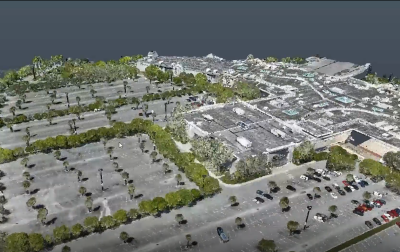
"Our field technicians are going to go out and do the groundwork. They're going to collect control points. We're going to fly with lidar, capture all the point clouds, and process these point clouds," Franklin said, describing a pipeline that runs through Drone as a Service's processing team before a licensed surveyor signs off on the final product.
In addition to that work, the company also runs an indoor drone product for warehouse and logistics environments, built for tasks like scanning QR codes, RFID tags, and barcodes for inventory counts, and generating 3D maps of racking and shelving. It's a smaller piece of the business today, but one the company has been developing over the last couple of years.
Absorbing FAA Compliance Risk
One of the other big value points that ZenaTech provides is absorbing regulatory complexity that customers would otherwise have to navigate themselves, including FAA waivers and coordination near restricted airspace.
"These are things that can be a liability if you don't understand how to approach them correctly. And so, since we have that experience, it lifts that liability off of the client," Franklin told CUAV News.
Looking ahead, Franklin expects the eventual rollout of Part 108 and broader BVLOS standardization to accelerate the Drone as a Service model further, particularly for customers who keep equipment on-site full time.
"If I can have something on site for my customer 100 percent of the time and I can fly that remotely, then obviously the work can be done more consistently and regularly," he said.
Most customers, he added, still expect a pilot physically present to watch the work happen, but that's likely to change as BVLOS matures and trust in autonomous operation builds.
Franklin also pointed to ZenaTech's vertically integrated structure, building its own hardware and batteries rather than depending on outside suppliers, as a reason the company can adapt to individual client needs faster than competitors working through third-party manufacturers.
For organizations still weighing whether to build a drone program internally or hand it to a provider, the calculation increasingly comes down to the same factors Franklin described: availability, skill, cost certainty, and speed.







Comments