

On a recent trip to Argentina, I had the opportunity to visit family who own and operate a large agricultural concern with thousands of acres of corn, soy, and wheat. An agronomist in charge of the large field was proud to show me videos of his drone use, in which he was using a DJI Agras T100 to spray his crops. When I asked him about the controversy around Chinese brands, he looked puzzled.
“What controversy?” he asked.
That’s when it hit me. Any controversy around Chinese drones is much more muted in many other countries around the world. I called a few friends and customers in Chile, Uruguay, Bolivia, Colombia, Spain, Portugal, and Italy, and the same answer came up again and again.
Regardless of the merits of the argument that created the official animosity against DJI, the fact remains that since the modern uncrewed aviation industry began to take shape around 2012 or 2013, one manufacturer has accomplished something no U.S. drone company has come close to matching: becoming the world's dominant commercial drone manufacturer.
Those arguments, it should be noted, largely revolve around national security. Proponents of limiting or outright banning DJI's presence in the U.S. point to potential data security vulnerabilities that could come from having such a large presence of Chinese-made technology in the space. This was the basis of the FCC's Covered List decision, among other regulatory decisions. DJI had welcomed an audit of their security measures. No such audit came from the U.S. government, though the company released data from a third-party audit earlier this year that showed no critical, high, or medium risk findings.
The scale of this achievement is easy to underestimate. DJI didn't just develop a successful aircraft. It built an enormous manufacturing and supply-chain ecosystem around small, unmanned aircraft, then steadily expanded its product range from consumer drones into professional photography, surveying, inspection, public safety, agriculture, and industrial applications.
Today, DJI's position remains extraordinary. A 2026 Financial Times report estimated that the Shenzhen-based company accounts for as much as 80 percent of the global non-military drone market. China's broader manufacturing ecosystem gives DJI access to a concentration of electronics, motors, batteries, sensors, cameras, circuit boards, and other components that would be extremely difficult for a new competitor to recreate quickly.
It should be mentioned that U.S. lawmakers and industry groups have also argued that Chinese government subsidies and industrial policy support DJI’s manufacturing, lowering its costs relative to unsubsidized competitors. DJI denies the claim.
The clearest indication of DJI's U.S. footprint comes from U.S. registration data. A 2025 submission to the Commerce Department by the American Drone Data Protection Coalition (ADDPC), a group that has argued against restrictions on Chinese-made drones, reported 285,552 DJI aircraft registered under Part 107 in 2024, representing approximately 90 percent of the registrations in the dataset. By comparison, Skydio had 9,995, while Freefly had 1,104.
Those figures are registrations, not annual production or sales, so they shouldn't be treated as a direct measure of DJI's factory output. Still, they demonstrate something important: The United States has accumulated an enormous installed base of DJI aircraft while domestic manufacturers remain dramatically smaller in unit volume.
The question, therefore, is not simply whether U.S. companies can build a drone as capable as a DJI. They can. The harder question is whether they can build hundreds of thousands, or potentially millions, of drones at competitive prices.
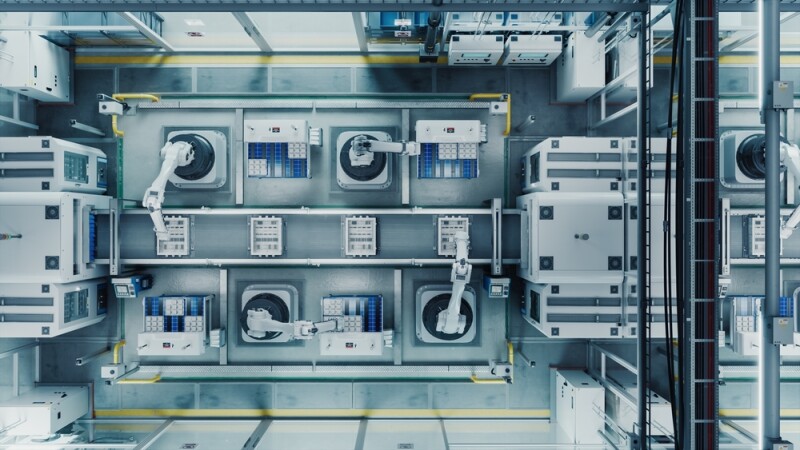
That is a manufacturing problem of an entirely different magnitude. DJI lives in an ecosystem of such supply-chain complexity that it's not just building drones; it’s matching an entire industry that can reliably supply batteries, propellers, motors, wiring, etc.
America Is Building Capacity, But from a Much Smaller Base
The most visible U.S. response comes from companies such as Skydio, which has made manufacturing capacity central to its strategy.
In April 2026, Skydio announced plans to invest $3.5 billion in the United States over five years to expand manufacturing, research and development, and its domestic supply chain. More than $1 billion of that investment is intended for domestic suppliers. The company also plans to build a new manufacturing facility five times larger than its current space.
The numbers surrounding Skydio illustrate both the progress and the challenge.
The company says it has shipped more than 60,000 flying robots to over 3,800 customers, including public-safety agencies, the U.S. military, allied nations, and utility and energy companies. It describes itself as the largest U.S.-based drone manufacturer and says it already produces more dual-use drones than any company outside China.
That is a substantial accomplishment for a U.S. manufacturer.
But compare 60,000 cumulative aircraft shipped with the 285,552 DJI aircraft registered in the United States in just the 2024 Part 107 dataset.
That still doesn't capture DJI's global installed base. DJI has spent more than a decade refining its production processes, developing suppliers and driving down component costs through enormous volumes. Its advantage is not simply the size of one factory. It is the manufacturing ecosystem surrounding the factory, even beyond the alleged government subsidies.
A U.S. company can build an assembly plant relatively quickly. Building a competitive domestic ecosystem for batteries, motors, electronic speed controllers, cameras, sensors, circuit boards, precision machining, plastics, and other specialized components is much more difficult.
Skydio's $3.5 billion commitment recognizes precisely that problem. The company's SkyForge initiative is intended not merely to increase final assembly but to encourage domestic production of critical components. Skydio says it plans to work with suppliers and, in some cases, help create domestic manufacturing capabilities that do not currently exist.
In other words, America is discovering that manufacturing the drone may be the easy part. Manufacturing everything that goes into the drone is the real challenge.
The Race May Not Be About Reproducing DJI, But Replacing Its Volume
A key distinction separates building a U.S. competitor to DJI from replacing DJI in the U.S. market.
The United States does not necessarily need to manufacture a U.S. version of every DJI model. It needs enough competitive domestic capacity to satisfy the applications in which U.S. customers can no longer, or increasingly do not want to, depend on Chinese-built aircraft. In other words, niche markets.
Public safety, critical infrastructure, utilities, defense and government customers increasingly want secure supply chains and aircraft designed around autonomy, cybersecurity and specialized missions. As a result, Skydio has shifted toward higher-value autonomous systems rather than trying to compete with DJI across the entire consumer market. Its 2026 financing announcement said the company was generating hundreds of millions of dollars in annual revenue while expanding production for public safety, defense, critical infrastructure, and security customers.
This could give U.S. manufacturers a path around DJI's greatest advantage: Volume.
It is extremely difficult to compete with DJI by making another inexpensive camera drone and attempting to match its production economics.
Autonomy is one example. Specialized sensors are another. Secure communications, BVLOS capability via fixed-wing designs, fleet management, automated inspection, and integration with enterprise systems could become more important than the basic aircraft itself.
But eventually, even those markets will require scale. If drones become infrastructure rather than specialized equipment, manufacturers will have to move beyond tens of thousands of aircraft to hundreds of thousands, and potentially millions, across multiple categories.
That is where the U.S. manufacturing challenge becomes much bigger than Skydio or any other individual company. The United States will need an ecosystem. It will need component suppliers, battery manufacturers, electronics companies, robotics manufacturers, software companies, testing facilities, tooling companies, and specialized production workers. It will need sustained demand large enough to justify the capital investment required to build it all.
And it will need time.
The encouraging news is that the process has begun. Skydio's planned $3.5 billion investment represents one of the largest commitments yet to U.S. drone manufacturing, with more than $1 billion specifically targeted at domestic suppliers and thousands of anticipated new jobs.
But the uncomfortable reality is that DJI is not standing still. While the U.S. tries to build a domestic drone manufacturing ecosystem, DJI continues to operate within one of the world's most mature electronics manufacturing environments. That means the United States is trying to build one fast enough to compete with an industry that already exists.
The question is whether the U.S. can build enough of them, at the right price, with enough domestic components, and quickly enough to replace a manufacturer that has spent more than a decade developing enormous scale, building a global footprint, and maintaining affordable prices.
And that raises the final question: Is it worth it?
Imagine, for a second, a group of investors considering launching an airline in a developing country, and instead of choosing between Boeing, Airbus, or Embraer aircraft, they decide to encourage that country's government to develop a new aircraft manufacturer to compete with the big three.
Crazy, isn’t it? Well, if it’s crazy in traditional aviation, why are we trying to rationalize that as normal for uncrewed aviation?
Trying to build a new aircraft manufacturer to compete with Boeing, Airbus, and Embraer is a losing proposition, and I believe the same applies to remotely piloted aircraft. Local manufacturers around the world will create successful models for niche markets, but challenging the dominance of a successful, affordable brand may be an exercise in futility.
The lessons from traditional aviation continue to make sense. The big three are here to stay, and trying to create the necessary manufacturing ecosystems is a non-starter. Does it make sense to do the same for an established brand with an obvious first-mover advantage?
Only time will tell.







Comments