

Commercial UAV Expo held its second annual innovation spotlight competition ahead of the 2026 event. The competition invited companies that have recently developed or launched products to submit their stories for a chance to be named the winner. This year, so many submissions came in that it felt unfair to have voters narrow down the field to a single winner. Instead, the submissions were broken down into categories, with one winner per category.
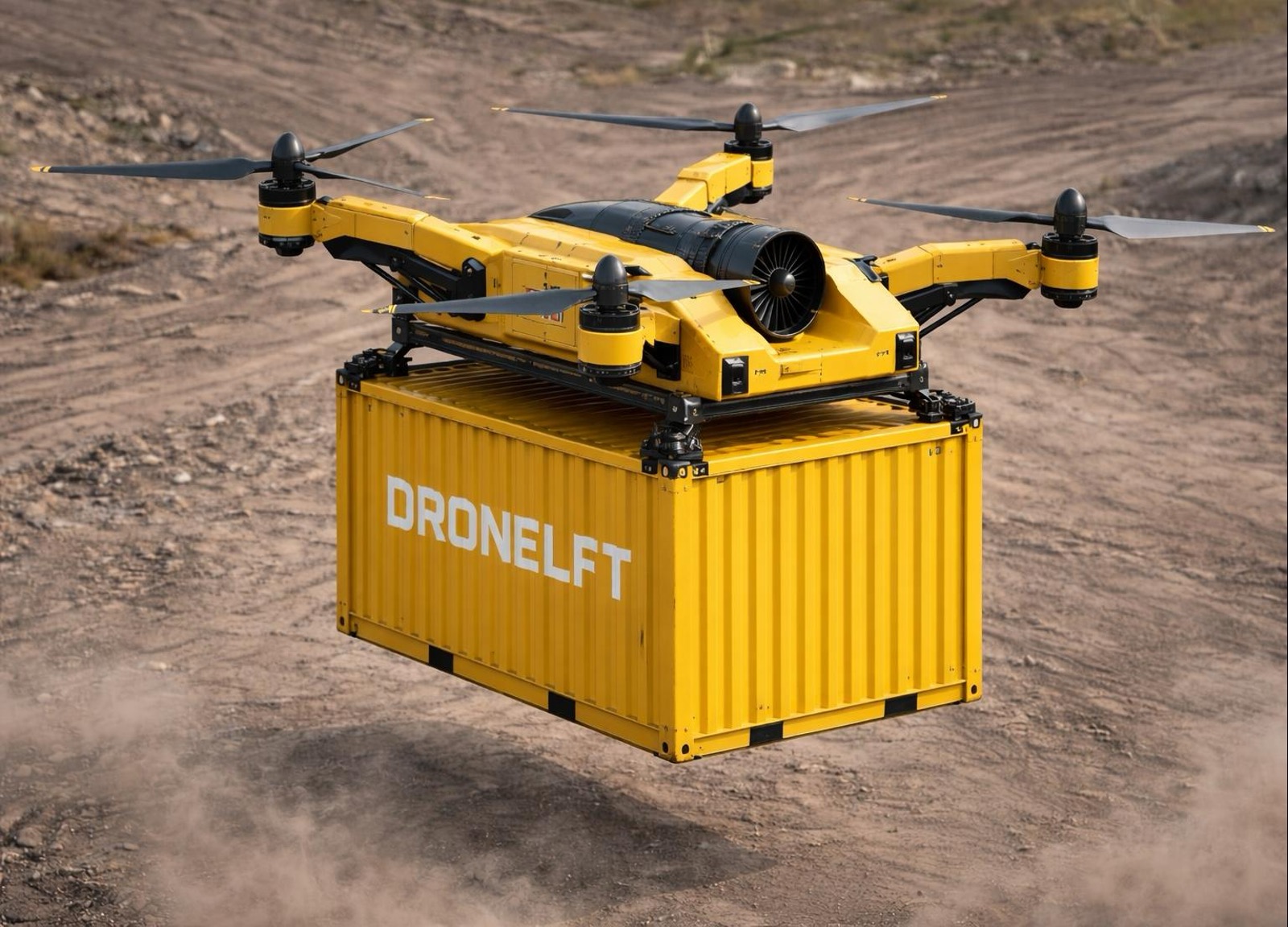
DroneLFT was awarded the innovation spotlight for the Aircraft Platforms & Complete Systems category. DroneLFT is a heavy-lift, high-volume unmanned cargo drone platform designed for infrastructure-scale logistics. Its goal is to create an aerial logistics network for hard-to-reach areas that need large-scale deliveries, such as mountaintop mines, inter-island communities, and offshore wind farms. The company also sees a role for its drones at the Mexico-U.S. border near its home base.
The El Paso Borderplex-based company is designing a VTOL drone capable of carrying a container in the 2,000 to 5,000+ pound range on missions of roughly 100 miles.
Commercial UAV News spoke with DroneLFT co-founder and CEO Sean Pond to learn more about the venture.
With many team members coming from the military, the company has seen firsthand the gaps in the drone delivery sector, the ones limited by weight and location.
"I spent a career in the U.S. Army as a transportation and logistics officer. I've been deployed all over the world into some austere environments that are really hard to move supplies. I've seen it with my own eyes and experienced it," Pond said.
Currently, aerial delivery of this size is carried out by helicopter, but that isn't always a viable option. Heavy-lift manned helicopters can cost $10,000 to $25,000 an hour, Pond said.
"So, there's this big gap of moving cargo that is in that 2,000 to 5,000 pounds that we're looking to service," he said.
The other part of the gap is that today's drone delivery services can't handle loads this large.
"We're designing and building a heavy-lift autonomous cargo drone platform. It's to fill the gap between the thousands of small drone companies that exist, whether they're delivery companies or doing surveillance or recovery," Pond said.
Despite transporting goods in a large container, DroneLFT expects to have a small physical footprint at loading and delivery sites, which is essential for the types of areas it will serve.
"Our drone is going to be able to hover, connect to a container, and vertically take off and go. We're looking at a very small footprint, like a drone landing zone," Pond explained.
DroneLFT plans to keep its first version simple. Pond noted that the minimum viable product will rely heavily on off-the-shelf components, such as rotors from whichever manufacturer makes the most sense. The company is looking at engine suppliers including Rolls-Royce, Pratt & Whitney and Hill Helicopters, and the drone will be turbine-powered and run on jet fuel.
Pond explained that mines high in the mountains, inter-island communities with cargo challenges and the oil and gas industry have already expressed interest in DroneLFT and its plans to ease logistics bottlenecks. All of these areas fall into the "hard to reach" category, but one more place needs this technology that is easily reachable yet still a logistical challenge for freight: the Mexico-U.S. border in El Paso, Texas.
Pond stressed that the border is a main artery for shipping from Mexico into the United States, with the port serving around 3,000 semi-trucks a day. Many of those trucks carry time-sensitive equipment that is held up when the crossing gets congested.
"We've spoken to companies south of the border that have time-sensitive equipment from the medical or automotive sectors who suffer when their freight gets stuck at the border, and they are losing a lot of money per hour. So having something that can quickly hop over, move back and forth is something these companies have been very interested in."
For a company still designing its first drone, the team behind it may be its strongest selling point. Pond said DroneLFT's founders and advisory board include rotorcraft experts and people who have worked at companies like Gulfstream, Joby and Honda Aircraft, along with geospatial mapping specialists and former helicopter pilots.
"We have a really strong team," Pond said. "And I feel really good about who is putting this together."








Comments