

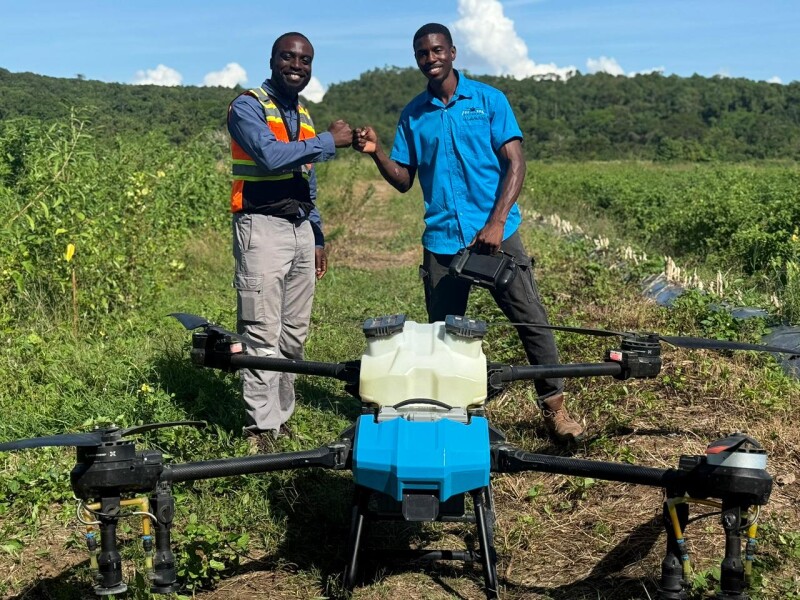
When they were just getting started in the UAS industry, Garnett Harris and his team at their new company, SkyCrop Solutions, were out to prove that they could provide value to growers in Jamaica with their spray drones. The good news is that they had a job lined up to prove the technology's viability. The bad news is it was a two-hour drive away, plus a mile-long hike from there. Equipped with a homemade, GPS-less prototype running QGroundControl, they successfully sprayed the area – right before crashing the drone immediately after the mission’s conclusion.
That was enough, though, to prove a concept the team had been working toward and is now bringing to customers across Jamaica, and to expand to other parts of the Caribbean. For Harris, the journey started around 2018 and 2019, when he was building FPV drones as a hobby. With an engineering background and equipped with tutorials and forums across the internet, he was pushing payload limits on some rough airframes to build his own drones.
Eventually, his stepfather came to him with a potential plan to turn this hobby into a career, pointing specifically to the agriculture industry as a place where Harris’ experiments with payload capacity and the potential for ROI intersect.
That first prototype was little more than an X-frame bolted together with a small tank and a pump, triggered by pneumatic nozzles wired to fire on command. There was no GPS and no safety net. Harris and his team sourced parts wherever they could, salvaging damaged components and building their own battery packs before Hobbywing motors and off-the-shelf packs became available to them. They calculated voltage ranges by hand and ran some of the oldest autopilot firmware still in circulation.
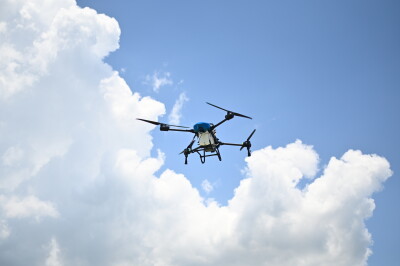
The one-acre job ended in a crash, but it didn't slow the team down. If anything, it sped things up.
"We knew we would be broke, but it didn't faze us," Harris said. "We knew what we were going to become from there on. This is our lives now. We are in the drone industry for good."
Early on, the company started by customizing and repairing DJI and XAG drones for other operators, work that gave Harris and his team a detailed look at how established manufacturers solved airframe and payload problems. That work became the basis for SkyCrop's own designs.
"We're not reinventing the wheel," Harris said. "We have our models that we actually reverse engineer from other models, because we assemble and customize drones for other users using DJI and XAG and so forth."
That process has produced a lineup that now includes a survey drone integrating Rock Robotic lidar and a heavy-lift model capable of carrying up to 200 kilograms, built with NDAA-compliant, U.S.-approved components. The company still imports its spray tanks, though a local supplier has begun developing tanks domestically, and SkyCrop has leaned into 3D printing, first for prototyping and increasingly for final production parts, as it works toward sourcing more components locally.
The company runs on a team of seven. Most work both sides of the business, serving as pilots on spray jobs and as technicians on the production line, depending on the needs at a given time. A separate crew handles final assembly, testing, and packaging for export. Harris also works with a remote developer based in the U.S. and a contact in China who supports SDK work.
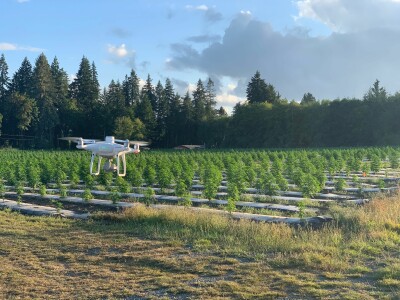
The company fields a small fleet of 50-, 60-, and 30-liter sprayers for jobs up to roughly 200 acres, spraying for growers across Jamaica. Around 50 customers locally own SkyCrop drones outright, and the company says it serves hundreds more through its spraying services. It has since expanded into four other Caribbean markets.
Much of that growth came without a formal marketing budget. RADA, the Rural Agricultural Development Authority, and the Agro-Investment Corporation, the two organizations that anchor Jamaica's agriculture sector, were critical for the company’s early days, with Harris referring to the organizations as the “backbones” of the local agricultural industry. From there, a few social media videos and word of mouth did the rest.
"It only takes one video of seeing a drone spraying, and everybody goes crazy," Harris said.
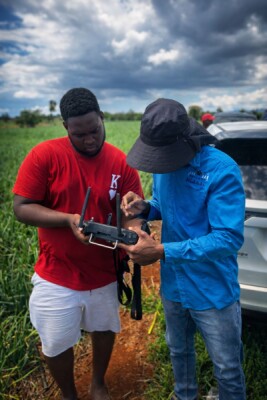
Harris also credits the DJI and XAG-based operators who were spraying fields in Jamaica before SkyCrop existed. "There were companies before us doing it with DJI drones and XAGs that kind of paved the way," he said. "All we had to do was come in and show that not only does it work, but we can build our own and make it work."
Harris holds a bachelor's degree in electrical engineering and computing, training he said helped with powertrain design and the basics of getting an aircraft to fly reliably. But he estimates that most of what SkyCrop actually builds on comes from outside the classroom, drawn from online forums, PX4 development communities, and, increasingly, AI tools that have cut development costs for the company's ground control software.
Looking back, Harris said the biggest thing he underestimated was how urgent the need was.
"We've helped thousands of farmers locally," he said. "People who have lost millions of dollars in the past. And we were just kind of joking around for the first couple of years."
He added that, in his experience, the drone industry tends to learn that lesson the same way everywhere: by stepping into the work and seeing the losses growers were already absorbing.
SkyCrop's next major project moves it beyond just agriculture. The company is developing a cargo drone Harris says will be the first aircraft able to switch between uncrewed and crewed configurations. The design carries over lidar and odometry systems from SkyCrop's survey line, and the team is developing payloads that include refrigerated compartments for transporting organs, a use case Harris said the company is preparing to pitch to the Jamaican government. Alongside this new development, SkyCrop is also developing a dedicated eVTOL airframe, still in the prototype stage.
It is a long way from a homemade sprayer with no GPS. But the path SkyCrop has taken, iterating on borrowed lessons, building what it could not buy, and committing fully once the need became clear, tracks with how a lot of small manufacturers have built their way into the drone industry. Harris does not describe it as anything unusual. For him, it is simply about building a company from nothing in a market with no existing playbook.








Comments