

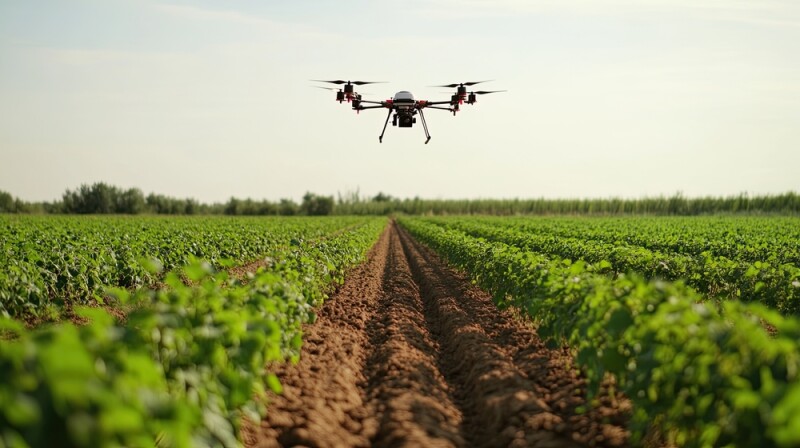
While agriculture is among the oldest industries on the planet, it is a sector that is always looking for the newest tools and technologies to increase output, improve profit margins, and just generally enhance efficiency in a demanding field. To that end, the growth of drone usage in this vertical has taken an interesting path. In some ways, it was one of the earlier adopters of the technology, with mapping technologies associated with UAV flights helping with precision agriculture being done for years. More recently, spray drones have become commonplace in areas around the world, and that usage is steadily increasing over time.
As more and more growers turn to drones to help with spraying, and mapping work continues to be done both independently and in concert with those spraying workflows, this is the perfect time for interested parties to start learning about where the industry is today in terms of drone adoption, and what trends are emerging to take the space to the next step. This is true for growers who might be looking to enhance efficiency in their own work, as well as drone service providers who may be looking to expand their offerings into different sectors.
That was the thought process behind a recent webinar hosted on Commercial UAV News entitled Unlocking the Value of Drones in Agriculture. The hour-long session was held on January 13, and featured insights from panelists Eric Ringer of American Autonomy Inc., and Jerimiah Contreras of FlyGuys. The discussion was moderated by CUAV News content manager Matt Collins, and featured insights from the perspective of both spraying and mapping providers, touching on topics like the current state of the industry, how regulatory issues like the recent FCC decision are impacting the providers today and into the future, and how a provider can best advertise themselves and get started within the space.
Below, you can find a short summary of some of the key points made throughout the discussion, and a free, on-demand recording is available by filling out the short registration form found at the link above.
State of the Market
One of the most telling portions of the webinar was Ringer’s assessment of the current state of the industry, drawing on his years of experience in the industry. From his perspective, the mapping side of the industry is “getting into the plane of productivity,” having experienced the massive hype cycle years ago and then entering the trough of disillusionment, referencing the Gartner Hype Cycle. While there is still plenty of growth to be had in that field, most notably in the near-future with greater implementation of AI and automation, there are real and practical use cases for the technology.
Turning to the spray drone side of the equation, though, Ringer talked about the sheer number of drones being sold, reflecting the path of adoption in the space. He notes that between 2022 and 2024, there was consistent and significant growth year-over-year for both sales of hardware and acres being sprayed. However, that growth rate did slow in 2025, largely due to supply chain issues and issues with procuring drones manufactured by DJI. This, he says, is bringing the sector to an inflection point.

“While 2024 had 9000 spray drones sold, 2025 only had about 3500. So, you’ve got this high demand and low supply, meaning unmet need. I think we’re at an inflection point now where we’re trying to figure out for a lot of folks that were excited about what spray drones can do, can this new generation of drones do those things, too?”
Filling Niches
Even with those questions, though, the discussion brought up very real value that is being demonstrated in tangible ways throughout the industry, not replacing existing tools but supplementing them. Both Ringer and Contreras discussed the idea that these drones aren’t really competing on the basis of speed for ground rigs or even other aerial applications, but rather filling niches that were otherwise not being met by existing technology.
For example, Ringer talks about one application for spray drones in Eastern Oregon that highlights the ability this technology gives growers to quickly react to situations that wouldn’t be possible with other methods.
“A good example of where [hyper localization] matters the most is in Eastern Oregon,” he said. “We grow a lot of onions, and when a thunderstorm comes through, you get hail damage on the onions, and that’s a critical phase for treating for fungus. You want to make sure that doesn’t take hold and ruin the crop, and you have a tight window when you can get it done. You need hyper-localized service providers that can spray, and you don’t get any more hyper-localized than the grower themselves having the ability to do it.”
Breaking In As A Provider
One of the other big topics that was covered in the conversation was how a drone service provider can advertise themselves within this community, particularly if they don’t already have those connections. That was something Contreras himself experienced early in his career when he was first trying to turn his drone piloting into a business. He said that one of the most important steps he took for this was to become familiar with and involved with the local ag community.
“One of the big things I did early in my career was getting involved with the local ag group,” Contreras shared. “At the time, I was part of the Young Farmers Bureau, and I was going to those meetings once a week, getting involved with other individuals. I started out just being a fly on the wall. You kind of have to get a seat at the table, but I was willing to say, ‘Hey, can you guys just let me sit in the corner?’ I wanted to hear the issues they were having, some of their limitations, and I learned a lot.”
That experience allowed him to simultaneously understand the issues that were facing growers in his local community and figure out how his technology could help fill them, and also put himself in front of future customers. Ultimately, both Ringer and Contreras noted the importance of word-of-mouth for making headway in this industry, noting that farmers talk with one another, and that means both good work and bad will spread quickly through the community.
To hear the entire 60-minute discussion, register for your free, on-demand recording at the link below.










Comments