

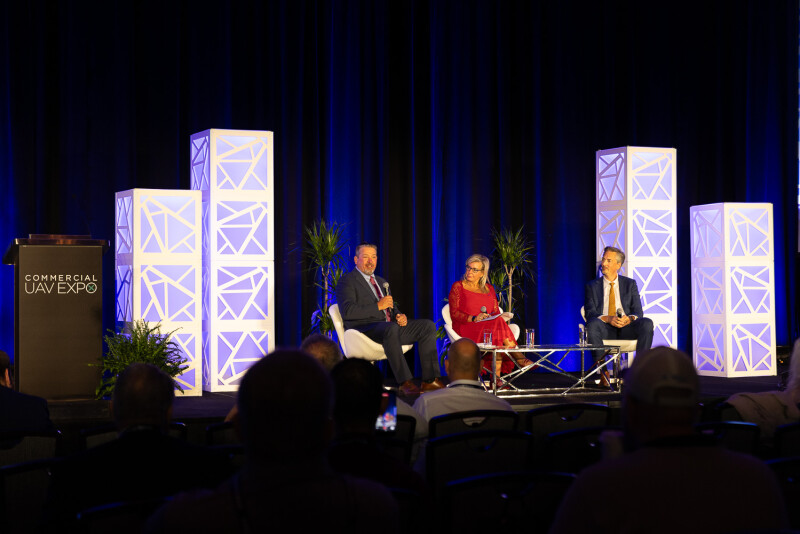
To kick off the third and final day of Commercial UAV Expo 2026, a keynote panel discussion featuring the FAA and EASA turned its attention to the global regulatory picture, and specifically how authorities across the world are approaching things differently and similarly. More importantly, the conversation also touched on what needs to happen in order to converge the global regulatory picture for a cohesive operating environment for operators with global footprints.
Moderated by Julie Garland, CEO of Avtrain, the conversation featured insights from Robert Reckert, the acting division manager of the Emerging Technologies Division within Flight Standards at the FAA; as well as Daan Dousi, the head of department for Innovative Air Mobility at the European Aviation Safety Agency (EASA).
As one would likely expect given the topic’s importance to the growth and overall health of the commercial industry today, much of the discussion focused on how both authorities are thinking about getting to a point where BVLOS operations are not only taking place – that, of course, is already happening in both the U.S. and Europe – but to have those operations normalized and scalable in a safe way.
The discussion had a clear theme: each counterpart aimed at the same goal of a safe, integrated airspace for all aviation, crewed and uncrewed, but their approaches were fundamentally different. On the U.S. side, of course, the focus is on Part 108. The good news on that front is that Reckert did note that the FAA is “hoping” that the final rule is out before the end of the calendar year. He put it in (American) football terms: "It feels like we're on the 10-yard line and we just got to get it in the end zone." Of course, he also said, “If you’re thinking, ‘Well, what’s in it?’ Well, I can’t talk about that part.”
Still, beyond the actual contents of what that final rule will look like, it was interesting to hear about the different types of approaches to rulemaking, both with Part 108 and with programs like the eIPP. The crux of rulemaking from the FAA perspective is to have these types of pilot programs during which the authority can collect as much data as possible from relatively controlled operations to determine what is working and what isn’t, so they can make a rule that is as safe as possible based on real-world operations.
On the EASA side, Dousi explained how SORA works on the European side, which is more of a risk-based approach. SORA (Specific Operations Risk Assessment) sorts operations into open, specific, and certified categories based on ground and air risk, with proportionality built in for factors like population density and traffic volume.
Dousi was candid about SORA's reputation. "When we talk about SORA, the first thing that comes to many people's minds... is complexity." He added, "It is complex, but it also enables a lot of flexibility."
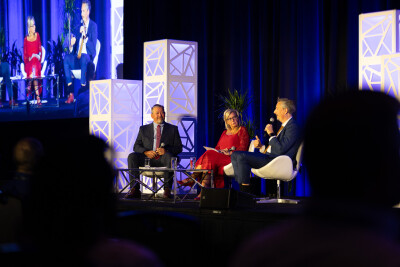
Dousi pointed to the FAA's data-driven, enable-first approach as a model EASA is working to replicate where possible, citing the agency's newly enabled regulatory sandbox authority as a step in that direction.
Despite these differences, there was largely an air of optimism about the premise of these two authorities coming together for a cohesive environment for operators. Multiple times during the conversation, Reckert and Dousi referenced the work the two agencies have done together for bilateral safety conversations in the crewed world. There is still work to be done, to be sure, but there was broad agreement that this work could, and will, be done for the uncrewed community.
Beyond that broad conversation around regulatory philosophies and how these two regions can converge, one of the other interesting points of conversation was focused on the idea of public perception, an area in which cultural differences drove the divergence in answers. Reckert spoke more positively about this area, noting that there is still some work to be done to educate the public, but that, by and large, when people hear about capabilities, they are still okay. There is a difference between, as he put it, deliveries for medication and deliveries for burritos, but for the most part the public is on board with the technology and its capabilities.
On the other side of the conversation, Dousi had a bit of a more negative tone, with the general public being relatively more apprehensive of the technology. On the positive side, he shared that the public is certainly in favor of medical delivery – a use case that he noted is more common in Europe compared to the U.S. – but that other delivery use cases are requiring more work to gain public trust. To that end, he preached the importance of not only working with EASA and your national authorities across Europe, but also at the local level to educate folks at that level and gain more of that public trust.
Although on the surface it would appear that there are wide gulfs between how the FAA and EASA are operating and thinking about creating a safe and viable option for normalized and scalable BVLOS operations, they are closer than they appear. Ultimately, they both have the same goal, as well as a shared history of cohesion in other areas of aviation. They just have different methods of getting to that point due in large part to cultural and structural differences.
Watch the session in full below:

.jpg.small.400x400.jpg)








Comments