

.jpg.medium.800x800.jpg)
Every year, regulation takes a central role at Commercial UAV Expo, but this year seemed to take that idea to a different level. Part 108 is close enough to finalized that the conversations on stage moved past "what will the rule say" and into "what happens once it's real" – though, of course, we still don’t know exactly what that final rule will look like. Between the keynote, the FAA's own sessions, the EASA insights on the floor, and the ongoing fallout from the FCC's Covered List decision, the regulatory discussions tried to clarify where the industry stands heading into 2027.
FAA and EASA Chase a Common Goal
The keynote to kick off the event’s final day, moderated by Julie Garland of Avtrain, put the FAA's Rob Reckert and EASA's Daan Dousi side by side to compare notes on regulation around the commercial UAS industry. Reckert offered the most concrete signal of the week on Part 108's timeline, saying the FAA is hoping to have the final rule out before the end of the year and describing the process as being on the ten-yard line. He stopped short of previewing what the rule will actually contain.
Dousi laid out how SORA works on the European side, sorting operations into open, specific, and certified categories based on ground and air risk. He was candid that SORA has a reputation for complexity, but argued that complexity is what buys operators flexibility. The two also diverged on public perception. Reckert described U.S. sentiment as generally positive once people understand the use case, drawing a line between medical delivery and consumer delivery. Dousi said European sentiment skews more cautious outside of medical use cases, and pointed to local-level education as the bigger lift for EASA compared to national-level rulemaking.
Despite the different starting points, both pointed to the FAA and EASA's existing bilateral work in crewed aviation as a model for where uncrewed regulation is headed.
You can read more about the discussion in our recap from the event.
The Job Gets Bigger Once BVLOS Is Routine
A separate session featuring the FAA's Jessica Jones, Executive Director of the Office of Advanced Aviation Technologies, and Ben Supko, Associate Administrator for Security and Intelligence, moved past approvals entirely. The two described a broader task ahead for the agency: building the systems needed to manage advanced aviation at scale, identify potential threats, and give operators, regulators, and law enforcement the information each group needs. The session, moderated by Kenji Sugahara of the Oregon Department of Aviation, framed Part 108 as removing a major barrier to BVLOS, but treated the rule itself as only one piece of a larger operational puzzle.
The distinction worth pulling out: operators, regulators, and security agencies all need information, but not the same information, and not for the same reasons. That's less a rulemaking problem than an infrastructure one, and it's a signal that FAA attention is already shifting toward what routine operations actually require day to day.
The Importance of Standards
A conversation with Marcus Cunningham from the agency's Emerging Technologies Division reinforced an important piece for anyone interested in future BVLOS operations needs to understand: much of Part 108's flexibility is built around standards rather than fixed rules. The FAA leans on bodies like ASTM and RTCA for the technical expertise behind those standards, but the agency still has to decide when a standard is mature enough to anchor a regulatory decision.
That leaves private industry with more responsibility than some manufacturers may realize. The clearest advice from the conversation was about the FAA review process itself: companies bringing new technology forward, whether a DAA system or a new payload, get further when they come in with detailed, well-documented submissions rather than something the agency has to chase down and interpret. For manufacturers still learning how standards get built, that level of detail is the difference between a straightforward review and a slow one.
EASA’s Focus on U-Space
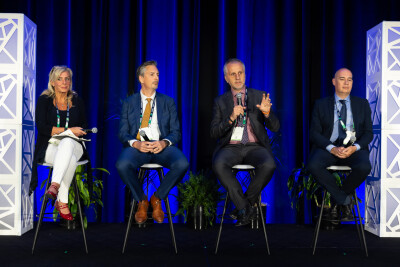
A separate EASA-focused session, moderated by Garland, dug deeper into how the pieces fit together on the European side. Dousi also featured in the conversation alongside two other EASA leaders, Giuseppe Scannapieco and Stéphane Vaubourg, for a session focused on SORA's mechanics and U-Space, the framework meant to manage traffic in lower-altitude airspace where multiple operators and use cases overlap.
The throughline was adoption. SORA gives operators a risk-based path to individual approvals, but U-Space is what EASA is counting on to bring a cohesive regulatory environment across the region once operations scale beyond isolated approvals.
How to Prepare for Part 108
Multiple sessions throughout the event turned to a more practical question: What should operators be doing right now to be as prepared as possible for the final Part 108 rule? There's an obvious limit to how much planning makes sense before the final rule is out, but panelists pointed to a few things worth doing in the meantime. Getting familiar with the NPRM itself was one, since it's the closest thing operators have to a preview of what's coming. Engaging with standards organizations was another, both to stay current and to have a voice in decisions that will shape how the rule gets implemented.
The clearest area of actionable prep was training. The NPRM introduces new roles that will likely carry over into the final rule, and panelists encouraged operators to start adjusting training procedures now rather than waiting for the rule to land before figuring out who needs to be trained for what.
Procurement Realities
A panel moderated by Erin Williams of Commercial UAV News, featuring Will Dawson of The Agricultural Drone Initiative, Ben Hance of DroneDeploy, and Jared Janacek of Texas Drone Company, acknowledged the pain points created by the FCC's Covered List decision but focused on how professionals need to deal with the reality of what’s happening. The biggest takeaway: Operators don't need to ground their current fleets, and the most useful step right now is to talk with peers and manufacturers to figure out the best options for future fleet decisions.
It’s worth noting, of course: the FCC's proposed ban on military-grade drones, if it goes through, could make repairing or replacing current fleets significantly harder, even for operators taking the panel's wait-and-see approach.
Taken together, these conversations point to the same underlying message from different directions. Nobody at Commercial UAV Expo 2026 could say exactly what Part 108's final rule will look like, what U-Space adoption will require, or how the FCC's next moves will play out. What came through clearly was that uncertainty doesn’t mean standing still. Operators can act now on standards work, training updates, and fleet conversations, regardless of when the remaining pieces fall into place.










Comments