

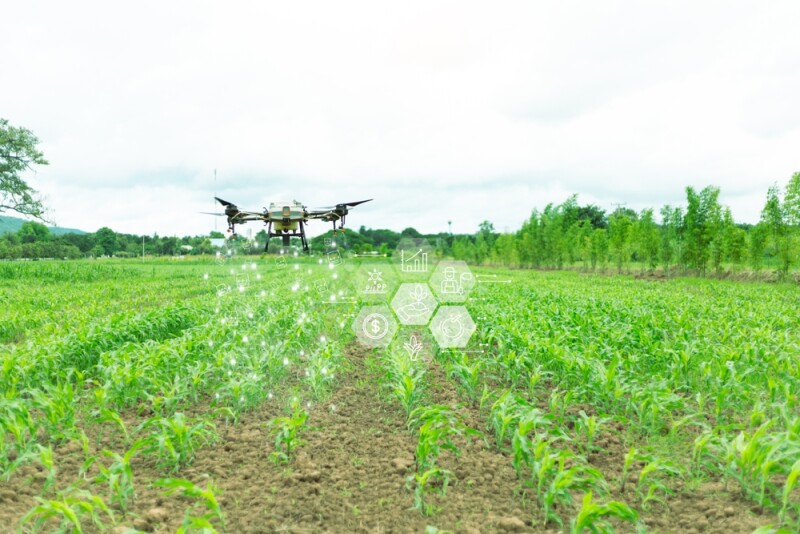
Agriculture is consistently one of the first verticals that comes up when new entrants to the drone industry start asking questions, whether the conversation is about spraying, mapping or crop monitoring. But how much of that interest reflects what's actually happening on European farms right now, and how much is still just hype?
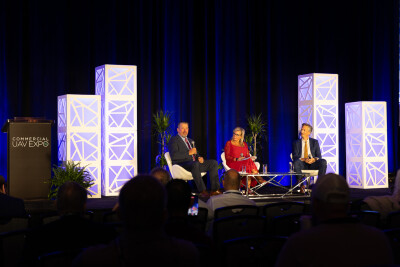
That was one of the main questions we set out to answer in our most recent webinar, How European Agriculture is Embracing Drones and What it Means for the Broader Industry. Content Manager Matt Collins moderated a conversation between Julie Garland, founder and CEO of Avtrain and president of the Joint European Drone Associations (JEDA), and Valerii Iakovenko, co-founder of Drone UA and Futurology and a former drone expert for the UN's Food and Agriculture Organization. The two speakers largely agreed on where the industry is headed, but had some disagreements throughout the conversation as well.
The entire 60-minute conversation is available on-demand for free by filling out our quick registration form. You can read a recap of some of the conversation below.
One of the standout moments in the conversation was when Iakovenko admitted that his own early business bet on agricultural drones didn't pan out the way he expected. His original plan was to build swarms of drones capable of mapping crops at a national scale and delivering that data to farmers. He says that satellite companies won that fight instead. As he put it, farmers "are not ready to buy in a large scale the scanning possibilities of drones," and services like Planet Labs now cover much of that ground more cheaply.
Where drones have actually found traction, both speakers agreed, is spraying and dispersal. Iakovenko noted that this is less like adopting a new technology and more like a farmer swapping a flip phone for a smartphone. It slots into an existing workflow rather than creating a new one.
The scale of that spraying opportunity is where the conversation got more concrete. Iakovenko estimated that roughly 75 percent of a farm's operations during the vegetation period could theoretically shift to drones, at a cost comparable to conventional equipment. He cited yield gains of two to four percent on wheat and six to ten percent on higher-value crops like sunflower and corn, framing the numbers as a matter of national competitiveness rather than just farm-level efficiency.Garland tied that back to precision agriculture, noting that drones let operators target specific plants instead of blanket-spraying a field, which cuts both cost and chemical volume.
If the technology and the economics are there, the regulatory environment is the piece still catching up. Garland pointed to one of the most significant structural problems: the EU's pesticide directive bans aerial dispersal by default, and exemptions have to be granted state by state rather than at the European Commission level.
"There is a disharmony amongst member states around the pesticide directive," she said, describing it as the single biggest obstacle to wider adoption.
That said, the regulatory picture is moving. Garland walked through the current framework, PDRA-S01 for drones under 3 meters and SORA 2.5 for larger ones, along with an upcoming standard scenario, STS-03, that would allow operators to declare compliance for drones up to 8 meters and 750 kilograms without a full SORA application.
Iakovenko pointed to Ukraine's early years of light regulation, which briefly let the country out-produce the rest of Europe combined in agricultural drone use. The U.S. followed a different path, with FAA exemptions accelerating sharply through 2024 and 2025. "Last year, 2025, was one of the breakpoints," he said, describing how quickly the U.S. market closed a gap that had taken years to open.
Not every warning in the session was about airspace rules. It was also mentioned that chemical labeling and operator liability are a bigger blind spot than flight regulations, and he predicted that security concerns tied to widespread drone use could eventually push the EU toward firearms-style controls on operators.
There was plenty more ground covered that didn't make it into this recap, including a detailed audience Q&A on crop size thresholds, tree crop and vineyard applications, and where hyperspectral imaging still has a role despite the satellite competition, among other topics
As mentioned above, the full conversation is available for on-demand viewing. Register below!

.jpg.small.400x400.jpg)







Comments