

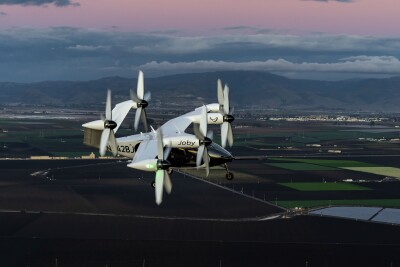
At the end of April this year, Joby Aviation made a series of test flights around heliports in New York City. These flights were part of their certification process with the FAA and included just a test pilot, with no passengers.
In the race to be the first AAM aircraft to hit the market, another important player, Electra Aero, announced last week that it had made a demo flight in Charleston, South Carolina, in front of a large audience.
Are these two events related, or do they just seem to be? We have always wondered if these announcements of test flights or new developments in aviation technology are part of a tight competition race or just isolated efforts by companies to advance their cause.
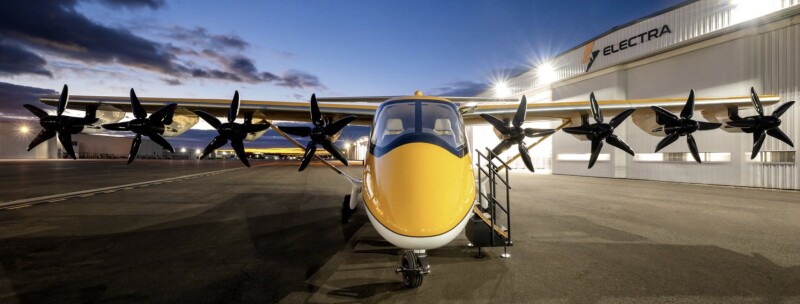
Electra Aero's approach to AAM is radically different from that of any other player in this new aviation. Their technology is an evolution of known and proven concepts, not a radical new way of doing things.
The flight was completed with one passenger, Alex Wilcox, Co-Founder and CEO of JSX, a public charter flying company. His participation reflected JSX’s active evaluation of Electra’s forthcoming EL9 as a potential fleet addition. After the flight, Wilcox described the experience as “flying in the future,” reinforcing his long‑standing interest in next‑generation regional aircraft capable of operating from smaller, less‑congested access points.
JSX was an early customer for the EL9 in December 2023, announcing an LOI to acquire up to 82 of the 9-seat Electra eSTOL aircraft, with 32 firm orders and 50 options.
Electra’s ultra‑short takeoff and landing (USTOL) capability, 500‑mile range, and nine‑seat configuration map directly onto JSX’s premium regional model. If performance and economics meet expectations, JSX is well‑positioned to become one of Electra’s early commercial customers.
This demonstration in Charleston comes at a pivotal moment in the evolution of hybrid‑electric aviation and the emerging category the company calls USTOL aircraft. While Joby Aviation’s high‑profile flights over New York showcased the promise of vertical mobility, Electra’s Charleston event offered a contrasting and, in many ways more pragmatic, vision for near‑term regional air access.
Held at the Columbus Street Terminal during the CAPA Airline Leader Summit Americas, the demonstration brought Electra’s technology out of the test range and into a real urban environment, giving industry leaders a first‑hand look at how its blown‑lift architecture performs in tight, waterfront spaces.
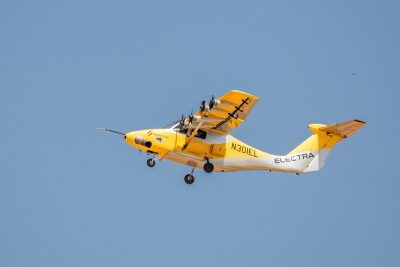
At the center of the demonstration was Electra’s EL2 technology demonstrator, a two‑seat experimental aircraft designed to validate the propulsion, aerodynamics, and control systems that will ultimately power the company’s commercial nine‑seat EL9. The EL2 is a flying laboratory, an essential step in proving the company’s core thesis that a fixed‑wing aircraft, equipped with distributed electric propulsion and a hybrid‑electric powertrain, can achieve takeoff and landing distances under 150 feet while retaining the efficiency, range, and payload advantages of conventional wing‑borne flight.
The Charleston flight was structured to highlight exactly that. In front of an audience of airline executives, port officials, and policymakers, the EL2 approached the waterfront pier at low speed, descending steeply and touching down in a remarkably short distance. Observers noted how little runway the aircraft required, essentially the length of a small pier, demonstrating the feasibility of operating from improvised or compact sites in dense urban areas. Moments later, the aircraft accelerated down the same short strip, lifted off in roughly five to six seconds, and climbed sharply away over the harbor. The sequence was a controlled, repeatable demonstration of the blown‑lift system that defines Electra’s approach.
That system is the heart of the company’s technology – eight electric motors mounted along the wing drive propellers that blow high‑velocity air over large, multi‑segment flaps. When the flaps are deployed, the accelerated airflow dramatically increases lift at low speeds, allowing the aircraft to fly safely at approach speeds far below those of conventional fixed-wing aircraft. Because the motors are electric, they can respond instantly to control inputs, enabling precise handling during the most demanding phases of flight. And because the aircraft uses a hybrid‑electric powerplant, a small turbine generator feeding batteries and electric motors, it avoids the range and endurance limitations that constrain fully electric aircraft. The result is a platform capable of 500‑mile missions, nine passengers, and takeoff and landing distances under 150 feet, all while consuming a fraction of the energy required for vertical lift.
Electra frames this capability as the foundation of a new transportation model the company calls ‘Direct Aviation’. Instead of relying on airports, passengers would board from ‘Ultra‑Short Access Points’, spaces as small as parking lots, piers, barge platforms, or repurposed heliports. The company’s market analysis suggests that tens of millions of U.S. trips each year fall into a neglected middle ground: too long to drive comfortably, too short to justify airline travel. By enabling airport‑free regional mobility, Electra aims to unlock a new layer of connectivity between small cities, suburbs, and rural communities.
The Charleston demonstration was a proof‑of‑concept for this operational model. The Columbus Street Terminal, with its constrained geometry and waterfront setting, served as a stand‑in for the kinds of real‑world sites Electra envisions. The event also underscored the company’s progress toward commercialization. The EL9, the production aircraft derived from the EL2’s technology, is slated for first flight in 2027 and FAA Part 23 certification in 2029. It will feature IFR (Instrument Flight Rules) capability, known‑icing approval, and a payload capacity of roughly 3,000 pounds, attributes that position it not only for passenger service but also for cargo, medical transport, and government missions.
In contrast to the vertical‑lift demonstrations that dominate public attention, Electra’s Charleston flight offered a quieter, more energy‑efficient, and more existing-infrastructure compatible vision of advanced air mobility. It showed that the future of regional aviation may not depend on reinventing the sky with entirely new flight modes, but on reimagining how fixed‑wing aircraft can operate in the spaces between cities. With its hybrid‑electric architecture and ultra‑short performance, Electra is betting that the next revolution in air travel will be as much about access as altitude.
But when it comes to autonomy, Electra’s two-seat EL2 prototype airplane is operated by a pilot. While the EL9 will be equipped with two pilot crew stations, Electra's Safe Single Pilot technology with fly-by-wire controls will enable ease of precision landings for a single pilot.
So, can we consider an aircraft that requires a highly skilled pilot to fly part of the new AAM trend? This is a highly debatable point because the important issue is that the design includes the future of complete autonomy included. According to the company, “As autonomous technologies and regulatory frameworks evolve, these foundational capabilities could support increasing levels of automation in future operations.”
In practical terms, Electra appears to be designing with future autonomous operations in mind. For now, however, current regulations and the limitations of the National Airspace System (NAS) make fully autonomous passenger aircraft unlikely in the near term. Rather than waiting for that environment to mature, Electra is focusing on capabilities that can be deployed more quickly, while laying the groundwork for greater automation as regulatory frameworks and enabling technologies continue to evolve.
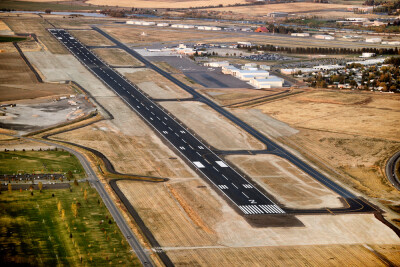
One item that seems to be common to both Joby Aviation and Electra Aero is the effort to use existing infrastructure and not depend on costly and hard-to-get new vertiports. In this effort, the current list of flights by JSX includes airports that are not necessarily the busiest in the nation, and using smaller hubs, as opposed to the busiest places like Chicago or Miami, allows carriers to add short routes at affordable prices.
There are 37 Class B airports in the U.S., dozens of Class C and hundreds of Class D facilities. Most of these ground infrastructure resources are underutilized by the general public and are used primarily by smaller aircraft for private flights. Imagine a technology that would turn some of these facilities into places where people can fly in and out of underserved communities without requiring large modifications to existing capacities.
Electra’s Ultra‑Short takeoff and landing capability, 500‑mile range, and nine‑seat configuration map directly onto JSX’s premium regional model. JSX was an early customer for the EL9 in December 2023, announcing an LOI to acquire up to 82 of the 9-seat Electra eSTOL aircraft, with 32 firm orders and 50 options. If performance and economics meet expectations, JSX is well‑positioned to become one of Electra’s early commercial customers.
Ed. Note: An earlier version of this article inaccurately described the relationship between JSX and Electro Aero, and has been updated.









Comments