

In a matter of minutes, a tiny spark can escalate into a potentially catastrophic wildfire. Wildfires have become a growing problem due to climate change, and drone technology has stepped up over the years to help detect and suppress them. So, what if a drone system could autonomously detect, locate, and extinguish a fire in the wilderness in under 10 minutes?
That is exactly what Dryad’s Silvanet Network and other competitors were challenged to demonstrate at the XPRIZE Wildfire finals this past June.
In the competition, finalist teams put autonomous wildfire response systems to the test in the remote Alaskan wilderness. Each team had to autonomously detect and completely suppress a fire within 10 minutes of ignition across 1,000 km² of forest. As if that weren’t challenging enough, teams also had to distinguish real fires from decoys and suppress only the real ones.
To learn more about the experience, Commercial UAV News spoke with Carsten Brinkschulte, co-founder and CEO of Dryad Networks, and Andrea Santy, executive program director at XPRIZE.
Brinkschulte explained the two-step approach his team used in the competition: Silvanet and Silvaguard.
How it Works
“The first step is Silvanet, a solar-powered network of gas sensors. They detect fires by analyzing the composition of the air, using artificial intelligence. They effectively smell the fire, so we can detect it very early. You don’t have to wait for a smoke plume to rise above the canopy or be visible from a distance,” he explained.
.JPG.medium.800x800.jpg)
“The sensors sit close to the source. We distributed them in the area in Alaska, and they picked up the smell of a fire. Over a solar-powered mesh network attached to the trees, we send the alert to the cloud. There we decide whether it’s a fire and launch the second phase, which we call Silvaguard.”
This is where the pair of autonomous suppression drones comes into play.
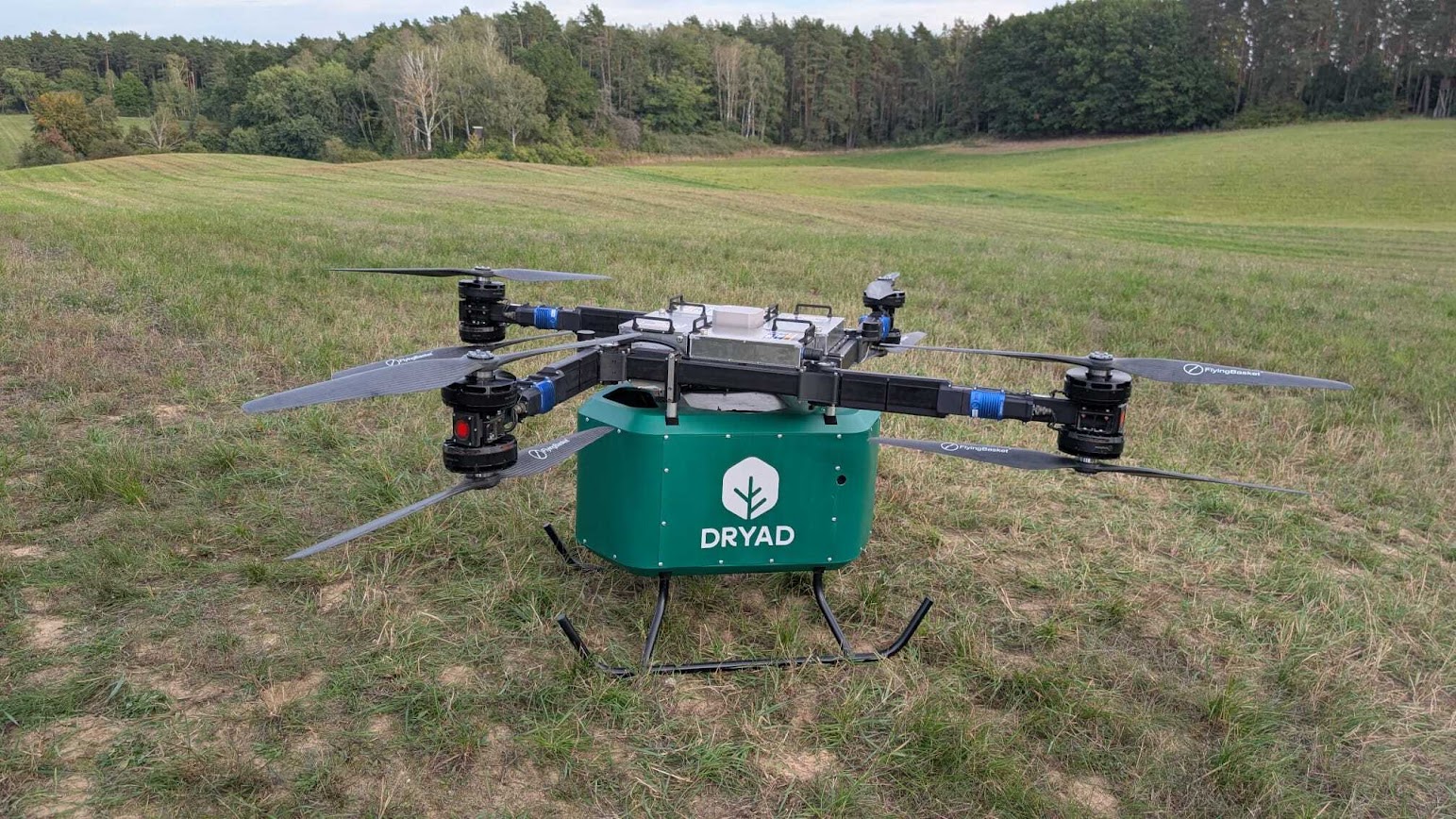
“Silvaguard consists of two drones. The first is an observation drone that flies to the location of the sensor and scans the area with infrared cameras to pinpoint the exact location of the fire. Then the second drone, which carries the suppression payload, flies out and drops water on it. That whole process is completely autonomous,” Brinkschulte said.
Dryad calls this approach “ultra-early detection,” and it underscores how critical timing is. Consider how much water a drone can realistically carry: A single drone could barely put out a small campfire, so reaching the scene before a fire has a chance to grow is the name of the game.
“From the moment someone drops a cigarette or a match, the clock starts. The XPRIZE target is 10 minutes from ignition to detect and extinguish. That sounds like an awfully short window, but it’s exactly the window of opportunity you have,” Brinkschulte said.
What sets this technology apart from other autonomous suppression systems is its sensor-based approach. Rather than flying a thermal drone over an area to look for a fire that has already ignited, Dryad’s sensors pick up the gases and particles given off by a smoldering fire, before it bursts into flame. Each sensor contains three elements: a volatile organic compound (VOC) sensor, a carbon monoxide sensor, and a particulate-matter (PM2.5) sensor that picks up small particles in the air.
The sensor monitors its surroundings and uses AI to decide whether its readings are unusual enough to be treated as a fire. It is also trained to tell real fires apart from non-threatening sources like diesel exhaust.
Camera-based systems are valuable tools for fighting active wildfires, but Dryad argues that sensors have the edge for early detection.
Putting it to the Test
Brinkschulte and his team traveled to Alaska for the final step of the competition: putting the whole system into action to detect, locate, and suppress a fire in the wilderness.
“It was really challenging, and the organizers definitely didn’t make it easy. The area was 1,000 square kilometers of remote and very difficult terrain, and fires could be set anywhere in it. Our teams were there, but they weren’t allowed to touch anything. The systems had to operate completely autonomously, hands off, or we would have been disqualified,” he explained.
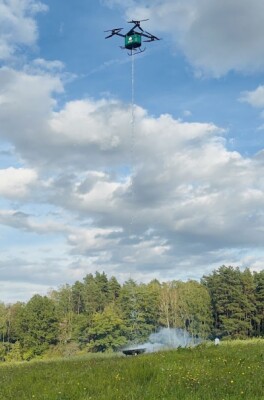
“That’s what they did. The sensors detected the fire, and then the observation drone flew to the location and used the data from our sensors to pinpoint the exact geolocation. Then we launched the second drone with the payload, in our case 40 liters of water, although its total capacity is about 100 liters. It dropped the water on the fire, flew back, and landed. That was the whole cycle, start to finish.”
XPRIZE chose Alaska because of its partnership with the University of Alaska Fairbanks, one of the leading FAA experimental drone testing centers, Santy explained, but the site brought its own difficulties.
“There was one road the teams could use. They were based at the Nenana airport, about 18 to 20 miles from the deployment road, roughly a 40-minute trip. Everything was fully hands-off, with no eyes on the systems. For many of the teams, that was a new situation, because they hadn’t tested under those conditions and had to put full faith in what they’d built,” Santy said.
Beyond mosquitoes and bears, Dryad faced a bigger challenge. Conditions on the ground when teams arrived made parts of the area unsafe, so XPRIZE narrowed the deployment zone to about a mile on either side of the road, and Dryad had only three days to deploy. The team placed 170 sensors instead of the 1,000 it had planned. Brinkschulte said the system depends on sensor volume, since more sensors mean faster detection. Even so, the technology worked, and XPRIZE saw that as a win.
“It’s a testament to the technology. They had no idea where the fires were going to be, so they had to build their plan around a complete unknown. The fires could be anywhere in that 1,000 square kilometers, so they had to strategize about where to place the sensors and what the team could do in the time available. It was impressive to see the technology work exactly as [Brinkschulte] described,” Santy said.
Beyond the prize money, the competition gave Dryad something arguably more valuable: a chance to test at real-world scale, which is difficult to do independently because of regulatory limits.
“Flying a heavy drone, [up to 180 kilograms], is simply not legal over large areas, so our test grounds are small. Testing the system in an area the size of the 1,000 square kilometers you actually need is much more realistic, so that was very helpful, and we learned a lot,” Brinkschulte said.
The event also let Dryad compare sensor-based and camera-based detection firsthand, and the team came away more convinced of its approach.
“We also had a camera deployed, which did not detect any fires. That confirmed our belief in the sensor-based approach for detecting fires as early as possible, with cameras as a safety net. Other approaches, like high-altitude drones, can be efficient too. But I see our approach as the right one, because it’s a 24/7, 365-day system that can work all year in a cost-efficient manner,” Brinkschulte explained.
What’s Next for Dryad
Dryad’s Silvanet sensors are already in production, while the Silvaguard drones are still prototypes, so the next step is the road to commercialization. The company plans to commercialize the drones from 2028 onward. As an

intermediate step, it is planning two to three live pilots next year, deploying
Silvanet sensors and Silvaguard drones under real-world conditions for several months rather than a single day like in Alaska. Each pilot would cover about 15,000 acres and run for six to eight months during fire season. The goal is to
test the next-generation prototypes and find the flaws and improvements needed before commercialization in 2028.
Inside the XPRIZE Wildfire Competition
The competition Dryad entered grew out of a problem XPRIZE has watched worsen for decades. The organization is based in Los Angeles, but Santy said wildfire is far from a California-only issue, pointing to fires in Australia, the Amazon, and even Scotland.
“Wildfires are becoming more destructive, more common, and faster, and they’re burning larger areas,” Santy said.
XPRIZE saw its opening in the gap between the problem and the tools meant to address it. “New technology is being integrated, but the problem is growing faster than the technology addressing it,” she explained. After consulting more than 100 experts from around the world, the organization settled on its 10-minute detection and suppression target. It deliberately steered away from predictive modeling, since so much effort was already going into that area, and it left the method wide open.
“We don’t predefine how you solve the problem,” Santy said. “We set the goal.”
The competition launched in April 2023, and nearly 400 teams registered. Each submitted a white paper that expert judges narrowed down, and XPRIZE then traveled to 13 teams’ sites around the world, including Dryad’s demonstration in Germany, before the finalists headed to Alaska.
XPRIZE isn’t done with the teams. It plans to launch an impact phase, reinvesting unawarded prize funds to support teams for another 12 to 15 months and matching them with end users who propose longer-term demonstrations. Santy sees Dryad’s sensors as a “first line of defense,” but she said the drone side still has work ahead.
“Fires grow very quickly, so getting them out within 10 minutes continues to be a challenge,” she said, adding that flight times, not just detection times, will determine whether that goal can be met.










Comments