

Pilot Institute recently presented a webinar with Commercial UAV News entitled Drone Thermography Essentials, bringing in subject matter expert Jason Wood to walk attendees through everything from the physics of thermal imaging to real-world inspection use cases. Whether you are new to infrared photography or a seasoned service provider looking to sharpen your workflow, the session offered practical guidance across all skill levels.
Technical Advice
Wood opened the webinar with a grounding overview of how thermal cameras work, covering the core technology types, wavelength considerations, resolution requirements, and the often-overlooked topic of file formats.
There are two primary thermal camera technologies relevant to drone operators: microbolometers and photon-counting cameras.
Microbolometers are the workhorse of the UAS world. They are compact, rugged, and do not require internal cooling, making them well-suited for handheld and drone-mounted use. Frame rates typically range from 9 to 60 frames per second. The trade-off is accuracy. They are not the most precise instruments available, but for the majority of field inspection work, they perform reliably.
Photon-counting cameras occupy the high end of the spectrum. They can capture 1,000 or more frames per second, making them ideal for fast-moving subjects. However, they come at a significant cost premium, both financially and operationally.
“If what you need to image is moving quickly, a photon-counting camera is likely your best option,” said Wood
Wood noted that the internal cooling required by photon counting cameras adds expense and reduces ruggedness, making them less practical for most UAS operations.
Wood presented a comparison chart breaking down the practical differences between 9 Hz and 30 Hz cameras, helping attendees weigh which option makes sense for their specific jobs.
One of the more nuanced points he raised was around international file sharing, particularly relevant for operators working with clients or partners overseas.
“30 is better, but it is restricted to U.S. and other countries on the Special Temporary Authority (STA) list. There is a federal regulation here that you can’t export or import microbolometers that have a frame rate above a certain amount without them going through specific checks.”
This is an important compliance consideration for any operator doing cross-border work or purchasing equipment internationally.
Wood also covered the science of infrared wavelengths, explaining which drone camera options are optimized for capturing the full thermal spectrum versus short-wave infrared only. He touched on resolution requirements relative to project scope, the functional difference between radiometric and non-radiometric cameras, and how manufacturers design specific color palettes into their cameras to enhance visibility for certain inspection types.
Deliverable format is a topic that every service provider eventually must sort out. Wood walked through the common options such as JPG, TIFF, RJPEG, MOV/MP4, and SEQ, each with its own strengths and limitations. Not all formats support post-processing, which directly affects how much analysis you can do after the flight.
“This is something to consider if you are going to be using both handheld and airborne systems is that maybe you want to use one ecosystem so that everything is compatible with everything else.”
For operators running mixed fleets, standardizing on a single manufacturer’s ecosystem can eliminate compatibility headaches down the line.
Drone Thermography Applications
After covering the hardware and technical landscape, Wood shifted to real-world applications, showing attendees where thermal drone imagery is most commonly deployed.
Common use cases include:
- Electrical infrastructure assessments
- Building envelope and roofing evaluations
- Oil and gas facility monitoring
- Livestock management
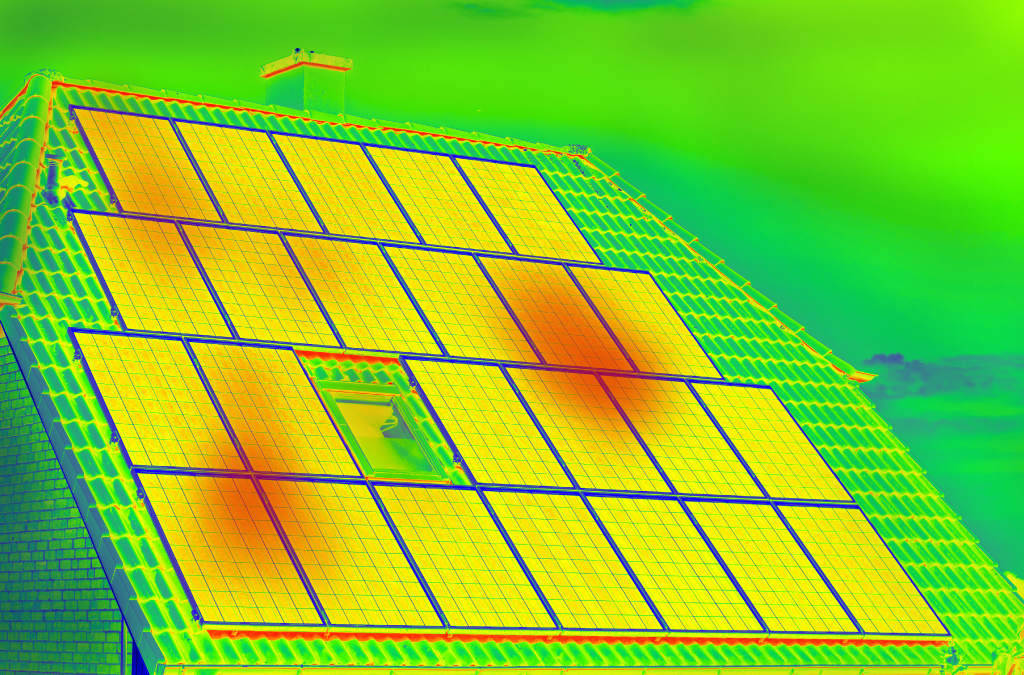
Wood opened this section with a hands-on look at thermal images of solar panels which are one of the most widespread applications in the industry and walked through how to identify anomalies in the imagery.
“Our job as infrared photographers is to compile images, note their locations, create a report, and give that report to the client. When compared with other things under the same conditions, that we have something that appears to be an issue.”
This framing is a useful reminder that thermography is ultimately a comparative science: the value is in context, not just raw data.
Training, Standards, and Best Practices
The final portion of the webinar addressed professional development and quality standards.
Wood was direct about the importance of following established inspection standards, noting that nearly every thermal inspection application has a corresponding standard to guide it.
“Best practices come down to standards. Just about anything you want to do with a thermal camera, there is a standard about. If you have a brand-new use for thermal cameras, there may not be a standard. But if you are looking to get into inspections for the uses I discussed earlier, there are a ton of different standards that I would recommend you do your inspections to.”
For operators building a credible inspection business, aligning with recognized standards is not optional and is what will distinguish you as a credible and thorough service provider.
On the training side, Wood’s recommendation was straightforward: work with providers who build their curricula around ISO and ASNT standards. These are the recognized benchmarks in the thermography world and provide a credible baseline for professional certification.
Wood closed by announcing that he will be hosting an onsite thermography workshop at the Commercial UAV Expo, where attendees will be able to watch a live solar panel inspection demonstration. For those looking to go beyond the webinar and see drone thermography in action, it is a strong opportunity to learn hands-on.
Missed the live webinar but want to learn more? The on-demand recording is available now, click below to register.









Comments