

This week’s news roundup looks at what Drone Safety Day means to DRONERESPONDERS, how drones are helping sherpas on Mt. Everest, and groundbreaking work done by university students around a blockchain black box for drones.
DRONERESPONDERS Celebrates Drone Safety Day
In light of Drone Safety Day approaching, DRONERESPONDERS is calling on the FAA to establish a National Public Safety Waiver (NPSW), a standardized, nationwide airspace authorization for first responders. Currently, the more than 50,000 public safety agencies across the U.S. must navigate case-by-case FAA approvals that can hinder time-critical emergency operations. The proposed waiver would create a unified framework allowing qualified agencies to conduct BVLOS operations, fly over people, and access appropriate airspace under consistent, performance-based safety standards.
The initiative has drawn support from a broad coalition of law enforcement, fire, and EMS agencies, including departments in California, Arizona, Florida, and beyond. Advocates stress the NPSW is not an expansion of commercial drone privileges, but a targeted framework for trained, accountable first responders. By replacing fragmented approvals with a single national authorization, proponents argue it would improve emergency response times, aid in disaster and wildfire mitigation, reduce crime, and keep the U.S. competitive in unmanned systems, all while aligning with the FAA's own safety mission.
Drone Service for Mt. Everest Climbers
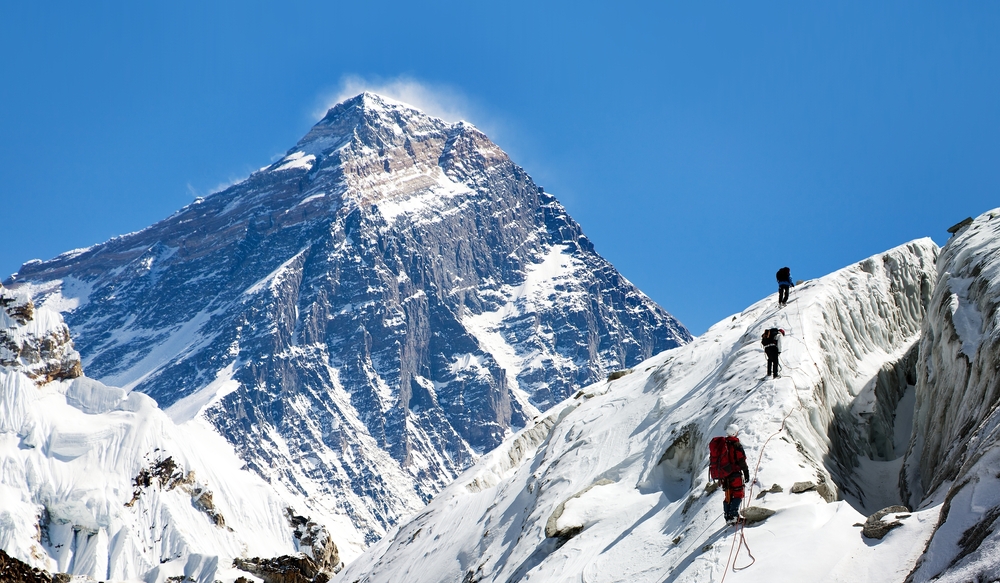
On Mt. Everest, Icefall Doctors are getting a helping hand from drones who are carrying supplies back and forth to their work areas. An Icefall Doctor plays a vital role in keeping the trail accessible. These sherpas build and maintain the treacherous route through the Khumbu Icefall on the mountain.
Drones have been used on Mt. Everest for the last year thanks to a partnership between Airlift Technologies and Dawa Steven Sherpa and Tenzing David Sherpa of Asian Trekking, supported by the Sagarmatha Pollution Control Committee and the Khumbu Pasang Lhamu Municipality. The drones are significantly reducing risk for sherpas by carrying new equipment to a base camp and bringing down old gear and litter from the previous expedition. This drastically cuts down trekking for sherpas and reduces their risk of catastrophic events. Last year, their drone was able to caryy 30kg. This year, the drone is capable of carrying 100kg at sea level, but due to the thin air, Airlift Technologies has set a limit of 50kg for the new aircraft.
University Students Create Blockchain Black Box for Drones
Researchers at the University of Southampton successfully demonstrated a drone that recorded its flight data in real-time onto a blockchain, creating a tamper-proof log without relying on cloud servers or central databases. The system ran on Minima's blockchain protocol, with every networked device holding a full node, making the records independently verifiable. The team achieved a 500x performance gain and up to 10,000% energy efficiency improvement by embedding the blockchain directly into a microprocessor chip instead of running it in software.
The implications extend well beyond drones. The same approach could be applied to autonomous vehicles, industrial robots, energy systems, and AI platforms to provide verifiable audit trails, which is a key requirement under the EU AI Act. By proving that secure, decentralized verification can function on constrained hardware in demanding real-world conditions, the project points toward a future where machines can independently prove what they've done.






Comments