

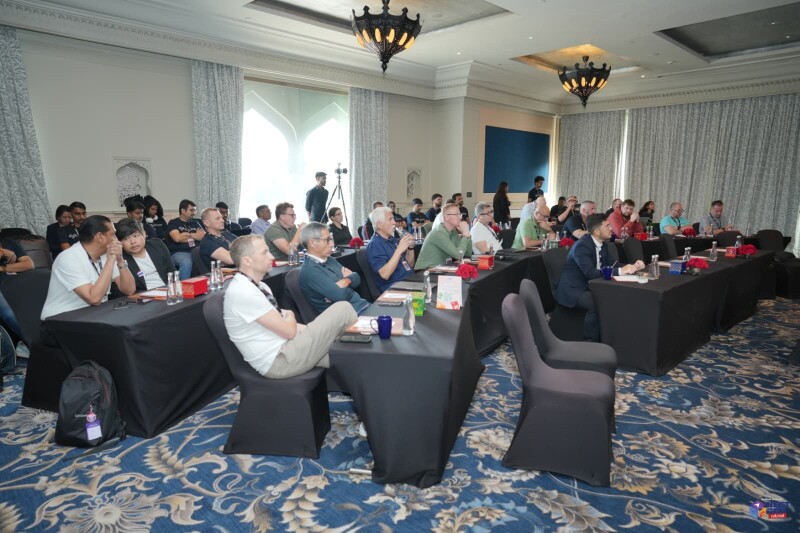
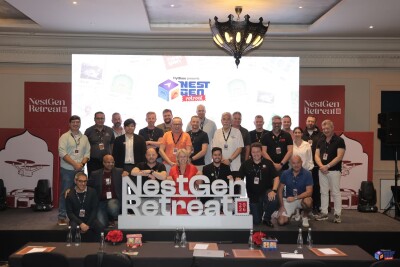
When the drone community gathered in Jaipur, India from March 1 to 5 for NestGen, the atmosphere carried an unusual mix of excitement and unease. The event, organized by Flytbase, showcased the rapid evolution of drone automation, Uncrewed Traffic Management (UTM) platforms, AI‑enabled operations, and enterprise adoption across sectors. Yet beneath the optimism, many attendees felt a deeper, more structural tension: The sense that the industry is approaching a decisive regulatory moment, and that the business side of the sector is effectively in a holding pattern while the world waits for the FAA's long‑anticipated final Part 108 rule on BVLOS operations. That uncertainty has created a paradoxical environment in which competitors are increasingly acting like collaborators, united by the recognition that the real threat to their future is not each other, but regulatory delay.
On February 20, we published an article that forecasted exactly the phenomenon felt in this gathering in India: The idea that the entire world seems to be waiting for Part 108 to mimic its basic guidelines in their local jurisdictions.
Commercial UAV News interviewed Juan Bergelund, CEO of UAV Latam, who expressed strong support for the meeting's purpose and corroborated the thesis that Part 108 seems to be a global preoccupation.
“There as a general feeling amongst the attendees that the industry is at a crossroads,” said Bergelund. “Most people I met had been in the drone business for a decade or more, and we feel as if we are in version 2.0 or even 3.0 technically, especially in BVLOS flights, but the regulation is holding back the entire industry around the world. That’s why there was so much talk about Part 108 in the corridors and meetings.”
The FAA’s approach to BVLOS seems to have civil aviation authorities across Asia, Europe, Latin America, and the Middle East watching closely, often using those frameworks as reference points for their own modernization. As a result, the pace of U.S. regulatory progress has become a proxy for global confidence in the scalability of drone operations. That dynamic was palpable in Jaipur, where companies from India, the Gulf, Europe, and North America all expressed variations of the same concern: The technology is ready, the demand is real, but the regulatory runway is not yet open.

The Industry Between Promise and Permission
The core of the anxiety stems from a simple reality. The drone industry has matured technologically, but the business models that depend on scale remain constrained by legacy rules. Under Part 107, operators are still limited to visual line of sight, a restriction that makes sense for early-stage safety but is fundamentally incompatible with the economics of large‑scale inspection, delivery, mapping, and public safety automation. Waivers and exemptions exist, but they are slow, inconsistent, and expensive. They also do not provide the predictability that investors, enterprise customers, and long‑term product roadmaps require.
“This regulatory uncertainty has forced companies to focus on those business models that can be profitable in the VLOS era,” Bergelund cautioned. “Areas such as infrastructure inspections, public safety, agriculture, certainly mapping and maritime security and to a certain extent, cargo drones. I felt from other businesspeople attending the conference a sense of camaraderie, that even if we are competitors, right now is time to close ranks and collaborate as we wait for the regulation to evolve.”
This ‘forced’ collaboration creates a structural tension. At too great a cost, companies have built sophisticated platforms, fleets, and AI‑driven workflows that can operate safely and efficiently at scale. Enterprise customers, from utilities to logistics providers, are ready to integrate drones into core operations. Yet the absence of a unified, performance‑based BVLOS rule means that the industry cannot fully commercialize what it has already proven technically. That gap between capability and permission is where the sense of danger emerges. It is not that the industry doubts its future; it is that the timeline for unlocking that future remains uncertain.
Coopetition as a Survival Strategy
One of the most striking dynamics at NestGen was the degree of collaboration among companies that would normally be considered competitors. Software platforms, UTM providers, drone manufacturers, and fleet operators all spoke openly about shared challenges and the need for unified messaging to regulators. This is not accidental. The industry understands that Part 108 will define the winners and losers of the next decade, not because of technological superiority alone, but because the rule will determine which architecture, safety cases, and operational models are viable.
“I was very impressed by the advances in the Drone-in-a-Box technology and how AI is contributing to make these operations completely autonomous," Bergelund said. “Companies like DJI, Skydio, Percepto and many others are making incredible technological advances that gave me the feeling that industry is ready to take off when we receive the blessing of the regulators.”
The stakes are high. Part 108 will shape acceptable detect‑and‑avoid (DAA) methods, pilot qualification requirements, the role of third‑party service providers, the structure of UTM integration, and the security obligations that operators must meet. If the rule is too restrictive, too costly, or too slow to implement, the entire ecosystem suffers. That shared vulnerability has created a rare moment of alignment. Companies are pooling safety data, coordinating advocacy, and presenting a unified front to regulators. The logic is simple: The industry cannot afford fragmentation at the moment when its regulatory foundation is being written.
“Right now, the mandate of one drone one pilot is putting the brakes on more profitable ways of using uncrewed platforms,” Bergelund said. “Once we can have one pilot, many drones in place, the industry will take off and from then on, the sky is the limit.”
This phenomenon is not unique to drones. Aviation in the 1930s, telecom in the 1990s, and autonomous vehicles in the 2010s all experienced similar periods in which competitors recognized that their collective success depended on regulatory clarity. The drone industry is now in that same pre‑takeoff phase, where cooperation becomes a strategic necessity rather than a philosophical choice.
A Global Ripple Effect
Although NestGen took place in India, the conversations repeatedly circled back to the FAA. India’s own regulatory environment is evolving, with increasing interest in BVLOS corridors, automated operations, and enterprise‑scale deployments. Yet many Indian companies, including the organizer Flytbase and their counterparts elsewhere, look to the FAA as a benchmark. When the FAA moves decisively, other regulators gain confidence to accelerate their own frameworks. When the FAA moves slowly, global momentum slows with it.
This is why the mood in Jaipur felt both local and global. Indian companies are innovating rapidly, particularly in automation, fleet management, and public safety applications. But they also understand that global investors, multinational customers, and cross‑border partnerships all depend on a stable regulatory foundation. The delay in finalizing Part 108 therefore creates a ripple effect that reaches far beyond U.S. borders. It affects capital flow, product development cycles, and the willingness of enterprises to commit to large‑scale drone integration.
A Moment of Maturity
Despite the anxiety, there is a deeper, more encouraging interpretation of what NestGen revealed. The very fact that the industry feels this pressure is a sign that it is maturing at a rapid pace. Early‑stage sectors worry about technology, adoption, and proof of concept. Mature sectors worry about regulation, scale, and long‑term viability. The drone industry has clearly crossed into the latter category. It is no longer asking whether drones can deliver value; it is asking when the regulatory environment will allow that value to be fully realized.
“We at UAV Latam are focusing on fine tuning our business models and technical procedures around maritime ports and airports’ inspections, 24/7 monitoring schemes in which a group of drone patrols constantly keep an eye on sensitive installations. Once we have BVLOS regulation in the different countries we operate, we’ll be ready to launch,” Bergelund concluded.
Unity among competitors is also a sign of maturity. Industries only collaborate at this level when they recognize that the structural conditions for growth must be secured collectively. The drone ecosystem is currently demonstrating that it understands the stakes and is willing to act strategically to shape its future.
In that sense, the mood at NestGen was not one of despair but of anticipation. The industry knows that Part 108 is coming, and that it will unlock the next phase of growth at the world level. The anxiety reflects the cost of waiting, not a lack of confidence in what comes next. And the collaboration reflects a shared understanding that the future of the industry will be stronger if it is built together.









Comments