

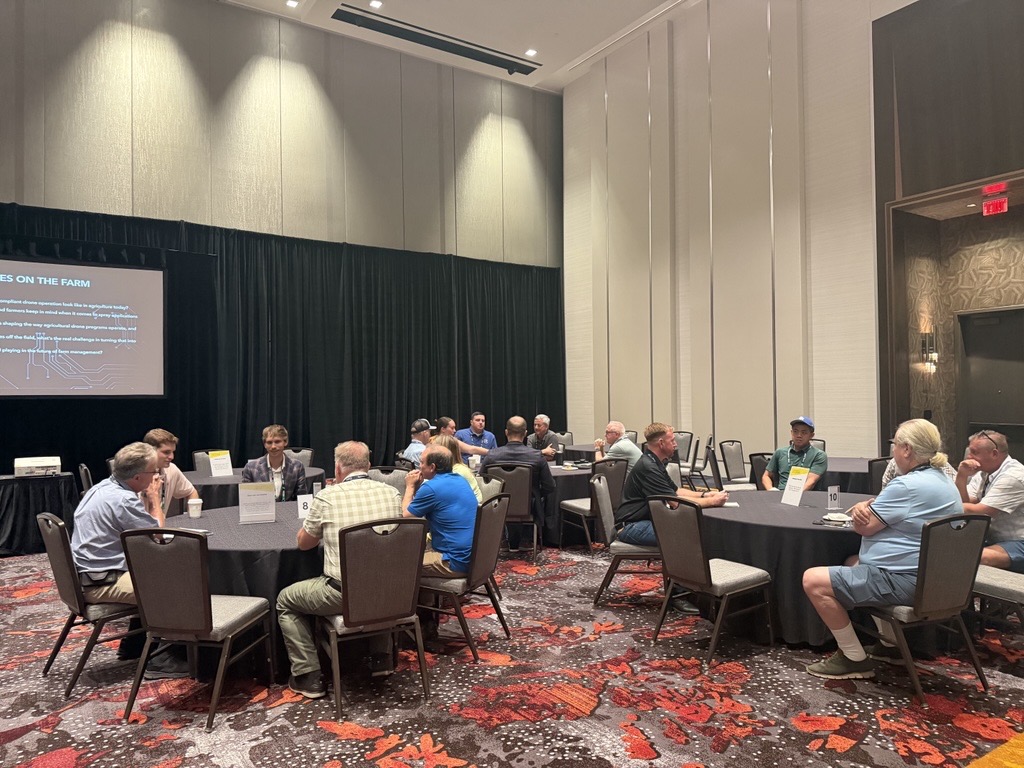
There was no shortage of topics to discuss at this year's Commercial UAV Expo. To make sure those conversations happened with the right people and were accessible to everyone, the Roundtable Sessions held space for exactly that. Instead of a traditional presentation or panel on stage, this room was designed to have attendees sit down with one another and a subject matter expert we called the discussion facilitator, to have a candid conversation on what challenges they are facing in the industry today.
This year's roundtable room hosted essential conversations on regulations, workforce and education, agriculture, business ownership, and safety. Here are some key considerations drawn from each session, featuring some reflection from the discussion facilitators from these sessions
Agriculture
Drones are becoming increasingly common on farms for their precision spraying capabilities, which have shown the capability to save growers time and money. But while drones have proven themselves a valuable tool in the field, a few roadblocks are still standing in the way of widespread adoption. Based on the conversations held at the "Drones on the Farm" roundtable, some of those roadblocks came into greater focus.
Discussion facilitator Ashley Hanson of John Deere Aviation pointed to a lack of standards across the country as a major source of delay and frustration for drone service providers trying to serve clients across state lines.
"There is not a clear process of what is required for drone spray operations state by state," Hanson said. "Every state differs, along with its state drone registration process. Oftentimes the federal process must be completed before the state process, and that causes long lead times to get up and running."
Other participants pointed instead to the need for better relationship-building and education within the agricultural sector. Discussion leader Jacob Thomas of Lee County Mosquito Control District shared a story that stood out to him about the value of that kind of mentorship.
"There was a great example of that happening in real time," Thomas said. "Two seasoned agricultural spraying professionals were working with a woman representing a California grower and walking her through how she could begin using geospatial tools to improve her operation. Rather than just discussing the technology at a high level, they were helping her think through practical first steps and how those tools could solve problems for her specific operation."
"A recurring theme throughout the session was that successful adoption isn't simply about having access to the newest aircraft or software," Thomas continued. "Education, mentorship, and understanding how to apply the technology to a real operational need are just as important."
Regulations
Roundtable discussions dedicated to regulations weren't the only place these conversations happened at the Expo, but they offered a unique opportunity to sit down with subject matter experts and talk through the issues at hand directly. While the details of each conversation varied, an overall mood emerged: uncertainty mixed with excitement for the future, and an eagerness for answers.
"I think the main focus was on how to think about the convergence of high regulatory standards being stated, enforcement going largely unseen in agriculture, and changes that are coming. But what are the right steps?" said Will Dawson of The Agriculture Drone Initiative. "I think, overall, there's a lot of enthusiasm in the long term but uncertainty in the short term. The mood was, 'ready to have some questions answered so we can all get to work implementing this technology.'"
Part 108 was a major point of discussion. "Attendees wanted to understand what Part 108 could mean in practice, what may change for existing programs, and what they should be doing now rather than waiting for a final rule," said Mary-Lou Smulders from Airdata UAV.
Recurring questions also centered on the operational infrastructure needed to scale safely: how to manage pilot qualifications and currency, aircraft and battery readiness, maintenance records, flight documentation, and regulatory reporting, especially across mixed fleets and increasingly autonomous operations.
"The larger question is how organizations operationalize that authority legally, safely, consistently, and at scale," Smulders said. That question resonated especially with attendees from construction, mining, and public-safety backgrounds.
"As programs expand from a handful of pilots and aircraft to larger fleets and multiple locations, spreadsheets and disconnected point solutions quickly become inadequate," she said. "Attendees recognized the growing need for a unified operational system of record that connects what happens before, during, and after every flight, including airspace and weather checks, aircraft readiness, pilot credentials, live situational awareness, maintenance, and compliance documentation."
Business Ownership
This growing industry is inviting more and more people to start their own drone business, but doing so on your own can be daunting. To help ease some of that burden and foster a sense of community, the roundtable “Tips for Getting Your Drone Business off the Ground” did just that.
Conversations here often circled back to Part 107. "The questions were all about where to start with getting airspace approval," said Zane Andrews of Cascade Flight, LLC. "I think it's important to highlight that the Part 107 test doesn't necessarily prepare you for how to do that in the field, it's a question almost everyone has when they start doing commercial drone work on their own. My questions were all along the lines of, 'How do I fly here if I don't know what the airspace is?' or 'Do I have to submit this approval to fly here on the map?'"
"More education is needed, especially on waivers and regulations," Andrews continued. "There should be more resources and information on how to go about it the right way, specifically from an unmanned perspective. A lot of the information on the Part 107 exam is more applicable to manned pilots."
Safety Management Systems
Safety remains a priority for all operators. This discussion focused specifically on the safety management systems that keep pilots safe and compliant in the airspace they operate in. Based on what we learned from the conversations in this room, there is a lot of work to be done.
"Small organizations are using 'trust' as their risk mitigation," said Paul Rossi of Nine Ten Drones. "The company owner knows her pilots are doing the right thing because she's known them for years and trusts them. But my favorite comment to folks when discussing safety is: trust will not stand up in an audit, documentation will. It's easy to trust everyone until you start to scale."
Wyatt Bowles echoed a related concern about internal alignment. "Across the groups, the general takeaway I had was that many organizations, regardless of size, still struggle with getting information around SMS to the wider organization, which can lead to silos," Bowles said. "Without executive buy-in at the top and an effort from within personnel, the safety management systems put in place by those leading UAS efforts inside the company generally fall flat."
Education and Workforce Development
Colleges and training providers need clearer, more consistent input from industry so their programs prepare students for real employment opportunities, said Jennifer Audette from the FAA. A recurring question in her session was how to demonstrate the value of drone-related degrees and training programs, particularly to parents footing the bill for their child's education. Parents, educators, and counselors alike need a better understanding of the wide range of careers available in this growing field.
"What stood out most to me was the shared recognition that no single organization can address these challenges alone," Audette said. "Workforce development is a puzzle. Many of the pieces already exist, but we need to do a better job connecting them."









Comments