
For more than half a century, the U.S. air traffic system has relied on a simple human ritual conducted via radio, mostly over Very High Frequency (VHF) radio: A controller provides instructions, the pilot responds, the controller acknowledges the response, and the sky stays orderly. Controller Pilot Data Link Communications (CPDLC) was designed as the first major attempt to digitize that ritual, and hence the National Airspace System (NAS). Introduced in the late 1990s for oceanic operations and expanded in Europe in the 2010s, CPDLC promised a future where clearances and instructions could move as text instead of voice.
The intent of the original design was that once pilots read and approved of the controller’s message, a route change - for example, a simple click on a button - would feed the information automatically into the navigation system, and the autopilot would turn the aircraft in the direction of the new route. It was a good idea designed to automate and streamline communications between controllers and pilots and reduce the time it took to listen, understand, read back, and acknowledge the instructions. The final version of the CPDLC, which is being used today, is something less automated and more text-oriented.
Yet in the United States, CPDLC remains only partially deployed, used mainly for departure and gate clearances and limited enroute messaging. Its slow adoption is not a failure of technology but a reflection of the deeper reality that the U.S. system was never built for automation at scale. CPDLC digitizes the message, but the future of aviation requires digitizing the operation itself.
Why CPDLC Could Not Become the Backbone of Automation
CPDLC works beautifully in the environments it was designed for, such as long‑range oceanic flights, structured European airspace, and routine altitude or route changes. But it was never intended to manage thousands of autonomous vehicles, orchestrate high‑density corridors, or replace tactical voice control in the busiest airspace on Earth. The U.S. fleet is too diverse, the avionic suite in each aircraft too uneven, and the operational tempo too dynamic. CPDLC requires a human to read, interpret, and accept every message. It is a digital extension of an analog philosophy.
The next era of aviation demands something fundamentally different. It requires rules that machines can follow, services that machines can interpret, and a regulatory framework that treats automation not as an addition but as the primary actor. That conceptual leap begins with Digital Flight Rules (DFR).
DFR is being developed through NASA research and represents the intellectual bridge between today’s human‑centric system and tomorrow’s automated one. If Visual Flight Rules (VFR) and Instrument Flight Rules (IFR) define how humans navigate the sky, DFR defines how machines will do it. The core idea is that every instruction, constraint, and contingency must be machine‑readable, predictable, and enforceable through automation. DFR is designed for a world where aircraft share intent continuously, where airspace constraints are updated in real time, and where separation is maintained not by human radio calls but by deterministic logic and possibly an extensive use of AI.
DFR is not yet a regulatory rule, but it is already shaping how the FAA thinks about automation. It provides the conceptual infrastructure for Part 108, the first true technology‑forward operating rule in U.S. aviation.
Part 108, the FAA’s forthcoming rule for Beyond Visual Line of Sight (BVLOS) drone operations, marks a historic shift. Unlike traditional aviation rules, which revolve around pilot qualifications and procedural compliance, Part 108 is built around system performance and corporate responsibility. Detect‑and‑Avoid (DAA) capabilities, command‑and‑control (C2) link integrity, automation functions, and remote operations are not supporting elements, but the rule itself.
.jpg.small.400x400.jpg)
Part 108 assumes that the operator may not be physically present, that the aircraft may be highly automated, and that the safety case depends on technology rather than human reflexes. It is the first FAA rule that aligns directly with the logic of DFR: machines must be able to interpret constraints, maintain separation, and operate predictably at scale. CPDLC could never have delivered this shift because it digitizes communication without digitizing behavior. Part 108 does both.
UTM and Part 146: The Digital Fabric Beneath Autonomous Flight
If Part 108 governs the aircraft and the operator, Part 146 governs the airspace services that make high‑density autonomous operations possible. This is the formalization of the Uncrewed Aircraft System Traffic Management (UTM) architecture that NASA pioneered. Under Part 146, airspace services will provide strategic deconfliction, dynamic constraints, conformance monitoring, and automated separation advisories. These services will not rely on human controllers to issue tactical instructions. Instead, they will rely on continuous data exchange between operators, service providers, and the FAA.
Where CPDLC sends a message from a controller to a pilot, UTM sends structured constraints from a digital service to an automated aircraft. Where CPDLC requires a human to read and accept a clearance, UTM allows a machine to ingest and comply with it instantly. This is not communication; it is digital coordination. It is the infrastructure required for thousands of autonomous flights per hour, something the legacy system could never support.
AAM: The First Industry That Truly Needs a Digital Airspace
Advanced Air Mobility (AAM), air taxis, autonomous cargo aircraft, and electric vertical lift vehicles will be the first aviation sector that cannot scale under the legacy voice‑based system. The density of operations, the proximity to urban environments, and the frequency of departures demand a digital architecture. AAM aircraft will initially operate under IFR or VFR with human pilots, but as automation increases, the system will transition toward DFR‑like rulesets, UTM‑based airspace services, and digital clearances that flow directly into onboard automation.
AAM is not simply a new aircraft category; it is the first real test of whether the United States can operate a mixed human‑machine airspace. CPDLC will continue to serve traditional aviation, but it will not be the backbone of AAM. The demands are too high, the tempo too fast, and the safety margins too narrow. AAM requires a system built for autonomy from the ground up, and that system is emerging now through the interplay of DFR, Part 108, and Part 146.
The New Architecture of Flight
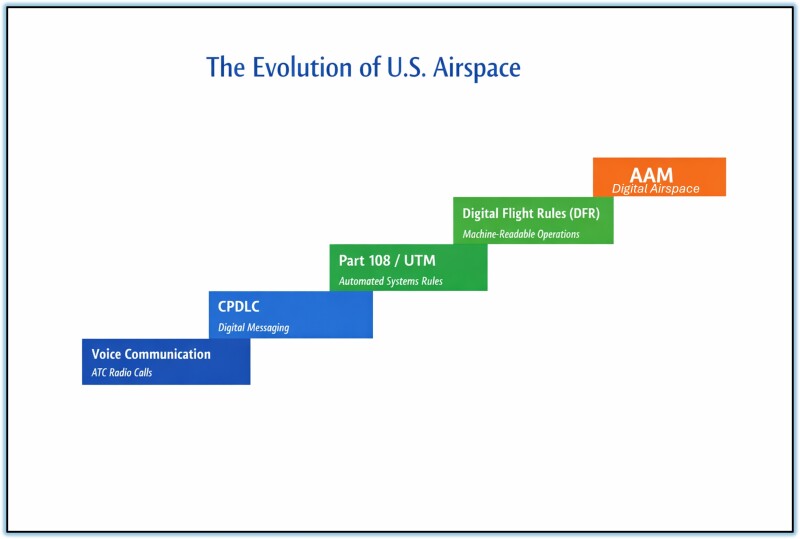
The evolution of U.S. airspace can be understood as a sequence of conceptual leaps. Voice communication defined the first era. CPDLC has the ability to digitize that voice. Digital Flight Rules digitized the behavior. Part 108 digitizes the operation, Part 146 digitizes the airspace, and AAM will digitize mobility itself, finally creating a fully autonomous digital NAS.
In the near future while we add drones and air taxis to the NAS, the FAA could start using CPDLC to add simple route changes to traditional aircraft, thus reducing the workload of both controllers and pilots by eliminating voice exchanges; perhaps not every route change on every flight and every aircraft, but whatever we can do to reduce the stress of the system under current conditions will help.
The progression could look like a staircase:
The next decade will not be defined by better radios or faster clearances. It will be defined by the creation of a digital operating system for the sky, one capable of supporting the most diverse, dense, and automated airspace the world has ever seen, and it will be done in a safe and orderly way to preserve the long tradition of aviation operational safety that has made the U.S. the safest place to fly.







Comments