
We are big fans of making absurd references to historical events, two of our favorites being: “A Recommendation to the FAA: How Part 108, the term “Big Wig,” and Mechanical Spring Watches are Connected” and “Tariffs, Import Restrictions, and What the Decline and Fall of the Roman Empire Means for Today’s Drone Industry.”
And this post takes that absurdity one step further. Because, why not?
So, Alexander the Great (aka the “ATG”). Yes, he took a small ragtag army of approximately 35,000 Greeks and beat the snot out of a Persian army of likely more than 100,000 in three separate battles. And these are all good things that earn the right to add “Great” to one’s name.
But we would argue that his greatness was more subtle, because it turns out ATG was equally adept at economics, free markets, and international trade. Really? Yes, really.
First, a quick history geek out. Today, you can easily convert your U.S. dollars into Euros then into Yen, etc., etc.; but most international trade happens in U.S. dollars, the reserve currency of the world, AKA the “standard” currency. And that makes it very easy to do a trade with someone in another country because everyone knows and trusts the U.S. dollar. But in the 4th-century BC there wasn’t a standard currency and there were no currency exchanges to speak of.
So if you wanted to trade with another city or kingdom, it was a bit of a pain. So much of a pain that generally you didn’t do it. And that’s a problem because trade is what makes everyone more wealthy. See Milton Friedman explaining here.
And because he is great, ATG realized this more than 2 millennia before there were economists.
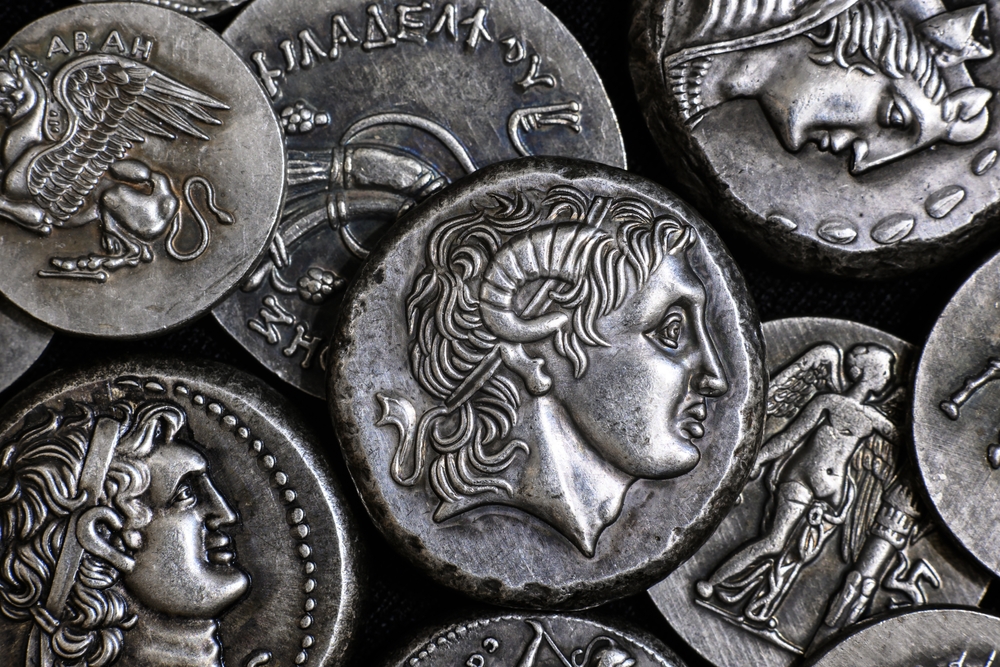
The first step: He standardized coinage throughout his empire so the “Drachma” was a certain size and weight, and most importantly was made of gold. The result was that, because everyone had a high degree of trust in the coinage, everyone was trading in standard-issue ATG-Drachmas. And the result of that result is that the economies of the Eastern Mediterranean exploded, generating an insane amount of wealth (which the Romans, about 2 centuries later during their civil wars, would pillage like it was an ATM - but that’s a story for another day).
So standards. They’re good at generating economic prosperity. But are they good at anything else?
It turns out the answer is yes. Because the same “trust” exchangeability principle that makes standardized coinage work at scale also applies to other standards. Like consensus standards on drone safety.
That’s not a big secret. Everyone knows that standards build trust and that standards make “exchangeability” a thing. But we’re willing to bet that ATG wouldn’t have been a big fan of building standards through “consensus.”

Why’s that? Well, this may come as a shock, but ATG wasn’t big on the whole democracy thing. As the king of the Greek country of Macedonia, he was more of a top-down kind of guy.
For example, when he first came to power in the 330s BC, Thebes and other city-states like Athens thought it would be a good time to rebel because, after all, ATG was in his early 20s and surely they thought: how good could ATG be?
Well, unbeknownst to the ancient Thebans, Athenians, and other city-states in the 330s (but beknownst to us now) ATG wasn’t destined to be “Alexander the Reasonably Good.”
That’s why in short order (like days after hearing of the rebellion) ATG absolutely crushed Thebes. And not in a happy-fun way either. ATG went proper old-school: killing nearly all the males and selling the vast majority of the rest into slavery. The message was clear to the other Greek city-states thinking of rebelling: the “G” in “ATG” stood for “Great” so “don’t even think of resisting.” And after the utter destruction of Thebes, they didn’t.
The net/net here is: ATG would have preferred the old-school FAA way of doing standards back in the 1960s, essentially: we’ll tell you what the standards are and how to build your airplane. And don’t resist.
Consensus standards are the opposite. Instead of the FAA dictating a particular design or process, the FAA has a set of safety objectives and then asks industry, government, and other stakeholders: “through consensus of all these stakeholders, tell us how to achieve those objectives.”
And as Americans who cherish everything about democracy, this of course feels like a much better approach that should result in a much better safety outcome. Afterall, it’s always better to have more minds on a problem.
But have “consensus standards” actually delivered this? Well, no. Or rather: we don’t actually know. Let us explain.
It turns out that Part 108 isn’t the first time the FAA has used this “consensus standard” approach. The FAA actually has a long history here.
It all started way, way, way back in 2005, where the FAA accepted over a dozen ASTM International consensus standards for the design, manufacture, and maintenance of various Light-Sport Aircraft.
Then on August 30, 2017 the FAA also launched a consensus-standard approach under Part 23, which prescribes the airworthiness standards for the certification of airplanes with a passenger-seating configuration of 19 or less and a maximum takeoff weight of 19,000 pounds or less.
This is where it gets juicy though. In its November 2020 report three years after implementation of the Part 23 consensus standards, the Government Accountability Office (“GAO”) found no evidence at the time that those Part 23 consensus standards were increasing safety and that the FAA lacked a plan to collect the data needed to make a determination.
Ouch.
Yet the FAA has worked hard and has taken steps toward implementing GAO’s recommendations. In March 2025 the FAA announced that it is now using its ASPIRE (Analyze Safety-Performance Insight-Results Environment) tool to track safety trends across aircraft fleets, including those certified under the Part 23 rewrite. But the FAA itself acknowledged that the number of aircraft certified under Part 23 remains very small, meaning it will take time before reliable trend analysis can show whether safety outcomes have actually improved relative to earlier standards.
However, anecdotally, people see the consensus-standard approach is the right way to do things. Groups like the General Aviation Manufacturers Association, National Business Aviation Association, and Aircraft Owners and Pilots Association have all supported the FAA’s acceptance of consensus standards and believe that it has accelerated the adoption of new safety technologies, e.g., improved stall protections have come to market faster, as measured in months rather than half a decade previously.
Plus there is a ton of evidence that the old top-down approach wasn’t and isn’t working at all.
Don Berchoff, Founder and CEO of TruWeather explains: “I was involved in 2005 with the joint program development office NextGen 2025 project focused on modernizing the FAA traffic management system. The goal back then: optimize airspace velocity and throughput to increase passenger volume through airports. The problem was that the right stakeholders were not in the room. The airlines weren’t brought in.”
This meant that the FAA couldn’t get support to pass legislation to get the budget to actually do it. And it died on the vine.
Retired Rear Admiral Philip M. Kenul, Vice Chair of the ASTM F38 Committee on Unmanned Aircraft Systems—which is developing consensus standards relevant to Part 108—echoes those concerns. “Look, the European Union is struggling to define a common approach across a wide range of stakeholders. Individual companies are advancing their own concepts for UTM and U-space standards outside of already established standards, and several civil aviation authorities are developing national versions of the JARUS SORA.
Taken together, this lack of interoperability does not make sense and has led to significant frustration. Many are looking to the United States as a model for how to address these challenges. That’s why an industry consensus-standards approach works—it brings together the right people to get this done, and to get it done right.”
Alexander the Great understood something regulators still grapple with today: scale requires trust, and trust requires standards. His solution was centralized authority and gold-backed certainty. Ours is consensus—messier, slower, and far more democratic.
Part 23 and Part 108 represent a deliberate bet by the FAA that modern aviation safety cannot be dictated from the top down, especially in domains evolving as quickly as small aircraft and drones. While the empirical proof of improved safety is still being assembled, the structural logic is sound: bring the right stakeholders together, define shared objectives, and let expertise—not bureaucracy—define the means.
Alexander would not have liked the process. But he would have recognized the ambition. Consensus standards are an attempt to do, peacefully and collaboratively, what empires once did by conquest: create systems that people trust enough to use at scale. Whether Part 108 succeeds will depend not on how loudly authority speaks—but on how well consensus is built, measured, and maintained.













Comments