


Two years ago, I was talking with a leader at a leading drone delivery company in South America that focused on covering the middle mile in food delivery in geographically complex cities. At the time, margins were razor-thin, and the founder told me the company had to develop a larger aircraft to carry more than one package at a time and share the cost per flight among multiple customers, not just one.
This comment reminded me how difficult it is to make money in aviation in general, and it gave me the idea to compare the profitability of existing companies in traditional aviation, such as commercial passenger and cargo airliners.
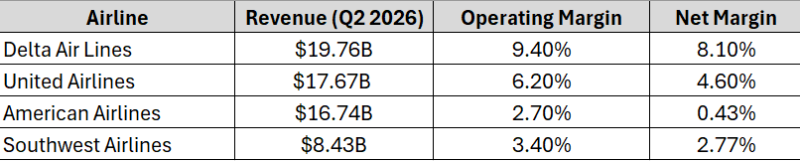
Although passenger airlines and cargo airlines share the same airspace, similar aircraft types, and many of the same regulatory constraints, their financial realities diverge sharply. Passenger carriers such as Delta, United, American, and Southwest operate on thin margins that rise and fall with consumer demand, fuel volatility, and labor costs. Cargo carriers like FedEx and UPS, by contrast, benefit from steadier revenue streams, stronger pricing power, and a business model that is less exposed to the unpredictability of human travel. The result is two industries that look similar from the outside but behave very differently on the balance sheet.
The uncrewed aviation industry finds itself at a regulatory point today at which most companies are struggling to make ends meet, especially service providers who are restricted to short flights and missions within the visual range of the operator. It may be the wrong time to compare it to a 120-year-old industry, but the lessons learned over a century of traditional aviation might be useful now.
Passenger airlines have always been high‑volume, low‑margin enterprises. Even in strong years, their profitability is modest. Delta and United occasionally reach operating margins near the upper single digits, but American and Southwest often hover near break‑even. The underlying reason is structural: Passenger airlines must absorb enormous, fixed costs while competing in a market where customers are extremely price sensitive. Even a few dollars in fare increases can shift demand, and airlines know it. They operate in a world where revenue is constrained by consumer expectations, but costs are dictated by global fuel markets, union contracts, and airport congestion.
Drone services, especially delivery, will face the same economic constraint. Customers may value receiving a package a few hours sooner, but the service cannot command a price premium so high that adoption becomes rare or disappears altogether. Another major difference from traditional aviation is fuel. The uncrewed industry has a rare fixation with electric propulsion, and that might be its biggest advantage when compared with traditional aviation, because it isolates itself from one of the largest uncertainties in crewed aviation: fuel prices.
Fuel alone can swing profitability dramatically. When fuel prices rise, airlines cannot instantly raise fares to compensate, and even when they do, the lag erodes margins. Based on reporting data, these traditional passenger airlines are seeing fuel costs rise by 66 to 85 percent.
Labor costs add another layer of pressure. Pilots, flight attendants, mechanics, and ground staff are unionized across the major carriers, and recent contract negotiations have added billions in new expenses. Passenger airlines also operate in crowded hubs where delays burn more fuel, extend crew duty time, and disrupt schedules. Every minute of delay costs money, and those costs accumulate across thousands of daily flights.
And here is where uncrewed aviation might have another huge edge: no pilots on board, which adds Human Resources costs to the equation. Once Part 108/Part 146 is issued, one pilot will be able to monitor hundreds of aircraft, and the cost/benefit analysis will shift to positive.
In traditional aviation, demand cycles further complicate the picture. Passenger travel is seasonal and sensitive to economic conditions, geopolitical events, and public health concerns. A recession, a pandemic, or even a shift in consumer sentiment can reduce load factors and push airlines into losses. This volatility is visible in quarterly financial results, where passenger airlines often swing from profit to loss with little warning. Even loyalty programs, now essential profit engines, cannot fully insulate carriers from the inherent instability of moving people.
Based on this financial data, it is easy to conclude that the first business model that would be profitable in the era of pilotless aviation will be cargo. This will likely start with package delivery and small eVTOL aircraft, then expand to larger, remotely piloted aircraft (RPAs).
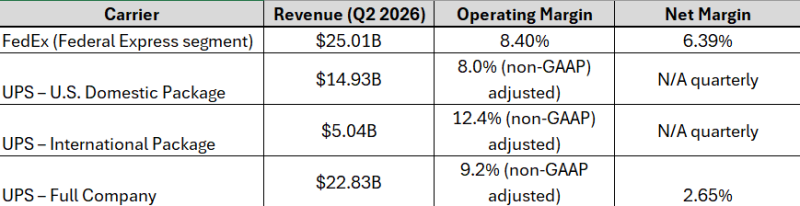
Cargo airlines operate under a different economic logic. Their business is tied not to discretionary travel but to global trade, e‑commerce, and long‑term shipping contracts. FedEx and UPS, the two largest publicly traded cargo carriers, benefit from more predictable revenue streams that are less sensitive to consumer mood. They move goods, not people, and goods do not care about holidays, weather disruptions, or seat comfort. Cargo demand follows supply‑chain needs, manufacturing cycles, and the relentless growth of online shopping.
This stability gives cargo carriers pricing power that passenger airlines rarely enjoy. Air‑freight rates remain structurally higher than pre‑pandemic levels, and cargo operators can adjust pricing more easily because their customers- businesses, logistics firms, and government agencies- are less price‑sensitive than leisure travelers. Contracts with Amazon, USPS, DHL, and global freight forwarders provide steady revenue that does not fluctuate with vacation seasons. When a cargo carrier signs a multi‑year agreement to move parcels or freight, that revenue becomes a predictable foundation for planning fleet utilization and capital investment.
Operationally, cargo airlines also enjoy advantages that passenger carriers cannot replicate. Cargo flights often operate at night or from less congested airports, reducing delays and improving aircraft utilization. They do not need to coordinate complex passenger itineraries or maintain schedules designed around human convenience. A cargo network is optimized for freight density and efficiency, not for connecting travelers through hubs at peak times. This flexibility reduces costs and increases reliability.
All these possibilities will open to uncrewed aviation once Parts 108 and 146 are finalized in the U.S. and similar regional legislation is in place worldwide. The International Civil Aviation Organization (ICAO) must work with every member worldwide to ensure rules are consistent everywhere, guaranteeing seamless cross-border operations.
International operations further strengthen cargo profitability. UPS’s international package segment has historically produced double‑digit operating margins, far above the averages seen in passenger aviation. FedEx’s express operations benefit from global trade flows that remain robust even when domestic passenger demand softens. Cargo carriers also avoid the customer‑experience costs that burden passenger airlines. They do not need cabin crew, loyalty program infrastructure, gate leases designed for passenger comfort, or premium cabin differentiation. Every dollar saved becomes a dollar that can support margin stability.
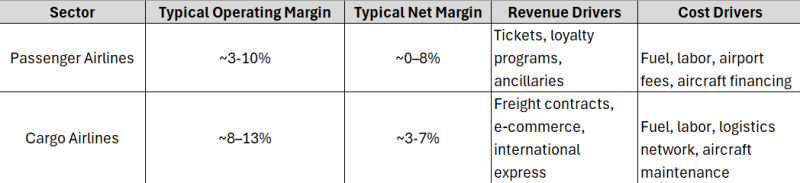
When comparing the two industries side by side, the contrast becomes clear. Based on the most recent reporting data, passenger airlines are typically operating with margins between three and ten percent, and those margins can evaporate quickly when fuel prices rise or demand softens. Cargo airlines often achieve margins between eight and thirteen percent, supported by contracted freight, e‑commerce growth, and operational efficiency. Passenger airlines are volume machines that rely on millions of travelers and thousands of flights per day to generate modest profits. Cargo airlines are yield machines that rely on fewer flights, higher pricing power, and more stable demand.
Despite sharing the same infrastructure, passenger and cargo airlines are fundamentally different businesses. One is built around human behavior, with all its unpredictability. The other is built around logistics, contracts, and global commerce. Passenger airlines must navigate the complexities of customer service, airport congestion, and seasonal travel patterns. Cargo airlines focus on moving goods as efficiently as possible, with fewer variables and more control over pricing and scheduling.
Both industries are essential to the global economy, but only one consistently earns its cost of capital. The skies may be shared, but the economics are not.
The good news for anyone thinking about getting involved in uncrewed aviation and for those already in the industry is that the aim, from the beginning, has always been services not associated with the transportation of humans. From the early days of rudimentary multicopters and basic fixed-wing aircraft, this nascent and promising industry has been built on services and the distribution of goods, not the transportation of passengers.
Companies worldwide are adding drones to their workflows to reduce costs and improve efficiency, and some applications also protect people from dangerous jobs such as cleaning windows on high-rise buildings. In principle, this new industry aims to tap into the profitable side of traditional aviation, and that is a great place to start.








Comments