

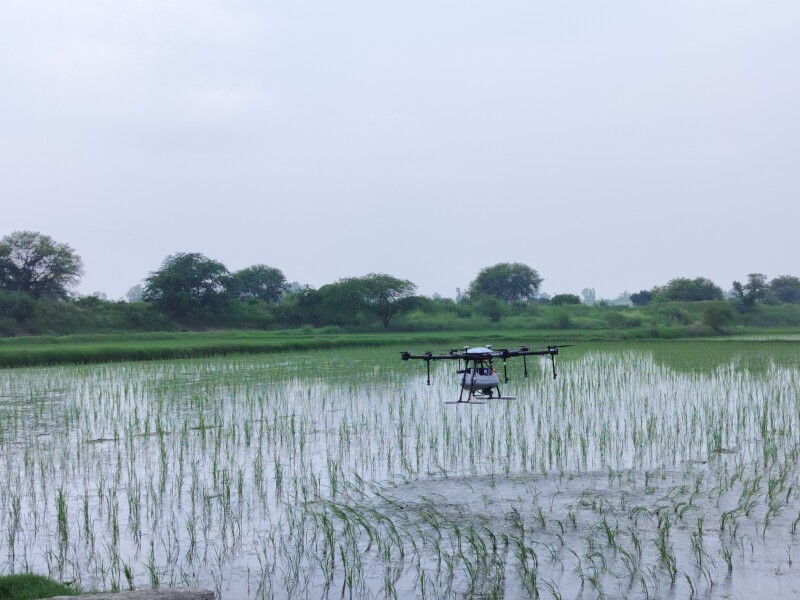
UAVs are rapidly becoming a core component of agricultural operations worldwide. From crop spraying to remote sensing, drones promise efficiency, precision, and reduced labor dependency. Yet, as adoption accelerates, a critical question remains largely underexplored outside academic circles: Are UAVs actually delivering sustainability benefits at scale, or are we simply shifting environmental burdens elsewhere in the system?
Over the past several years, my research and field work in India has focused on answering this question using life cycle assessment (LCA), machine learning–based efficiency analysis, and field-level performance evaluation of agricultural UAV spraying systems. The findings point to an important conclusion: the sustainability of UAV operations is not determined by the platform alone, but by how design choices, operational parameters, and data-driven decision-making are integrated into real-world deployment.
Efficiency Is Not Sustainability
Much of the current discourse around agricultural drones emphasizes speed, coverage, and labor reduction. While these metrics are important, they tell only part of the story. In a peer-reviewed life cycle assessment study published in Sustainability (2025), we evaluated UAV-based spraying systems against conventional ground-based spraying in Indian agricultural contexts.
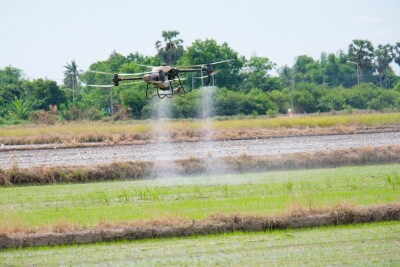
The results were revealing. UAV spraying demonstrated significant reductions in water use, chemical input, and operator exposure, but only under optimized conditions. Poorly selected nozzle configurations, excessive flight overlap, or inappropriate application rates could quickly erode these benefits. In some cases, energy intensity per hectare increased when UAV operations were not matched to crop canopy structure or environmental conditions.
This highlights a critical insight for practitioners: efficiency gains do not automatically translate into sustainability gains. Without system-level evaluation, UAV deployment risks becoming a technologically advanced but environmentally ambiguous solution.
Why Life Cycle Thinking Matters for UAS Operations
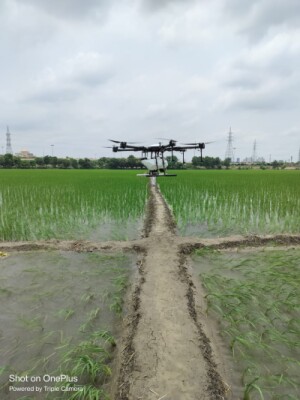
Life cycle assessment forces us to examine UAV operations beyond the flight itself. Energy consumption during charging, manufacturing impacts of components, chemical drift, water savings, and even indirect emissions all contribute to the true environmental footprint of a spraying mission.
By integrating LCA with operational performance metrics, we were able to identify decision points where sustainability gains are either amplified or lost. For example:
- Ultra-low-volume spraying reduced chemical load significantly, but required careful nozzle selection to maintain deposition efficiency.
- Optimized flight speed and altitude reduced drift while maintaining canopy penetration.
- Matching UAV parameters to crop type (rice, mango, sugarcane) had a measurable effect on both environmental and agronomic outcomes.
These findings suggest that UAV sustainability is fundamentally a systems engineering problem, not just a hardware problem.
From UAVs to Climate Intelligence
In parallel work presented through Springer and IEEE conference proceedings, we explored how machine learning and computational intelligence can enhance UAV sustainability. Rather than treating drones as standalone tools, we framed them as data-generating nodes within a broader climate-smart agriculture system.
By combining UAV operational data with environmental variables and life cycle indicators, it becomes possible to:
- Predict optimal spraying parameters for specific agro-climatic zones
- Quantify trade-offs between energy use, water savings, and chemical reduction
- Align UAV deployment strategies with climate adaptation goals and SDG indicators
This shift from UAVs as delivery mechanisms to UAVs as climate intelligence platforms is where the technology’s long-term value lies.
The Human and Policy Dimension
Technology alone cannot deliver sustainable outcomes. Field observations consistently showed that training quality, institutional support, and policy alignment play decisive roles in determining whether UAV systems deliver real benefits.
Smallholder farmers, women operators, and rural service providers often lack access to standardized training or evidence-based operational guidelines. When UAV adoption is driven purely by market availability rather than contextual suitability, sustainability outcomes become uneven.
Future UAV deployment frameworks must therefore integrate:
- Evidence-based operational standards
- Capacity building for operators
- Alignment with regional water, pesticide, and climate policies
Only then can UAV systems move from being novel tools to becoming reliable instruments of climate-resilient agriculture.
Looking Ahead
The next phase of agricultural UAV adoption will not be defined by larger fleets or longer flight times. It will be defined by how intelligently data, design, and decision-making are integrated across the system.
Research-driven insights show that UAVs can indeed reduce environmental footprints, enhance efficiency, and support climate adaptation, but only when deployed with a systems perspective. As the industry matures, the most impactful innovations will come not from flying higher or faster, but from thinking deeper about sustainability, equity, and long-term resilience.








Comments