

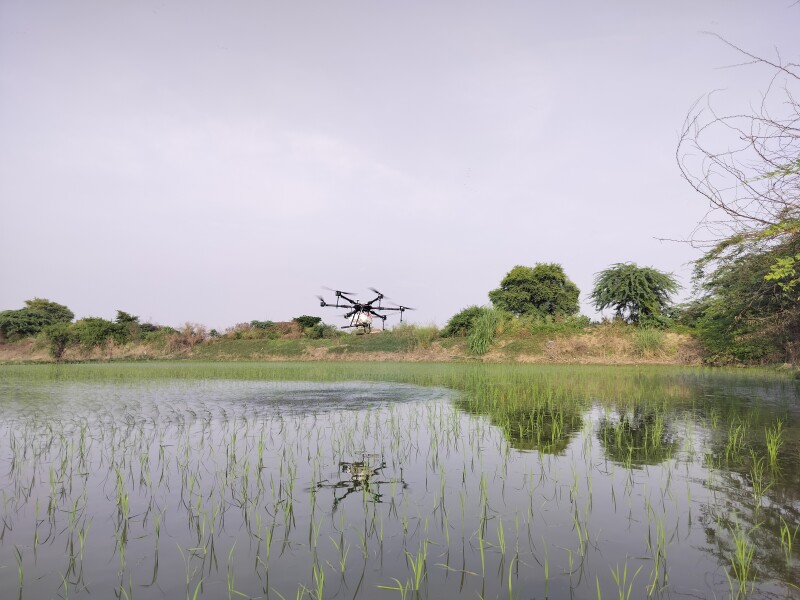
As agricultural UAV adoption accelerates, decision-makers often rely on anecdotal evidence or vendor specifications to justify deployment. However, data-driven evaluation of UAV spraying systems remains surprisingly scarce in industry discourse, particularly when it comes to environmental performance, resource efficiency, and operational trade-offs.
Over multiple field trials and simulation-based studies conducted across Northern and semi-arid regions of India, I evaluated UAV spraying systems using quantitative life cycle assessment (LCA), machine learning–based performance modeling, and comparative nozzle-level experimentation. The results offer concrete insights into where UAVs deliver measurable advantages, and where assumptions break down.
Water Use: The Most Consistent Advantage
Across crops including rice, mango orchards, and sugarcane, UAV-based spraying consistently demonstrated an order-of-magnitude reduction in water consumption compared to conventional ground-based spraying.
- Conventional spraying: ~150–250 L/ha
- UAV ultra-low-volume spraying: ~10–25 L/ha
This reduction was not theoretical. It was achieved under field conditions using optimized ultra-low-volume (ULV) nozzle configurations, maintaining acceptable canopy deposition while minimizing runoff and evaporation losses.
However, data also showed that incorrect nozzle selection or excessive flight overlap negated up to 30-40 percent of expected water savings, reinforcing the need for parameter optimization rather than blanket adoption.
Chemical Load and Deposition Efficiency
Chemical input reduction is often cited as a key UAV benefit, but results varied significantly based on nozzle geometry and flight parameters.
In controlled comparative trials:
- Certain ULV nozzle configurations achieved 15-30 percent reduction in pesticide usage per hectare
- Deposition uniformity improved when flight altitude and speed were matched to canopy height and density
- Drift risk increased sharply when speed exceeded threshold values, even with ULV spraying
These findings indicate that UAV spraying efficiency is highly sensitive to micro-level design choices, and cannot be generalized across platforms or crops.
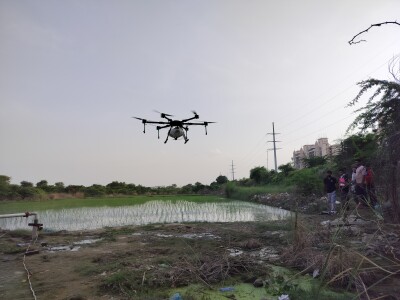
Energy and Carbon Footprint: A Conditional Advantage
Life cycle assessment revealed a more nuanced picture regarding energy use and carbon emissions.
While UAV spraying eliminated fuel combustion at the field level, battery charging energy and operational intensity became dominant contributors to the carbon footprint. Under optimized operations, UAV systems demonstrated lower or comparable CO₂-equivalent emissions per hectare relative to tractor-based spraying.
However, increased flight repetitions, inefficient mission planning, and suboptimal payload utilization
This underscores a critical point: Carbon efficiency is operationally determined, not inherent to UAVs.
Machine Learning for Parameter Optimization
To move beyond trial-and-error optimization, machine learning models were applied to operational datasets combining:
- Flight parameters
- Nozzle types
- Environmental conditions
- Application outcomes
The models successfully identified non-linear relationships between spraying parameters and efficiency metrics, enabling predictive optimization rather than reactive correction. This approach allows operators to pre-select mission configurations that minimize environmental cost while maintaining agronomic efficacy.
From an industry perspective, this represents a shift from UAVs as mechanical tools to decision-support systems informed by data intelligence.
What This Means for UAV Professionals
The data clearly indicates that agricultural UAVs can deliver measurable sustainability gains – but only when deployment is evidence-led. Hardware capability alone is insufficient.
Key takeaways for practitioners include:
- Parameter tuning matters as much as platform selection
- Environmental gains must be quantified, not assumed
- Data integration (LCA + performance metrics) is essential for credible sustainability claims
As regulators, insurers, and climate-finance mechanisms increasingly demand evidence-based justification, operators who can demonstrate quantified performance advantages will be better positioned for scale and legitimacy.
Toward Standardized, Data-Driven UAV Sustainability Metrics
The industry now faces an opportunity: to move toward standardized performance benchmarks for agricultural UAV operations, integrating water use, chemical efficiency, and carbon intensity into decision frameworks.
Such metrics would not only strengthen operational outcomes but also align UAV deployment with broader climate adaptation and sustainability goals. The future of agri-UAS will belong to those who can measure, model, and optimize – not just deploy.








Comments