


Contributed by Dr. José Ramírez
The European commercial drone market is projected to approach $13 billion by 2030, with sustained growth across logistics, infrastructure inspection, precision agriculture, and emergency services. For U.S. operators already working at scale domestically, Europe represents one of the most significant growth opportunities available today.
However, the regulatory distance between Washington and Brussels is far greater than the geographical one. The framework U.S. operators know does not translate, and understanding the differences is key to unlocking a market that, in many commercial segments, remains less mature and less competitive than the United States.
The good news is that operators willing to invest in understanding Europe’s regulatory architecture may find themselves with a powerful first-mover advantage in a market of over 500 million consumers where commercial drone services are still in relatively early stages of development. The wider the maturity gap, the greater the business opportunity.
Your Part 107 Means Nothing in Europe. But European Certification Opens 31 Countries
The FAA’s Part 107 Remote Pilot Certificate carries no legal weight in Europe. There is no reciprocity agreement between the FAA and EASA, and none is under discussion. The gap is real, and there is currently no indication that it will close anytime soon.
In the EU, drone operations are governed by Regulation (EU) 2019/947, which classifies all operations into three risk-based categories: Open, Specific, and Certified. Each carries different pilot competency requirements, operational limitations, and authorization procedures.
A U.S. operator wanting to fly commercially in Europe must register with a national aviation authority, obtain the relevant EASA competency certificates, and comply with local operational requirements. For advanced operations (including BVLOS flights, operations over populated areas, or flights in controlled airspace), operators enter the Specific category process, requiring a SORA (Specific Operations Risk Assessment) and formal operational authorization.
This requires planning, local presence, and regulatory engagement. But here is the critical difference: While the FAA gives you access to one country, a single EASA framework opens the door to 27 EU Member States plus Norway, Iceland, Switzerland, and Liechtenstein. The investment in European regulatory compliance is an investment in continental-scale market access, across all 31 countries.
The CE Marking Wall And the Competitive Moat Behind It
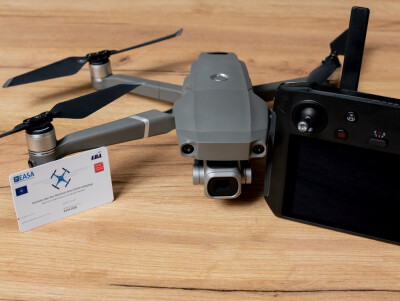
In the EU, drones increasingly require a CE class identification label to operate within the Open and Specific categories. These labels certify compliance with European technical standards for safety, remote identification, geo-awareness, and noise.
U.S. manufacturers selling into Europe without CE marking can still operate under transitional provisions, but these are progressively tightening. Compliance with Delegated Regulation (EU) 2019/945 is becoming essential for long-term market access.
This may look like a barrier. In reality, it is a strategic investment. Manufacturers capable of adapting their products to European certification standards position themselves not only for EU market access but also for broader international credibility as global drone regulation gradually converges toward more sophisticated safety and traceability requirements. The sophistication of European certification creates a significant barrier to entry. Companies that invest early often find themselves operating in a far less crowded competitive environment than they face domestically.
Insurance: Mandatory, Not Optional But a Sign of Market Maturity
Under U.S. rules, drone liability insurance is recommended but not federally required under Part 107. In Europe, it is mandatory for commercial operations under Regulation (EC) No 785/2004. Several Member States impose even broader obligations. Italy, for example, requires insurance for all drone operations regardless of weight.
For U.S. operators entering Europe, this means securing aviation liability coverage recognized under European law and compliant with national minimum coverage requirements that vary across Member States.
This may seem burdensome, but it reflects a market built on institutional maturity. Public authorities, infrastructure operators, and industrial clients increasingly expect drone operators to demonstrate professional compliance, risk management, and financial accountability. Operators meeting those standards command premium pricing precisely because the regulatory framework filters out unqualified competition while reducing risk and increasing confidence for clients, investors, and insurers alike. And for clients, working with a fully insured operator provides something that no technology alone can deliver: certainty, security, and peace of mind.
SORA: Rigorous, But a Competitive Advantage
U.S. operators accustomed to the FAA waiver system often misunderstand EASA’s Specific category process. SORA is not a waiver request. It is an official structured risk framework, endorsed by EASA, requiring operators to identify ground and air risks, implement mitigation measures, and build documented safety cases.
The recently updated SORA 2.5 framework introduces additional considerations for increasingly autonomous and AI-assisted operations, adding further complexity that has no direct equivalent in the US system.

But SORA expertise is rapidly becoming a genuine competitive advantage. Many European operators (particularly smaller firms) are still developing their Specific category capabilities. A U.S. company arriving with experienced compliance teams capable of producing high-quality SORA documentation will stand out immediately.
Furthermore, Europe’s framework includes the Light UAS Operator Certificate (LUC), allowing mature operators to self-authorize flights across the entire EU without requiring individual national authorizations. Master the system in one Member State, and you unlock a continent.
The European Premium: Why the Effort Is Worth It
Many commercial drone segments that are already saturated in the United States (inspection, mapping, surveying, agricultural monitoring) remain in early adoption phases across large parts of Europe. Demand for professional drone services is growing faster than the supply of qualified operators capable of meeting European regulatory standards.
EASA’s apparent regulatory complexity is, paradoxically, part of the opportunity. The level of commitment required represents a genuine challenge, but one that rewards those who rise to it. Operators who invest in CE marking, SORA expertise, and local regulatory relationships will find that what initially seemed like a burden has become their strongest competitive advantage.
With the progressive rollout of U-space (Europe’s digital airspace management ecosystem), the continent is building the infrastructure for routine beyond visual line of sight operations at scale. U.S. operators establishing themselves in Europe now will be positioned to capture BVLOS opportunities as that infrastructure progressively comes online.
The Strategic Calculation
Europe is not a harder version of the U.S. market. It is a different market: one with a more structured entry path, but also with higher margins, lower saturation, and a regulatory framework designed to reward professional operators who take safety and compliance seriously.
The companies that will succeed are those that treat Europe as a distinct regulatory environment requiring dedicated local infrastructure, not as an extension of their domestic operations.
The regulatory Atlantic is wider than it looks. But for companies prepared to cross it strategically, the opportunity on the other side is wider still.
 Dr. José Ramírez is a Spanish aviation and corporate lawyer with 28 years of legal practice and a member of the Madrid Bar Association (ICAM). He holds an MBA from ESADE, a PhD in Airport Marketing, and is currently a doctoral researcher in EU aviation competition law. He advises internationally on cross-border aviation matters, drone regulation, and European aerospace law.
He can be reached at [email protected]

.jpg.small.400x400.jpg)










Comments