
Ten years ago this Saturday, on August 29, 2016, something happened that is easy to overlook today but fundamentally changed the trajectory of unmanned aviation in the United States: The FAA’s Part 107 Small UAS Rule went into effect.
The drones already existed. The cameras existed. The entrepreneurs existed. The demand existed. What was missing was a practical regulatory framework that allowed thousands of people and companies to turn those ingredients into an industry.
Before Part 107, commercial drone operations were largely trapped in a case-by-case regulatory system. The principal pathway was the FAA's Section 333 exemption process, often accompanied by a Certificate of Waiver or Authorization. By the time Part 107 arrived, the FAA had issued 5,551 Section 333 exemptions. That was evidence of enormous demand, but also of a system that was difficult to scale.
Part 107 changed the basic proposition. Instead of asking the FAA for permission to conduct ordinary commercial drone operations, one company and one operation at a time, an individual could obtain a Remote Pilot Certificate, register the aircraft and operate within a clearly defined set of rules. The FAA described Part 107 as the foundation of the regulatory framework for integrating UAS into the National Airspace System (NAS).
That distinction is enormously important, because the technology was already there; what Part 107 did was to create the conditions in which the industry could scale.
The results appeared almost immediately. Within its first year, the FAA issued more than 59,000 Remote Pilot Certificates and registered more than 79,000 commercial aircraft. The agency itself called the rule a "game changer" because it allowed routine public and commercial operations without case-by-case FAA approvals when conducted within the rule's parameters.
The growth since then has been remarkable. The FAA's latest aerospace forecast reports that more than 493,000 Remote Pilot certifications had been issued by December 2025, an increase of more than 70,000 in a single year. Approximately 78 percent of those pilots held only a Part 107 certificate, while the remaining 22 percent held both Part 107 and a traditional Part 61 pilot certificate.
The FAA's 2025 forecast projected approximately 482,000 remote pilots by 2026. In other words, the industry has gone from a few tens of thousands of newly created certificates in Part 107's first year to roughly half a million certificated remote pilots a decade later.
From Regulation to Infrastructure
Part 107's greatest accomplishment is that the rule became the platform upon which an entire regulatory and technological ecosystem could be built.
The original Part 107 was deliberately conservative. Operators generally had to maintain visual line of sight, operate below 400 feet, fly during daylight and avoid flying over people who were not directly participating in the operation. Yet the rule also contained an important mechanism for the future: operators could request waivers from certain provisions when they could demonstrate that their proposed operations could be conducted safely, and that opened the door for the industry to begin getting its feet wet in beyond visual line of sight (BVLOS) operations in preparations for a future expanded rule.
That made Part 107 both restrictive and flexible. It established a baseline for routine operations while leaving a pathway toward more sophisticated ones.
The next major development came in 2017 with Low Altitude Authorization and Notification Capability (LAANC), which turned what had been a cumbersome airspace-authorization process into something increasingly digital and almost instantaneous. By 2021, FAA-approved LAANC providers had processed more than 700,000 authorizations, with the vast majority occurring automatically in seconds.
The FAA's 2021 data show the scale of that transition even more clearly: cumulative LAANC authorizations had approached one million, including more than 527,000 Part 107 automatic authorizations and almost 100,000 Part 107 requests requiring further coordination.
This was an important change in the character of remotely piloted aviation. The industry was beginning to develop the digital infrastructure necessary to manage thousands and eventually millions of aircraft sharing low-altitude airspace.
Then Part 107 itself evolved.
On April 21, 2021, the FAA's Operations Over People (OOP) and Night Operations rules took effect. Qualified Part 107 operators could conduct certain nighttime operations and operations over people and moving vehicles without obtaining individual waivers, provided they met the requirements of the new rules.
Remote ID followed, adding another layer of identification and accountability to the expanding drone ecosystem. Today, drones that require FAA registration generally must also comply with Remote ID requirements unless they are operated within an FAA-recognized identification area.
Each of these steps, put together, represent something much larger: the gradual transformation of drones from an emerging technology into an aviation system.
The First Decade Ends with a Very Different Industry
The most revealing way to look back at Part 107 is to compare the industry that existed before August 29, 2016, with the industry that exists today.
In 2016, the FAA was dealing with an emerging technology whose commercial potential was obvious, but whose regulatory framework was still being assembled. The agency had issued thousands of exemptions, hundreds of thousands of aircraft owners had registered drones, and companies were experimenting with aerial photography, mapping, inspection, agriculture and other applications. But there was still considerable uncertainty about how those operations could become routine.
Drones are now routine tools for surveying and mapping, construction, infrastructure inspection, agriculture, public safety, emergency response, real estate, media production, industrial operations and even small package deliveries. They have become increasingly integrated into the workflows of companies that previously would never have considered themselves aviation businesses.
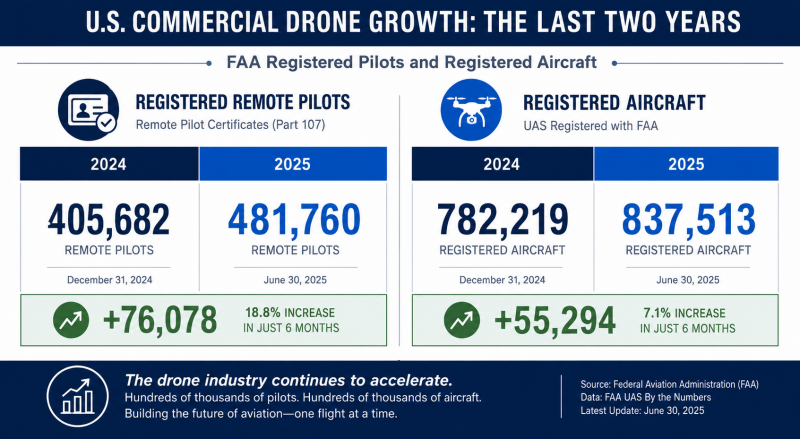
The numbers demonstrate the scale of that transformation. The FAA's 2026 aerospace forecast reports more than 493,000 Remote Pilot certifications at the end of 2025 and forecasts continued growth to more than 500,000 during the next several years.
And yet the most interesting part of the Part 107 story may be what has not happened yet.
Part 107 was designed principally around small UAS operating under relatively simple conditions. It was never intended to be the final regulatory framework for autonomous delivery networks, routine BVLOS operations or large fleets of highly automated aircraft.
The FAA itself described Part 107 in 2016 as only the first step in its incremental approach to UAS integration, with operations over people, BVLOS and transportation of persons and property identified as future challenges.
That makes the tenth anniversary less of an ending than a dividing line. Now that we have the Notice of Proposed Rulemaking (NPRM) for Parts 108 and 146, the industry has ten years under its belt to prepare for the final integration of crewed and uncrewed aviation in the NAS, something that no law mentions but it’s an inevitable conclusion of both regulations working together.
The first decade was about establishing legitimacy, creating rules, certifying pilots, registering aircraft and demonstrating that drones could safely become part of the aviation system. The next decade will be about scale: how many aircraft can operate simultaneously, how far they can fly, how much autonomy they can safely exercise and how deeply they can become integrated into the NAS.
Part 107's greatest legacy may therefore be surprisingly simple.
It gave the industry something it desperately needed in 2016: a predictable answer to the question, "How can I legally operate this drone for my business?"
Once that question had an answer, entrepreneurs could invest. Manufacturers could build products for a defined market. Training organizations could develop pilots. Software companies could develop flight-management and airspace tools. Surveyors, inspectors, farmers, emergency managers and countless other users could begin incorporating drones into their operations.
The technology had been waiting for the market.
The market had been waiting for the rules.
On August 29, 2016, the rules finally arrived.
Ten years later, nearly half a million certificated remote pilots and an enormous commercial drone ecosystem stand as evidence of what happened next. Part 107 created the market for the drone, and, arguably, the modern U.S. commercial drone industry itself.
In October 2015, when the first Commercial UAV Expo opened its doors to the public, the future was uncertain. Now, a decade later, Commercial UAV Expo 2026 open its doors to a mature industry, waiting for the regulatory flood gates to finally release the energy and the investment potential of a nation waiting to regain its place in aviation history.






Comments