

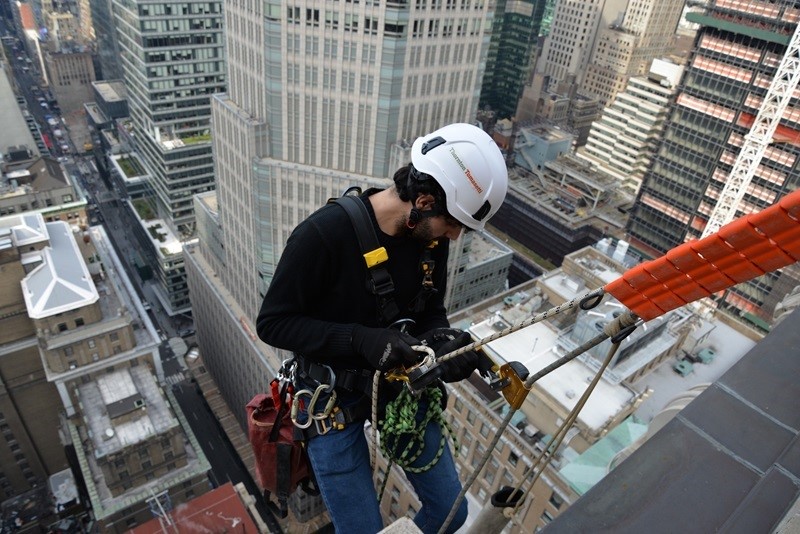
Walk through any city, large or small, and you’ll notice lots and lots of scaffolding. Look around and you’ll see rows upon rows of metal and wood clinging to the sides of buildings. You’ll see workers moving along those rickety rows while pedestrians hurry along in the drafty, open “sidewalk sheds” below.
Scaffolding and sidewalk sheds are unsightly and potentially dangerous but they're also necessary for new construction, building repairs, and façade inspections. To address the issues around scaffolding and sidewalk sheds, New York City’s Department of Buildings recently announced changes to their policies. These changes could lead the way toward less scaffolding in the city and the adoption of new approaches to building construction, maintenance, and inspection, including the use of drones.

“New York City has the oldest facade inspection standard in the world,” according to Jonathan Ehrlich, CEO of the asset inspection firm T2D2. The standard, Erlich said. “was established in 1980 and has been updated periodically since then.” These updates, he explained, have been made “to address new technologies, new risks that have appeared as construction progresses, and new inspection methodologies.” In recent years, the city’s standards have also evolved to adapt to the ways drones can aid in inspections.
Ehrlich told Commercial UAV News that New York has increased the hands-on requirements for building inspections “but they've acknowledged the capability of drones to acquire incredibly helpful amounts of visual inspection data.” He said that “the law does require a 100% visual inspection of these buildings, in addition to a focused analysis of some hands-on inspection, so drones have played an increasingly important role.”
This movement toward drone inspections has taken a big step forward in recent years as New York Mayor Eric Adams has pushed for fewer sidewalk sheds in the city with a program called “Get Sheds Down.” Ehrlich said that that program recently announced that it is redesigning the options for putting up sidewalk sheds and working with engineering companies, including T2D2, to re-evaluate existing laws and find ways to adapt new technologies. That’s where drones come in.
“We are excited that the full report and its recommendations will be coming forward shortly, and that there will be components of it that will allow for some alleviation in the inspection requirements if drones are used instead of human inspectors for certain buildings that meet particular criteria,” Ehrlich stated.
Ehrlich’s firm stands ready to take advantage of these new approaches to building inspection. For the past five years, his New York-based company has been involved façade inspection and analysis all around the world, using its sophisticated software and drone pilot network to serve a range of clients. “We are a software company and also a drone service provider, mostly for building facade inspections around the world,” Ehrlich said.
His company has worked on the Empire State Building, Citi Field and other baseball stadiums around the country, as well as nuclear power plants, hydroelectric facilities, and other critical infrastructure assets. “We primarily do photogrammetry, computer vision analysis, and report generating, and we work with a lot of the commercial drone service providers in establishing best practices for gathering data for the purpose of that analysis,” said Ehrlich. “We're used commercially by many major drone service providers and engineers and architects.”
Ehrlich said that T2D2 does vertical photogrammetry and orthomosaics, along with traditional horizontal mapping photogrammetry. In addition, he said, “we do a lot around the vertical plane and doing full facade elevations for very detailed facade inspection, not just on older masonry buildings, but also on new glass curtain walls and everything you can possibly imagine.”
In many of these situations, drones play a key role. “We've been tremendously encouraged by the growth of the drone service provider industry over the past few years. We think that the tech, the hardware technology itself, has become only better, higher resolution, easier and safer to operate as a licensed drone pilot.”
For that reason, Ehrlich stated, T2D2 has “decided to focus on what we know best, which is software, and to rely on a network of partners that we’ve worked with in the past, whether it's in New York or other cities around the country, who specialize in a drone flight and do this every single day.”
With the recent changes in New York City around façade inspections and scaffolding, Ehrlich sees an opportunity to grow his company’s position. “Even before this announcement, we’ve seen drones playing an increasingly important role in building inspection,” he said. The new Department of Buildings rules, he said, could open the door to greater use of uncrewed systems.
“Drone technology is far superior than having to deal with human inspectors that are peering through windows constantly,” Ehrlich said. “So, to us, this is nothing more than the next generation for processes that are already happening. And New Yorkers, as far as we can tell, are wholeheartedly embracing it.”






Comments