

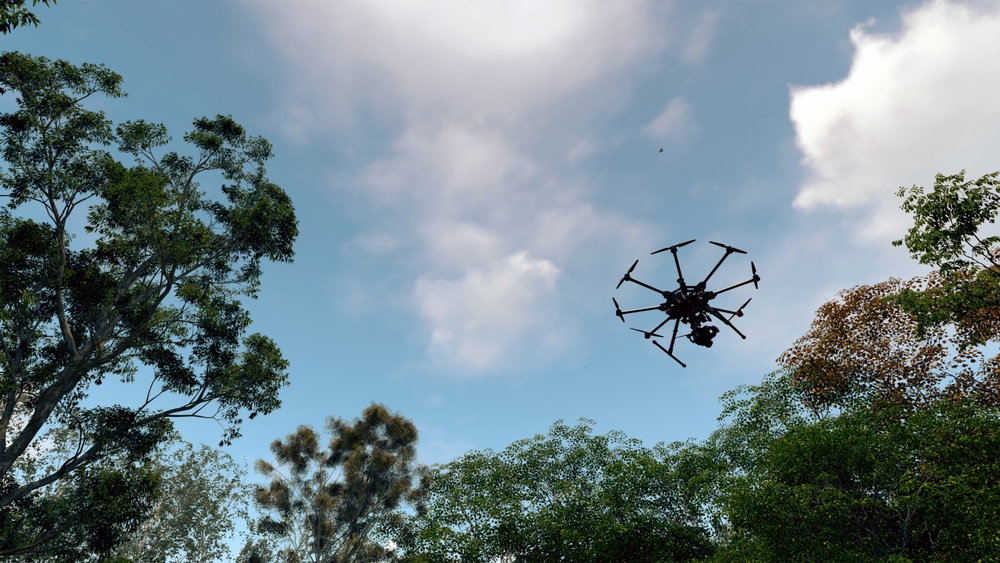
This week’s news roundup looks at a group of students who built drones that have no moving parts, how thermal drone imaging is helping a fragile animal species, and a new drone corridor for tissue and blood sample opens.
Experimental Drone Flies without Moving Parts
Aerospace engineers at Rutgers University have developed a drone that flies without motors, gears, or linkages, but instead using "smart" piezoelectric materials that flex and twist when electricity is applied, mimicking the muscular action of a bird in flight. This research demonstrates that this "mechanism-free" design could be well-suited for complex environments, with potential applications in search-and-rescue, environmental monitoring, and urban delivery.
For now, the concept is largely computational, as current piezoelectric materials aren't yet capable enough to make the design physically viable. But as Bilgen noted, "our mathematical model allows us to look into the future with reasonable assumptions", and the same principles may eventually extend to improving wind turbine efficiency by enabling real-time adjustments to blade shape.
Thermal Drones Prove to be Essential Tool in Wildlife Monitoring
A review published in Biodiversity and Conservation examined 38 global studies from 2018 to 2025, finding that thermal drones show strong potential to outperform traditional ground-based surveys for detecting threatened rainforest species. The technology identifies wildlife through heat signatures and works especially well for arboreal mammals like primates, though detection success depends heavily on how the technology is deployed rather than the technology alone.
The review also highlights opportunities beyond primates. Recent trials have expanded to bats, sloths, elephants, and birds, and points to the potential for supporting Indigenous-led conservation efforts. As Professor Susan Laurence noted, "when co-designed and adequately resourced, drone-based monitoring programs can strengthen local technical capability while integrating cultural knowledge and respecting data sovereignty."
Drone Corridor Opens for Organ Donation
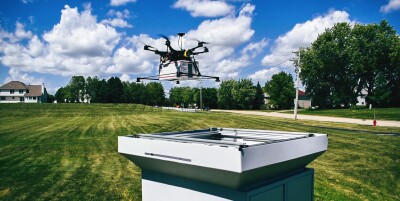
In an effort to expand access to healthcare in rural areas, Mid-America Transplant organization has opened a dedicated healthcare drone corridor in Missouri. As an organ transplant procurement organization, this corridor will be used specifically for tissue and blood sample delivery to test samples from potential organ donors. The route currently remains in Missouri, but there are plans to expand into Illinois and Arkansas.
Flights are carried out in collaboration with Valkyrie UAS Solutions, using their fixed-wing aircraft to transport samples. This method of delivery significantly cuts down transport times. Before, ground transport of samples from Springfield took three hours. With drone delivery, it only takes under two hours.










Comments