

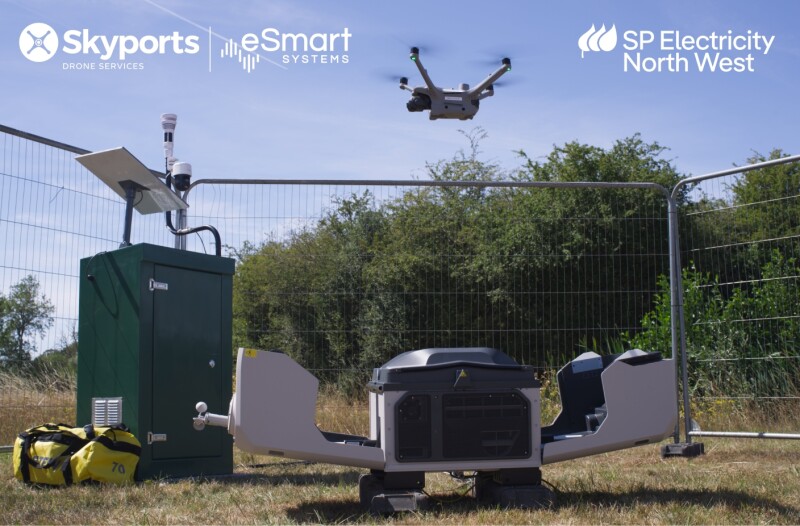
.png.small.400x400.png) On Wednesday, UK-based Skyports Drone Services announced a partnership with eSmart Systems and SP Electricity North West (SP ENW) for what they are calling “Project VOLT” (Visual Overhead Line Tracking). Through this partnership, the companies will launch a pilot program to deploy a remotely piloted fault response service using drone-in-a-box technology, with initial operations taking place on a portion of SP ENW’s network in the Lake District in northwest England.
On Wednesday, UK-based Skyports Drone Services announced a partnership with eSmart Systems and SP Electricity North West (SP ENW) for what they are calling “Project VOLT” (Visual Overhead Line Tracking). Through this partnership, the companies will launch a pilot program to deploy a remotely piloted fault response service using drone-in-a-box technology, with initial operations taking place on a portion of SP ENW’s network in the Lake District in northwest England.
The hope is that, by deploying this technology, they will improve network uptime through rapid fault finding, prevention, and continuous asset condition monitoring. They say their overall objective is to improve customer service, reduce costs, and enhance operational safety while informing future decision-making for both SP ENW and other distribution network operators.
“We’re constantly looking for new ways to deliver a better service for our customers, and the VOLT project has the potential to be a game-changer,” said SP ENW innovation project manager Martin Tejada in a statement.
Traditionally, identifying where faults lie after storms and other incidents can be difficult, as foot patrols have been the primary detection method, and storms can restrict physical access. As severe storms become more frequent and damaging, new technologies are being leveraged to help facilitate more efficient work in their wake. Project VOLT fits into this theme, using both drone-in-a-box technology and AI analytics, which the companies say will provide a “rapidly deployable and safer alternative to ground inspections.”
“Traditional inspections are largely reactive, relying on manual assessments after issues have developed,” said Skyports Drone Services CEO Alex Brown. “Using remotely piloted drones, that can be instantly deployed, allows operators to identify faults much faster and prioritize repairs without delay, ultimately getting customers back online quicker. Through this pilot, we hope to prove a new model for powerline inspections that can be replicated across the country, improving the UK's overall grid resilience.”
This pilot project will include four drone-in-a-box setups, each available 24/7 throughout the 12-month pilot program. Remote pilots from Skyports Remote Operations Centre over 200 miles away in Buckinghamshire will complete these BVLOS missions, with data captured streaming live into SP ENW’s control center while being processed and analyzed through eSmart’s Grid Vision software, which is powered by AI to help quickly identify faults. The service will work alongside SP ENW’s existing fault response processes.
Alongside the post-storm surveys, the project will also include drones flying continuous asset condition monitoring along the lengths of the powerline adjacent to the substations. Again leveraging the AI-powered software from eSmart Systems Grid Vision, the drones will be able to detect defects such as loose connections, insulator damage, overheating and failing hardware, and vegetation encroachment. Just as the fault response workflow aims to ease reliance on foot patrols, this workflow aims to do the same for expensive helicopter surveys.
“Across Europe we are seeing a clear shift from periodic inspections to continuous grid intelligence. Permanent, efficient remote inspection is not simply a cheaper patrol, it changes what an operator can know about their network,” eSmart Systems vice president, commercial, Joscha Köllner said.
The project is supported by Ofgem Network Innovation Allowance funding, which encourages distribution network operators to carry out innovative projects focused on the energy system transition and/or addressing consumer vulnerability.












Comments