

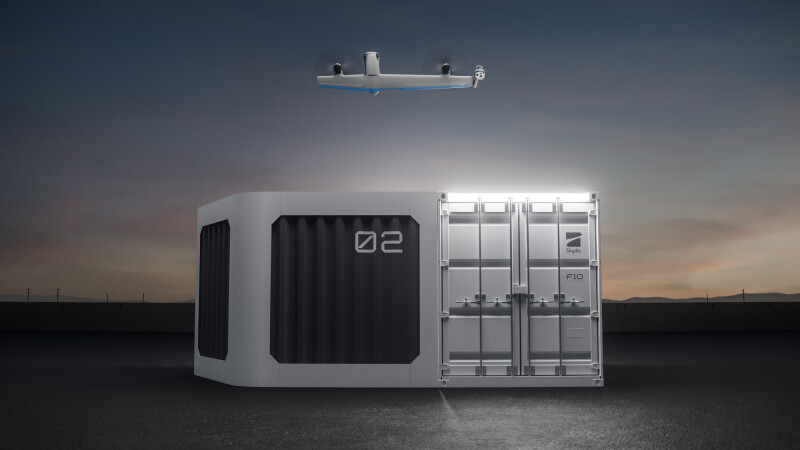
On Wednesday, at Skydio’s annual in-person event Ascend, CEO Adam Bry ended his keynote presentation which was livestreamed outside Las Vegas, Nevada – which was livestreamed – with an introduction to the company’s latest offering, the F10 Lightrunner. The new drone moves away from the quadcopter aircraft that currently dominates Skydio’s lineup of drone offerings, representing its new flagship fixed-wing offering that Bry noted was built for long-range public safety missions and linear corridor inspections for utilities.
In his introduction to the product, which included a live flight around the event space, Bry emphasized that solving real issues for the company’s customers was the throughline behind all of the design decisions for the aircraft, particularly given the relative lack of fixed-wing options, including from Skydio. The F10 Lightrunner can reach speeds up to 100 mph with a 30-mile coverage radius and max endurance of two hours. You can find more specs for the drone on Skydio’s website.
Bry made sure to point out, though, that one of the traditional drawbacks for fixed-wing aircraft in this space has been the wings creating blindspots for the camera payloads, something the Skydio team set out to mitigate in its design. To do so, they introduced what they call its “SideEye” design, placing the rolling gimbal onto the wingtip. The payload includes a three-sensor integration featuring telephoto, narrow, and thermal cameras.
Among the potential issues for a fixed-wing drone, particularly one traveling at this speed, is obstacle avoidance. To address this, Skydio introduced Foresight and Pathfinder engines into the drone to bring Skydio Autonomy to the F10’s flights. According to the company, Pathfinder charts the route prior to the flight, including terrain, obstacles, geofences, and airspace rules, while Foresight adjusts that route in real time to what the aircraft detects. Those engines are in addition to onboard 360-degree navigation cameras, as well as the Skydio Airspace Assurance System, which receives ADS-B and other inputs to maintain awareness of its surroundings.
Early in the announcement at Ascend, Bry made note of the fact that one of the major issues that often prevents fixed-wing aircraft from being a viable option, particularly in the public safety sector, is the personnel required for takeoff and landing. To counter that, Skydio also introduced the MegaDock. This autonomous docking station was designed for the F10 Lightrunner, and can house up to five of these drones at once with a robotic arm-based system handling takeoff and landing without any runway or people on-site. Operators can keep up to three F10 aircraft in the air simultaneously, with two standing by in the charging dock.
Just about every application across the UAS industry today is dominated by quadcopters, but Bry noted toward the end of his presentation that no single aircraft should be relied upon as a solution to every problem. He ran through a couple of scenarios within the public safety and infrastructure industries and how the different offerings from Skydio – including the X10 quadcopter and R10 indoor drone – can work together for different pieces of a workflow. The company believes the F10 Lightrunner fills a critical gap for long-range, rapid-response missions, and its design was clearly aimed at addressing all of the traditional drawbacks of a fixed-wing aircraft.






Comments