
In the race toward advanced air mobility (AAM), most of the attention has gone to the high‑profile electric vertical takeoff and landing (eVTOL) manufacturers promising to reinvent urban transportation. On January 9, we published an article comparing the FAA certification paths of three companies born of the AAM era and how Archer, Joby, and Electra have raised billions, built clean‑sheet aircraft, and embarked on some of the most ambitious certification programs in modern aviation. Yet, while the spotlight has been fixed on the futuristic silhouettes of tilt‑props and blown‑lift wings, legacy Robinson Helicopter Company has been quietly pursuing a radically different strategy, one that may prove faster, cheaper, and ultimately more commercially durable.
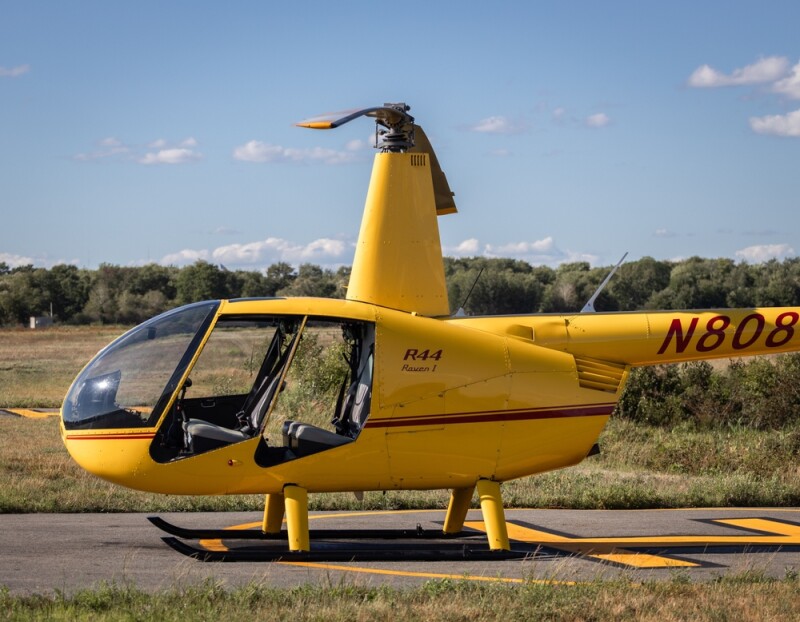
Robinson’s approach begins with a simple but powerful insight: The fastest way to certify an autonomous aircraft is not to certify a new aircraft at all. This approach is very similar to Electra's, but it uses a standard powerplant. Instead of designing a clean‑sheet platform, Robinson is modifying two of the most widely used light helicopters in the world, the R44 and R66, and certifying only the systems that transform them from piloted machines into autonomous or remotely piloted ones. The airframes themselves, along with their engines, rotor systems, structural loads, and flight characteristics, are already fully certified under Part 27. The FAA has decades of operational data on them, and operators around the world know their maintenance profiles intimately. This gives Robinson a regulatory foundation that the eVTOL startups can only envy.
What remains for certification is the autonomy stack, the command‑and‑control (C2) architecture, the detect‑and‑avoid (DAA) logic, and the removal of pilot controls. These are significant challenges, but they are challenges confined to systems rather than airframes. The FAA will evaluate the autonomy software under DO‑178C, the hardware under DO‑254, and the overall system under the existing Part 27 framework. The agency does not need to validate a new propulsion architecture, a new aerodynamic configuration, or a new structural design. It only needs to validate the changes.
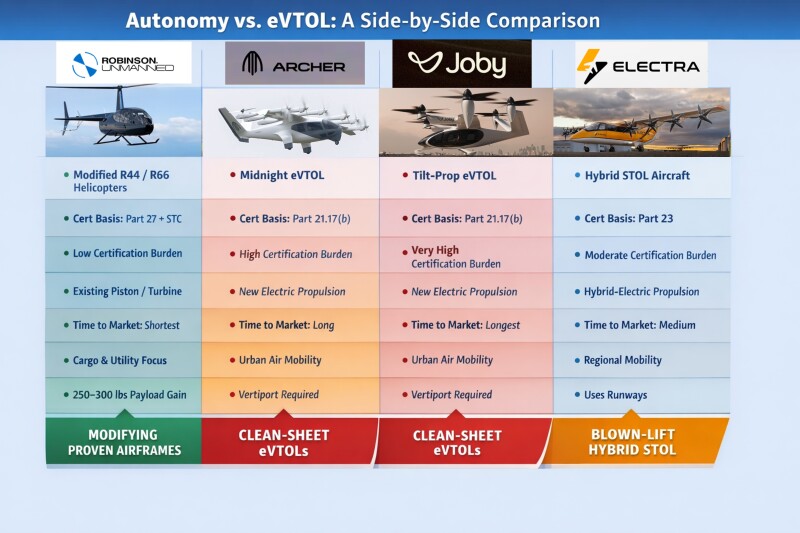
This distinction, certifying changes rather than certifying an aircraft, is the heart of Robinson’s advantage. It is also what separates their strategy from the clean‑sheet approaches of Archer, Joby, and Electra. Each of those companies is pursuing a fundamentally different certification journey, one that requires proving not only autonomy or advanced flight controls but also the aircraft itself.
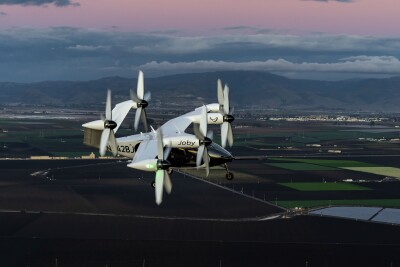
Joby, for example, is certifying a tilt‑prop eVTOL under Part 21.17(b), a special category used when no existing certification basis fits the aircraft. This means the FAA must negotiate and approve every element of the certification basis, from structural loads to crashworthiness to propulsion safety. Joby’s aircraft is a technological marvel, but it is also a first‑of‑kind machine, and first‑of‑kind machines face first‑of‑kind scrutiny. The company has made impressive progress, but the path is inherently long, expensive, and filled with unknowns.
Archer faces a similar challenge. Its Midnight aircraft is also a clean‑sheet eVTOL, also certified under 21.17(b), and also dependent on the FAA’s willingness to define and validate new standards for distributed electric propulsion, tilt‑rotor dynamics, and novel flight control architectures. Archer has moved quickly, and its partnership with United Airlines gives it a strong commercial anchor, but the certification journey remains complex. Every component, every system, every aerodynamic behavior must be proven from scratch.
Electra’s approach is different but no less ambitious. Its blown‑lift hybrid‑electric aircraft is being certified under Part 23, which provides a more established framework than 21.17(b) but still requires extensive validation of a propulsion system and aerodynamic configuration that have no direct precedent in the FAA’s historical data. Electra’s STOL performance is extraordinary, but extraordinary performance requires extraordinary proof. The company has been methodical and transparent, yet the certification path remains long and technically demanding.
Against this backdrop, Robinson’s strategy looks almost understated. But that understatement is precisely what gives it power. By starting with aircraft that the FAA already knows intimately, Robinson avoids the structural testing campaigns, the aerodynamic validation programs, and the propulsion certification challenges that dominate the timelines of the eVTOL startups. The company does not need to prove that its aircraft can fly; it only needs to prove that its aircraft can fly without a pilot.
This difference has profound implications for cost, risk, and time to market. Clean‑sheet eVTOL programs require billions in capital, years of flight testing, and extensive negotiations with regulators over novel technologies. Robinson’s program requires none of that. The company can focus its engineering resources on autonomy, remote operations, and safety‑critical systems, areas where the FAA already has emerging frameworks thanks to the work of companies like Reliable Robotics and Xwing, now owned by Joby Aviation. The regulatory questions are challenging, but they are not unprecedented.
There is also a commercial advantage that Robinson enjoys almost uniquely. Removing the pilot and cockpit structure from an R44 or R66 frees up roughly 250 to 300 pounds of useful load. For cargo missions, that is transformative. A helicopter that once carried a pilot and a small payload can now carry a significantly larger payload with no change to its fundamental airworthiness. For utility operators, offshore logistics providers, and remote‑area service companies, this is not a futuristic promise, it is an immediate operational benefit.
The global footprint of Robinson’s fleet amplifies this advantage. R44s and R66s are already in service in more than 60 countries. Converting even a fraction of that installed base into autonomous aircraft creates a market presence that no eVTOL startup can match in the near term. While Archer, Joby, and Electra are building their first production lines, Robinson is building a bridge from today’s operations to tomorrow’s autonomy.
None of this diminishes the ambition or importance of the eVTOL programs. Joby’s tilt‑prop architecture, Archer’s urban mobility vision, and Electra’s blown‑lift STOL design represent genuine breakthroughs in aviation. They are pushing the boundaries of what is possible, and their long‑term impact may be profound. But in the near term, Robinson’s strategy may prove more commercially resilient. It is grounded in known airframes, known maintenance ecosystems, and known regulatory frameworks. It is incremental rather than revolutionary, and sometimes, in aviation, incremental wins the race.
The story of advanced air mobility is often told as a competition between futuristic aircraft. But the more interesting competition may be between certification strategies. Clean‑sheet designs promise transformative capabilities but require transformative regulatory work. Modified legacy aircraft (the Cessna Caravan turboprop for example) promise more modest capabilities but can reach the market far sooner. Robinson has chosen the latter path, and in doing so, it may become the first company to field a widely used autonomous rotorcraft.
In an industry defined by bold visions and long timelines, Robinson’s quiet pragmatism stands out. The company is not trying to reinvent aviation. It is trying to evolve it, and evolution, especially when paired with autonomy, may prove to be the most disruptive strategy of all at least in the short term.






Comments