

One of the few certainties of our modern industry is that drones of all types, from multicopters to fixed-wing, will be using propellers for the foreseeable future. Although jet engines are the engine of choice for traditional passenger- and cargo-crewed aviation, and miniaturization advances are making them smaller, their cost and operational complexity make them impractical for an industry trying hard to stay all-electric.
At the recent Commercial UAV Expo, held earlier this month in Las Vegas, I visited a series of propeller manufacturers offering a variety of sizes, shapes, and performance characteristics that could be adapted to almost any mission. For the most part, the designs were almost universally traditional and conservative.
One company in particular, REV Labs, featured an innovative design and a new business model to accompany its technology. Its founder and CEO, Jeff Downard, spoke with Commercial UAV News to share more about the company.
“REV Labs is a research and development company based in Flagstaff, Arizona," he said. "We develop Fly staggered blade configurations for propellers and fans, working with engineering and manufacturing partners to turn those designs into commercial products. Our first marine product line, PowerBoost!, is scheduled to reach the market this fall through our manufacturing and commercial partner, PowerTech! REV Labs has been nominated for the National Marine Manufacturers Association’s innovation award in marine propulsion. The company is now setting its sights on similar recognition for innovations in aerial propulsion.”
The Technology
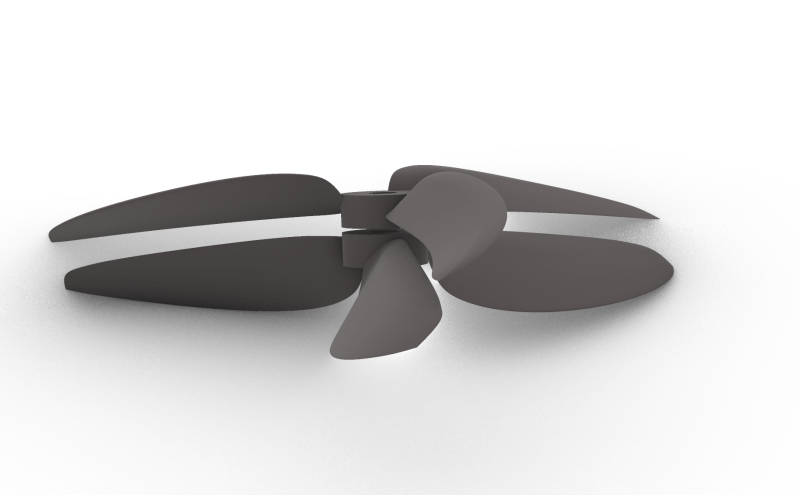
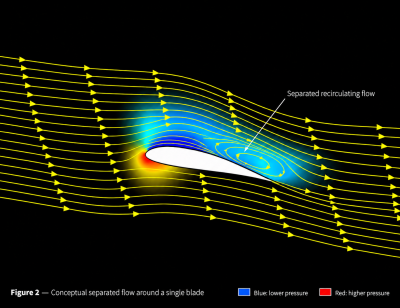
Staggered-blade propeller design is a relatively new aerodynamic/hydrodynamic concept that appears in both marine and aerial propulsion research. The core idea is simple but powerful: Instead of mounting all blades in a single plane, pairs of blades are offset fore‑and‑aft (i.e., front and back), with carefully tuned differences in rake, skew, and pitch. This creates a ‘slot effect’ between the blades that conditions the flow and reduces losses.
As the blades rotate, their speed increases toward the tips, and the flow through them changes with operating conditions. Downard drew inspiration from the interaction between a sailboat’s jib and mainsail, then began investigating whether paired propeller blades could produce useful flow interactions. REV Labs’ design treats the sail-slot analogy as a starting point. The propeller geometry must be developed and tested on its own terms.
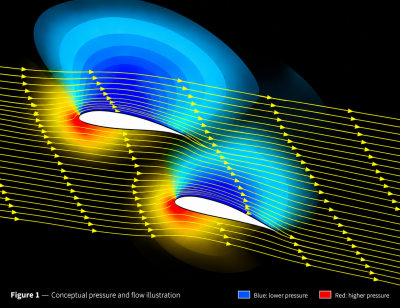
Several aspects of the design matter:
- Blade shape and angle: Each blade must suit the flow it actually encounters within the pair.
- Axial spacing: The distance between the forward and aft blades affects their interaction.
- Angular offset: Their relative positions around the shaft help determine how the surfaces and wakes interact.
- The shape of the gap: The three-dimensional passage between the blades changes along their length.
- The operating point: A configuration must be matched to its intended speed, load, diameter, and application.
Adding blade area can increase thrust but also increases the required power. REV Labs' design objective is to improve the relationship between useful output and power input. For a drone hovering at a given weight, for example, the useful question is how much electrical power the propulsion system needs to maintain that lift.
“CFD [computational fluid dynamics] helps us investigate these relationships. It allows us to examine pressure distributions, flow direction, blade loading, and wake behavior in detail. We can vary the geometry and identify promising configurations before committing to another physical prototype. Testing then tells us how well those predictions hold up in practice,” Downard said.
“Marine work also brings in cavitation: the formation of vapor cavities when local pressure in the water becomes sufficiently low. Cavitation can affect thrust, noise, vibration, and blade durability. Our marine studies therefore examine how the staggered configuration changes pressure and loading, alongside its effects on propulsion.”
Unlike water, air is compressible, so applying the design to drone propellers required a fresh round of development and testing in air, with attention to thrust, power consumption, weight, and noise.
“For drones, the priorities shift toward thrust per unit of power, weight, noise, vibration, and performance across hover and forward flight. Better propulsion efficiency could support longer endurance, greater payload capability, or a smaller battery for a particular mission. Those are the benefits we are working toward; their magnitude must be established through aerial testing,” Downard said.
“Noise is another important target. Blade loading and wake interactions influence the sound a propeller produces. We want to explore whether carefully designed pairs can improve the acoustic performance as well as the energy efficiency of a drone. That requires measurements at comparable thrust and operating conditions.”
The Business Model
REV Labs does not manufacture propellers of any type. Instead, it licenses its designs and focuses on extensive research.
“We chose licensing because our principal contribution is the technology: developing the blade configurations, building the intellectual property, and working with partners to refine and validate designs,” Downard explained. “An established propeller manufacturer brings another essential set of capabilities. It knows how to manufacture consistently, select materials, control quality, balance finished products, support customers, and distribute through existing sales channels. Those capabilities are a substantial part of turning an invention into a dependable product.”
REV Labs’ relationship with PowerTech! illustrates the model in the marine market. REV Labs contributes the staggered blade technology and participates in its development. PowerTech! brings manufacturing expertise, commercial experience, and established customer routes. Licensing provides the framework through which each company can earn a return as it sells products incorporating REV Labs’ technology.
“That arrangement lets us concentrate our resources on further research and development while working with people who already understand the practical demands of producing and supporting marine propellers. It also suits the breadth of the opportunity. A recreational boat propeller, a delivery-drone propeller, and a commercial ventilation fan have different materials, production methods, performance requirements, and customer bases. Licensing allows us to work with specialists in each field and adapt the technology to their applications, ” Downard said.
“For drone manufacturers, our aim is to collaborate on a design that fits a particular aircraft and mission. That means working through the operating requirements, developing suitable configurations, and testing them with the partner. The strongest business case will come from demonstrated improvements that matter to the customer.”
Jeff Downard’s presence at Commercial UAV Expo underscored REV Labs' intent to enter the drone market.
“We see licensing as an ongoing engineering relationship. Our partners’ manufacturing knowledge and field experience help improve the designs, while our research supplies further developments for them to evaluate,” Downard said and concluded with an invitation to potential partners, “We invite drone propeller manufacturers, motor suppliers, and aircraft developers to collaborate on prototypes and comparative testing for a defined aircraft and mission. We can be contacted through our website.”
REV Labs aims to improve how propellers move through water and air, as well as how fans circulate air through machines and buildings. What began as a question about two sails working together is now guiding the development of propellers for uncrewed aircraft through design, testing, and partnerships.
As the industry seeks better batteries and longer flight times, more efficient propeller designs could offer another route to greater endurance for demanding commercial missions, as we enter a new era to be brought on by the finalization of Parts 108 and 146, which is hoped to be published by the end of 2026.










Comments