


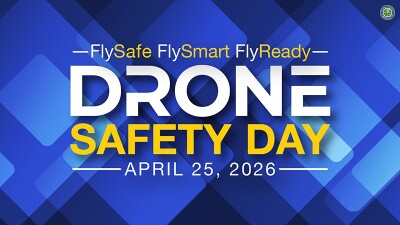
Every April, the FAA uses Drone Safety Day – this year’s edition was held this past weekend, on April 25 – to focus the drone community's attention on the principles that make our complex national airspace work: Know the rules, fly responsibly, and treat the airspace as a shared ecosystem. It is an important effort, and for an industry with over 800,000 registered drones and more than 400,000 certificated remote pilots operating across a myriad of use cases, a moment of collective reflection is vital for the continued growth of the space.
However, generally speaking, Drone Safety Day reaches the people who are already invested. That’s certainly not to say that keeping industry professionals and dedicated hobbyists focused on safety is a negative, to be sure. But the harder and arguably just as consequential challenge is earning the trust of everyone else.
That challenge around gaining the acceptance of the public is more urgent now than it has ever been. The FAA's upcoming final Part 108 rule will open the door to standardized BVLOS operations, enabling drones to fly farther, more autonomously, and in more places than what current standard operations allow. The scale of integration that many envision being unlocked by the finalization of Part 108 can only happen with public permission, and public permission is not guaranteed. The safety record the industry has built over a decade of operations under Part 107 is real and worth communicating, but it exists largely within the echo chamber of the industry itself. Outside of it, within the general public, it’s a different picture.
Research on public perception of drones consistently surfaces the same cluster of concerns: safety, privacy, and noise. Even with drone delivery steadily becoming more commonplace in some parts of the country, with a largely (but not entirely) clean track record, public sentiment still expresses concern around potential privacy invasion as well as noise complaints.
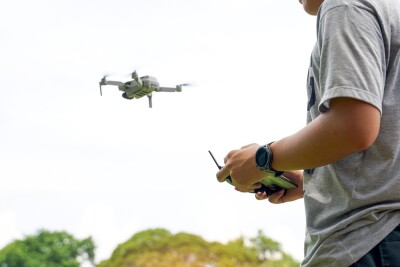
Acceptance is also highly context-dependent. Generally speaking, it’s been found that trust toward institutions deploying drones varies significantly depending on who is flying and why. Firefighters, emergency response units, and scientific organizations tend to receive strong public support. Private companies tend to receive considerably less.
None of this, to be clear, is a verdict against drones. It is a description of where the industry starts from when it asks communities to accept expanded operations over their neighborhoods, parks, and infrastructure. There is still a gap between what those within the industry know this technology is being used for – and the tremendous value it brings – and what the public believes is happening, and closing that gap through education and outreach is critical to unlocking the full potential of our post-Part 108 industry.
Arguably no vertical has encountered public trust challenges more than drone delivery, and the pattern that has emerged across multiple markets should inform how the broader industry thinks about community engagement.
In College Station, Texas, approximately 150 residents submitted comments opposing Amazon's expansion plans, far more than a typical FAA environmental review receives. Sustained noise complaints ultimately led Amazon to shut down its College Station operations in August 2025. The story in Richardson, Texas has followed a similar trajectory. Residents near Amazon's delivery facility reported hearing drones multiple times per hour, and the city council requested an updated noise study, alternative routing options, and stronger privacy protections before permitting expanded operations. The pattern is not limited to the United States. In Australia, Google's Wing delivery service faced organized community opposition in Canberra over noise, and ultimately ceased operations in the area in 2023.
It’s important to note to what exactly the communities here are objecting. Even technical, provable evidence around decibel levels doesn’t always assuage these concerns. In actuality, these complaints boiled down to familiarity, predictability, and the feeling of having something unfamiliar imposed on a neighborhood without adequate input. As one analyst told the E-Commerce Times back in 2024, “The opposition is rooted in the potential for constant noise disruptions, which could adversely affect the quality of life.”
There is a meaningful difference, of course, between compliance and communication. Compliance means meeting the regulatory requirements: current certification, Remote ID adherence, proper airspace authorization, and documented operational procedures. Communication means making those things visible and legible to the people who share the environment where drones operate, and doing so in a way that non-experts can understand.
For smaller commercial operators, this can be straightforward. Posting a notice before flying a construction site or pipeline survey, taking a moment to explain the operation to a curious neighbor rather than treating the interaction as an interruption, and being identifiable and approachable as a professional are not complicated actions. However, they accumulate into the kind of reputational infrastructure that makes expanded operations possible.
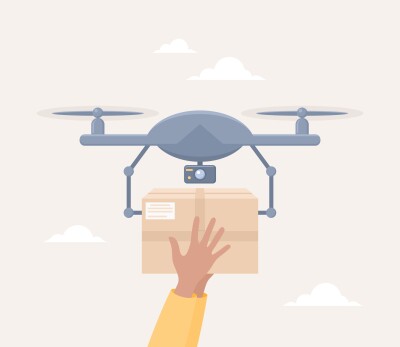
For larger organizations pursuing BVLOS corridors or delivery programs, the required investment is higher, commensurate with the impact these expanded operations will have on their business. Research on public acceptance of drone technology suggests that effective integration requires not only technological readiness but real, targeted public engagement. That means involving communities in planning processes before deployment decisions are made, and treating public feedback as operational data rather than opposition to be managed.
The FAA's investment in Drone Safety Day reflects a real understanding that safety culture matters as much as safety regulation. The event has grown from a weeklong awareness campaign into a national platform that brings together recreational flyers, commercial operators, and industry stakeholders around a shared set of values.
That has real value, but also limited reach. The commercial operator who reads this publication, attends Commercial UAV Expo, or monitors the FAA's rulemaking calendar is already engaged. For the city council member weighing a drone delivery pilot program in their district, the community organizer filing noise complaints with a local HOA, the local journalist covering a near-miss incident at a regional airport, Drone Safety Day does not necessarily reach them without intentional amplification beyond the insiders.
The industry's most effective ambassadors on public trust are, ultimately, the operators working and potentially living in communities every day, the ones who can translate what responsible commercial drone operations actually look like into terms that make sense to someone who has piloted a UAV, and doesn’t have much interest in doing so.
The commercial drone industry has built a safety record worth defending and communicating. Millions of flight hours under Part 107 have demonstrated that drones can operate reliably, professionally, and with tangible benefit to the sectors that have adopted them.
As Part 108 moves toward a final rule and BVLOS operations begin to scale, the operators and organizations that treat public trust as an ongoing operational priority will be the ones that get to fly in the places and corridors that matter. Drone Safety Day is a useful annual reminder that safety is foundational. The work of earning public trust, then, must happen on every flight, in every community, throughout the rest of the year.






Comments