


On Tuesday, Percepto announced the launch of Axion, the company’s new hardware-agnostic Physical AI platform. Its announcement says Axion is “designed to give mission-critical operators a continuously updated understanding of their infrastructure and the knowledge to act before problems escalate.”
This announcement goes beyond a simple product launch, however, a fact to which the corresponding press release calls attention. The key fact in that announcement is that Axion is “hardware-agnostic,” a shift in strategy for Percepto, which has long been known for its own hardware and in-house software products linked to its drones. With this launch comes a shift to a software-first business, as well as a new leadership team to move Percepto forward. Ahead of the announcement, Commercial UAV News spoke with new chief marketing officer Amir Khoshniyati about Axion, the company’s shift in strategy, and what it all means for the existing products in Percepto’s lineup.
According to Khoshniyati, it is the company’s long history with hardware and data collection that made the shift toward this hardware-agnostic software product make sense. Axion follows recent trends of AI-powered platforms aimed at streamlining workflows in enterprise applications that ingest massive amounts of data to provide relatively quick and reliable insights. Percepto says that Axion “puts more than 160 specialized AI models to work,” with the platform having been trained on more than 100,000 hours of real-world autonomous inspection data that has been gathered over more than a decade of Percepto’s existence.
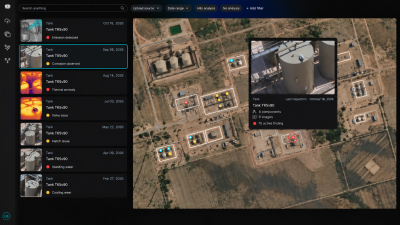
Khoshniyati tells CUAV News that the data spans four main segments – upstream oil and gas, transmission and distribution, downstream processing, and renewables – and the platform works with data from a variety of sensor types, including lidar, RGB, thermal, and OGI. With all of this data in hand, creating this type of platform, and shifting into software more generally, seemed like a natural step.
“Out of those four categories, we have so much data and so much footage from the hardware that we’ve produced,” Khoshniyati said. “The shift is almost obvious at this point to software because we have all of the different scenarios.”
In one hypothetical example, Khoshniyati talked about a high risk of corrosion that could create an issue with a pipe. Given the trends that can be pulled over the years of Percepto’s data, they believe they can match current data against past trends and alert operators before a potential failure.”
“We have a very high probability of being able to match [a data point] one-to-one with something that we’ve seen over the last 12 years.”
While Percepto is making a fuller shift into software, this isn’t the first software product the company has offered. AIM is the company’s autonomous inspection and monitoring software that had been used hand-in-hand with its existing line of hardware, including drones and base stations with their Ranger and Harbor products. Khoshniyati notes that this software is sticking around, but tells CUAV News that it, too, can be a hardware-agnostic offering.
“AIM is still our autonomous flying software. That’s how we fly one-to-many,” he said. “That’s how we control our drone fleet and our Harbor base station, where the drone is housed, charges, and then takes off and lands. That software also now has the opportunity to be white-labeled out so any drone manufacturer can actually use that software for autonomous flying.”
For Axion, while the official launch of the product came on Tuesday, it has been live with a select group of customers already as part of a soft launch. Khoshniyati says those customers have been providing feedback that has shaped the models, with one example being end-to-end visibility and wanting both proactive and reactive capabilities.
As mentioned above, this type of AI-powered platform is becoming more common across the energy and utility sectors. Drones are providing these organizations with significantly more data than ever before, but managing and analyzing all of that data is becoming increasingly difficult for an industry with an aging and shrinking workforce. Axion, Khoshniyati said, separates itself from the competition on four criteria: it works across any drone, dock, or sensor; it orchestrates hardware from a single location; it provides consistent inspection AI tied to the asset model; and it provides regulatory compliance.
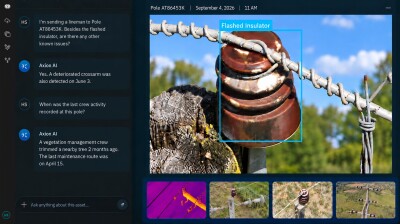
“As we looked at repositioning the business, we hit all four of those categories,” he told CUAV News. “When we looked at other hardware coupled with software, and standalone software players out there, we found that maybe they were hitting one or two of them.”
While there is a defined shift toward hardware-agnostic software for Percepto, Khoshniyati made clear that they are not abandoning the hardware side of their business. In response to a question about potentially moving away from hardware, he described the hardware side of the business as being “still business as usual.” In supporting American Drone Dominance-related requirements, the company is in the process of consolidating its engineering, manufacturing, and assembly in the U.S., a process Khoshniyati expects to be completed in the “near-term.” Assembly, he noted, is already taking place domestically.
The announcement also introduced a new leadership team. In addition to Khoshniyati coming aboard as the company’s chief marketing officer, the announcement also names Julien Bellanger as its CEO and Kurt Nantkes as its chief revenue officer. All three had previously worked at Wiliot, a company with a self-described focus on Physical AI, making it a seemingly natural fit for this strategic shift for Percepto.
From Khoshniyati’s perspective, the new team is positioned to take the company to the next level.
“The stars aligned at the right time, and it’s a dream scenario to be able to work with two other individuals who have experience across a handful of different segments,” he said. “We have all the components to take the business from everything that it’s grown to right now and really accelerate and scale from this point forward.”
On measuring success for this strategic shift, Khoshniyati said it’s about pushing the industry forward as a whole.
“As much as Percepto is growing as a business, Axion can be something that any other industry player can really leverage.”

.jpg.small.400x400.jpg)










Comments