


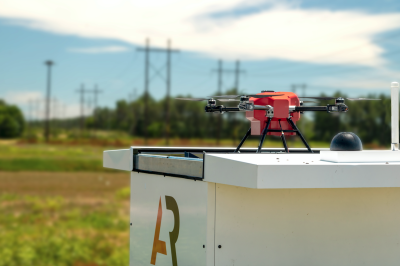
.png.small.400x400.png) A NASA-sponsored working group is working to address the technical and regulatory barriers standing between today's commercial drone operations and a future where autonomous, multi-aircraft fleets routinely share the national airspace.
A NASA-sponsored working group is working to address the technical and regulatory barriers standing between today's commercial drone operations and a future where autonomous, multi-aircraft fleets routinely share the national airspace.
The Routine Autonomous Multi-Aircraft Operations (RAM-AO) Working Group—formerly known as the m:N Working Group—will hold its next biannual meeting March 3-5 at NASA Ames Research Center in Mountain View, California. Aptima, Inc., operating under a NASA award, is leading facilitation efforts, applying its “expertise in human-autonomy teaming” to advance the group's mission.
The working group's core challenge is scaling UAS operations safely and efficiently. Rather than focusing solely on the ratio of operators (m) to aircraft (N), which was the initial focus of the working group, researchers have found the problem is considerably more nuanced. Factors including air traffic density, the geographic area being monitored, and the specific role human operators play in a given operation all influence how many aircraft a single operator can safely manage.
"To determine the true limits to safely scaling autonomous operations in the national airspace you have to consider the aviation ecosystem as a whole," said Dr. Samantha Emerson, senior scientist in Aptima's Performance Augmentation Systems Division and principal investigator for the NASA contract, in a statement.
Research presented at the working group's 2025 biannual meeting at NASA Langley Research Center offered several notable findings. For example, communication requirements, not the sheer number of UAS being managed, were identified as the primary driver of operator workload and performance changes. The meeting also highlighted a proposed ASTM standard that would provide a flexible framework for implementing autonomy in aviation, focused on the relationship between human operators and autonomous agents rather than rigid autonomy levels.
The March meeting will focus on developing white papers across five subgroups: Interventions & Exceptions (I&E), Small UAS, Scalable Remote Crew Design Considerations, m:N Validation and Verification, and System of Systems Design. The sUAS subgroup, in particular, is working to close regulatory gaps around BVLOS multi-aircraft operations, helping ensure policymakers have current information on technologies that may be outpacing rulemaking timelines. This, of course, is a familiar challenge for the commercial drone industry.
The working group is actively recruiting new members from industry, academia, and government. Those interested in participating can learn more and apply via the group's interest form.
Key insights from the 2025 biannual meeting are available in the full report on NASA's Technical Reports Server.
Source: Aptima, Inc.




Comments