

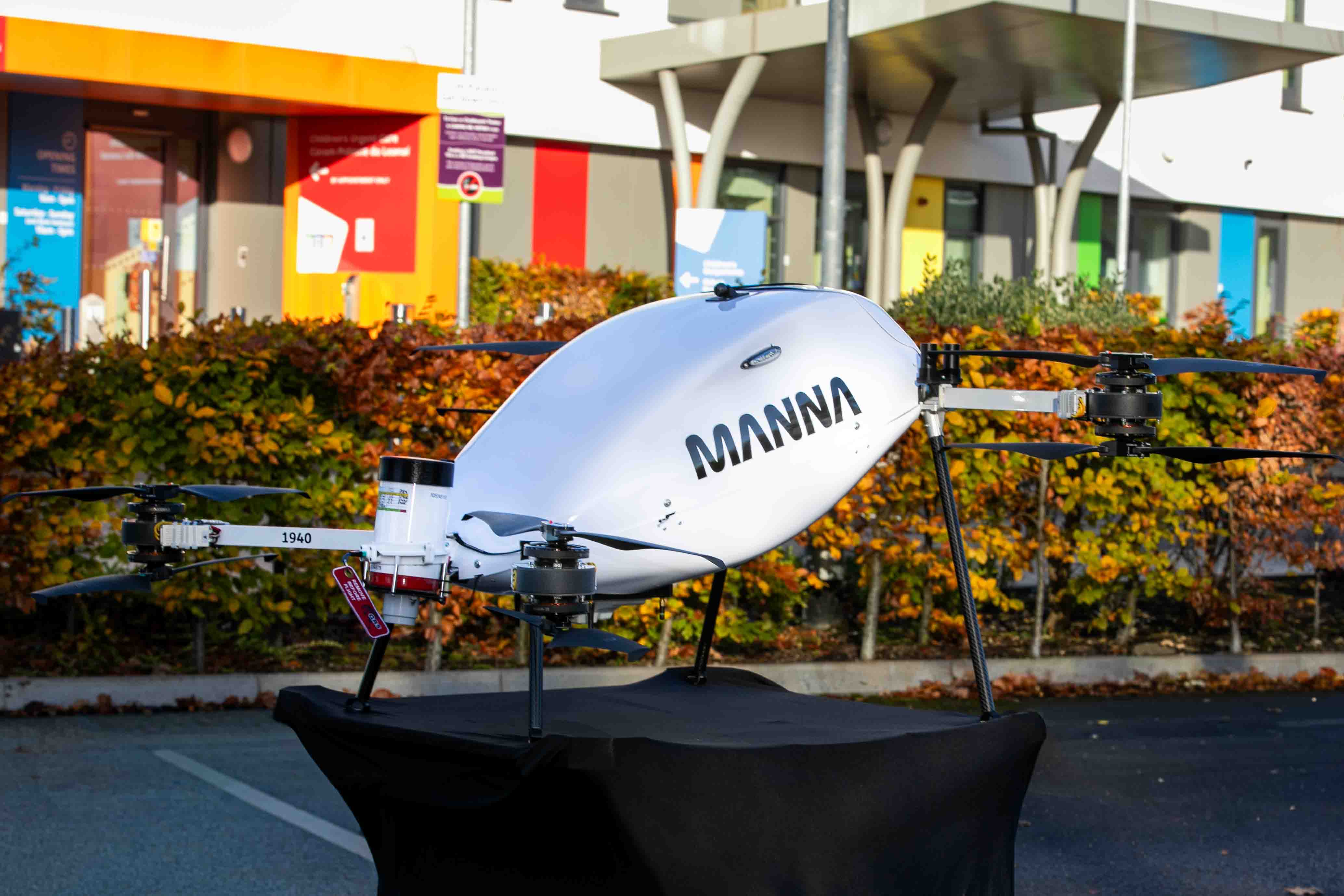
Busy schedules and the everyday demands of life have adapted humans to become creatures who crave convenience. I’m sure I can speak for most readers when I say having take-out delivered to your front door when you don’t want to face traffic is peak convenience. Yet there is a caveat to that. Wait time for delivery drivers can drag on, leaving you with a cold dinner on your stoop at 9:00 PM.
Ireland-based drone delivery company Manna Aero is on a mission to change that dinner delivery dread. To learn more about how this company is advancing drone delivery on an international level, Commercial UAV News sat down with Bobby Healy, CEO of Manna Aero.
Right off the bat, it was clear that Manna has their focus on something bigger than just drone delivery.
"We're not selling drone delivery, we're selling logistics," said Healy.
It's a distinction that goes a long way toward explaining how the company he started in Dublin in 2018 has grown from Irish suburbs into Finnish cities and American states, not by chasing the futurism of autonomous flight, but by solving the oldest problem in retail: getting things to people quickly and efficiently.
Manna’s drone delivery is as simple as choosing their service when checking out with your online order on participating mobile apps. Customers drop a pin that gives the platform a GPS coordinate for the drone to deliver to, and within 3 minutes, the product arrives at the customer’s pinpoint. Once the drone has positioned itself over the drop-off spot, it will hover at about 10 feet to lower the tethered product and drop it off gently.
The company has many aggregator partnerships with local vendors for whom they perform deliveries. And these are not limited to food either. Manna delivers almost anything within their weight limit of 8.5 pounds.
These partnerships have been critical in the company’s efforts to scale up operations. At the time we spoke, Manna had completed 300,000 flights and projects to hit two million by the end of the year.
“Everyone can use us through the delivery apps. We don't need to sign up customers. We don't need to do marketing, and the restaurants are already signed up through the app,” said Healy. “We put 10 aircraft in the air, and one aircraft does eight deliveries per hour. So, if you think about 10 aircraft, with 80 deliveries per hour, when we open in a city, we immediately go to 100 percent utilization”.
Part of what makes this possible is Manna’s manufacturing practices. As an international drone service provider, they made the strategic decision to manufacture their drones locally in their areas of operation. Especially in the United States, this allows their new drones to get up and running faster than they would if they were outsourcing aircraft due to the regulatory requirements.
Scaling across three countries and two continents doesn't happen in isolation. Behind Manna's growth is a web of relationships: with regulators, with competitors, and with the government bodies that ultimately decide where drones can and can't fly. Healy is candid about how much that collaborative ecosystem matters.
Recently, FAA Administrator Bryan Bedford visited Manna’s office to learn more about their operations. Considering the company’s ties to the States and how different the regulatory framework is from that of European nations, this was a great learning opportunity for both entities. Manna has regulatory approvals for BVLOS flights that cover densely populated cities and has the capability to fly over highways. Healy stated explicitly that neither Ireland nor the United States was in competition in terms of regulatory frameworks.
“I don't think there's a better or a worse in this situation. I think there's a readiness and willingness to work together, and that is a differentiating factor. So, if you're ready and willing to work together, you'll find a way forward,” Healy explained.
“Sometimes it can be elegant, sometimes it can be inelegant, but it gets fixed later. The key thing is the European regulator, the Irish regulator, the American regulator are all working together proactively as are the operators.”
Recognizing that cross-industry collaboration is an essential tool to lift the entire commercial drone industry, Healy is excited about the relationships the company has already established.
“We're an Irish company, but we have operations in Dallas and Oklahoma. We've done the UTM integration with Wing, where we've shared the airspace. We've literally flown over each other. And they've been to Dublin. We cooperate well together as an industry, and we love to share. Manna loves to share. Wing loves to share. There are a bunch of operators that really work well together. It's a very unusual industry in that regard.”
At the end of the day, the goal is not to be in competition with others in the industry, but rather with themselves to build the safest and most efficient operation possible.
“In the end, our belief is that the winner in this space will be the one who understands how to scale a low-cost airline. It is not sexy. It is safe and efficient, and almost, I would say, pragmatic.”
That pragmatic mindset extends beyond meeting rooms. For Manna, building a sustainable operation means bringing the communities they fly over along for the ride.
Healy describes a deliberate, ground-up approach to launching in new markets.
"We talk to the local government, we talk to the local stakeholders, the schools — everyone. We spend a lot of time engaging before we launch. But inevitably, some people will be surprised and will be annoyed, and we just talk to them," he said.
That kind of community engagement seems to be paying off. In Ireland, where Manna has operated the longest, the numbers speak for themselves. Healy reported that 62 percent of households in their service areas use the platform, with growth skyrocketing to the point where residents are now lobbying on the company's behalf.
Thousands of letters have been sent to local and national government demanding that Manna's service expand, pressure that prompted Ireland to create a national drone framework designed to accelerate the growth of companies like Manna.
"We have very strong government support, very strong local support, support from the community beyond belief," Healy said.
It's a dynamic that neatly mirrors the cross-industry collaboration Healy supports at the operator level: start with transparency, invest in the relationship early, and the path forward tends to open up.












Comments